The Value of an Aging Life Care Manager

Recently we spoke with a group here in Houston that employs Aging Life Care Managers to assist individuals and their families through the complexities of elder care.

Care Managers provide expert guidance and support to ensure that older adults receive necessary and appropriate care to maintain a high quality of life. Until meeting with them, we did not fully appreciate the value and breadth of their services.

These professionals differ from other elder care service providers through their comprehensive expertise and advocacy across several key areas:

Health and Disability: Aging Life Care Managers have extensive knowledge of healthcare services, covering physical health, mental health, and dementia-related issues. They can act as advocates by attending medical appointments with their clients and facilitating communication between healthcare providers, the client and their family.

Financial Management: Life Care Managers help manage bills, insurance claims, and other financial matters. They can work with accountants and financial advisors to ensure financial affairs are in order, thus alleviating a family’s burden of managing finances during a challenging time.

Housing: Deciding on the best living arrangement for an aging family member is often complicated. These professionals have in-depth knowledge of local in-home care options and residential facilities. They assist families in understanding these options and finding uniquely suitable living arrangements. This includes the physical move to a new living arrangement to promote a smooth transition or in the case of those remaining in their home, recommending additions or modifications for elder safety, mobility and function.

Family Mediation: Families often face conflict and disagreements when making decisions about an aging loved one’s care. Aging Life Care Managers can serve as mediators to help resolve these conflicts. Their goal is to create a collaborative environment where the family can agree on the best course of action for their loved one’s care.

Local Resources: These professionals possess extensive knowledge of local community resources and programs. They can easily connect aging adults and their families to valuable services, such as community centers, senior programs, transportation services, home healthcare agencies and senior living facilities.

Crisis Intervention: During times of crisis, such as emergency room visits or hospital stays, Aging Life Care Managers can provide 24/7 support. They can design personalized care plans based on comprehensive assessments and recommend modifications as circumstances change. This support is especially helpful for families who live further away and cannot be present during emergencies.

Many families realize they need help when they become overwhelmed taking care of an aging family member.

It is generally time to look for help when the older adult:

  • Has multiple medical or psychological issues.

  • Cannot safely manage their current living environment.

  • Is unhappy with the care they are receiving.

  • Is unable to manage their financial or legal affairs.

  • Has limited family support.

Families may also seek assistance when:

  • They are new to caregiving and need expert advice about available services.

  • They are exhausted or lack the time, expertise, or resources to manage chronic care needs.

  • They need guidance in dealing with dementia.

  • They live far away or are in conflict over caregiving decisions.

Aging Life Care Managers typically charge an hourly rate. Costs vary but typically are in the $100 – $200 per hour range. They can be hired for a single consultation or assessment or for as much care and help as desired.

These costs are not covered by Medicare nor most private health insurance or gap policies. Some long-term care insurance policies, however, may cover some of the costs.

Aging Life Care Managers can play a vital role in elder care. They provide comprehensive support across various areas, ensuring that older adults receive the care they need while offering families peace of mind. Their expertise, advocacy, and coordination of services make them an invaluable resource for families navigating the complexities of aging and elder care.

If you would like to learn more, we would be happy to discuss further and make an introduction to a provider. Situations like these and others related to aging are a growing focal point of Tanglewood’s planning and services. This is such an important area that we are planning client meetings this fall to introduce several of the providers and discuss options in more detail.

Disclosures

Disclosure Requirements for Entities in Effect…for Now.

The Corporate Transparency Act (CTA) was originally passed back in 2020 and went into full effect on January 1 of this year. CTA represents a significant effort by the United States Congress to combat money laundering, terrorist financing and tax fraud, among other illicit activities.

Nearly every business entity formed or registered to do business in the United States, excluding sole proprietorships and general partnerships, is subject to these requirements – an estimated 30 million entities!

In this article, we will review at a high-level the reporting requirements, compliance deadlines, fines, exemptions, and the impact on various stakeholders. And, as you might expect, the CTA has not gone unchallenged.

Objectives:

The primary objective of the CTA is to enhance transparency by requiring companies to disclose information about their “beneficial owners” and “company applicants” to the Financial Crimes Enforcement Network (FinCEN). A beneficial owner is someone who exercises substantial control over the entity or owns 25% or more of an entity. A company applicant is the individual involved with filing the formation or registration documents of the company. By collecting, storing, and maintaining this information in a centralized database, the FinCEN and other agencies gain valuable insights to investigate and prosecute illegal activities they uncover within these corporate structures.

Reporting Requirements:

The CTA mandates reporting companies to file a “Beneficial Owner Report” with FinCEN, containing detailed information about the individuals who ultimately own or control the entity. This includes their full legal name, date of birth, residential address, identifying number from a valid document (e.g., driver’s license or passport) along with uploading an image of the identification document.

After the initial report is filed, it must also be kept current. Should there be any change to this information (or a change of beneficial owners altogether), it’s the company’s responsibility to update their filing within 30 days from when it became first aware of the new information.

The Beneficial Owner reporting is accomplished online through the FinCEN website. They intend to maintain this information in a secure database that will only be accessible by certain law enforcement agencies, taxing authorities and a limited number of other potential users who can apply for access upon request.

Compliance Deadlines and Fines:

There are important deadlines for compliance. Reporting companies formed on or after January 1, 2024 are required to report beneficial ownership information within 30 days of formation. Those formed prior to this year must file their initial report before January 1, 2025.

Failure to comply with these requirements can result in significant fines of up to $500 per day and (in some cases) criminal penalties, including up to 2 years imprisonment.

Exemptions and Exceptions:

While the CTA casts a wide net, there are a few exemptions and exceptions. The new rules do not apply to charities, publicly traded companies and large private operating companies (defined as those with more than 20 full-time employees, revenue greater than $5 million, and have a physical presence within the U.S.). There are more exemptions for companies where disclosure and reporting requirements already exist such as banks, credit unions, accounting firms, broker dealers, investment advisors, etc.

It is important to note that trusts by themselves do not have to file under the new law. However, if a trust is a beneficial owner of a reporting company such as an LLC or corporation, that company’s registration will need to disclose information about the trust’s grantor, trustees and beneficiaries.

Legal Challenges:

On March 1st a U.S. District Court of Alabama found the CTA to be unconstitutional and “cannot be justified as an exercise of Congress’s enumerated powers.” The ruling thus far seems to only cover the plaintiffs in this particular case – the 65,000 members of the National Small Business Association (NSBA). The Justice Department promptly filed an appeal. The argument could ultimately make its way to the Supreme Court if not addressed or repealed by Congress.

In the meantime, FinCEN is enforcing the filing requirement. We recommend filing within the prescribed 30 day deadline for any newly formed entities this year. For those existing entities that have until Jan 1st to file, waiting a little longer (until we know more) would be prudent.

Tanglewood is not making these filings on behalf of clients. However, your Wealth Advisor stands ready to work with your Estate Attorney or other legal advisor to help determine filing requirements and to provide necessary information.

Navigating Medicare Premium Surcharges

Tanglewood performed more income tax reviews and projections for our Wealth Management clients in 2023 than any other year.

Areas that proved most beneficial include Roth conversion opportunities and uncovering more efficient charitable gifting strategies. In a surprising number of cases, we discovered errors and omissions in client tax returns that either saved money or reduced the likelihood of an audit. We are further expanding this and other planning “pillars” in 2024.

Many of these tax planning discussions revolved around analysis of converting traditional IRA funds into a Roth IRA. The conversion is considered taxable income, so the decision on the appropriate amount is unique for each client. Variables such as current year income, income tax rate, expected future tax rate, client ages, size of the IRA, client health, beneficiaries etc. impact the decision making process.

For clients on Medicare, there was one element of the analysis that almost always seemed to strike a particularly sensitive nerve – the “Income-Related Monthly Adjusted Amount” (IRMAA).

Perhaps IRMAA is so disliked because it is visible each month (as a reduction of social security retirement benefits). A higher IRMAA bracket means paying more for the same benefits.

What is IRMAA Exactly?

IRMAA represents an increase to the monthly Part B and Part D premium over the base amount as determined by Medicare each year. Simply put, it is a surcharge that increases the premium for those with higher incomes. The higher the income, the greater the surcharge.

IRMAA increases are calculated every year based on Modified Adjusted Gross income (MAGI) as reported on your tax return from the two years prior. 2024 Medicare premiums are based on your 2022 return and the recently completed 2023 tax year will affect 2025 premiums.

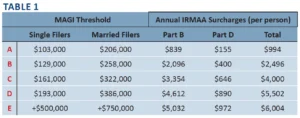
Specifically, MAGI is your reported Adjusted Gross Income plus any tax-free interest or dividends received that year. The IRMAA surcharge is determined by both the MAGI number and a taxpayer’s filing status. Here’s a summary of the thresholds for 2024. See Table 1.

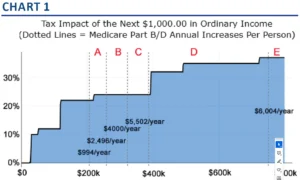
Chart 1 shows how IRMAA aligns with ordinary income tax rates for a joint filer. Taxable income is across the bottom and tax rate percentage is along the vertical axis. The dotted lines represent the IRMAA surcharge thresholds. Unfortunately just one dollar across the threshold incurs the full annual adjustment – no tiering or phase-in.

We help optimize a client’s income within the 22% and 24% ordinary tax rate, while also navigating three levels of IRMAA surcharges. This planning is most critical for those clients with large IRA accounts facing significant required minimum distributions in the future.

It is Just Another Tax.

Depending on the starting point, the surcharge viewed as a percentage might not be as onerous as it seems on the surface.

Source: Holistiplan

For example, a couple starting from the first threshold “A” considering a Roth conversion to fill the 24% bracket is looking at an incremental surcharge of $3,006 per person (A to C). As a percentage of the incremental income of $180,000, it’s a 3.3% equivalent tax.

If that couple started from the second IRMAA threshold “B”, the incremental cost would be $1,504 per person (B to C) and a conversion of up to $128,000 would be possible to get to the same point – a 2.3% equivalent tax.

These are not inconsequential dollar amounts but should be looked at in the broader context of lifetime tax planning. Meaningful Roth conversions forever reduce RMDs and taxable distributions. IRMAA surcharges should not be the only factor in determining how much to convert or whether a Roth conversion makes sense.

As you file your 2023 tax return, this is an early reminder to send Tanglewood a copy for review and use as the basis for 2024 tax planning. Your Wealth Advisor and team stand ready to help.

Gifts are an Effective Way to Curb Estate Tax Exposure

Clients often employ annual gifting as a way to transfer assets (plus the future appreciation of those assets) to children or other individuals to provide them immediate financial assistance or as part of an overall estate tax planning strategy.

First, let’s take a minute to review the annual gift exclusion, lifetime exemption and the current estate tax landscape.

The annual gift exclusion is the max amount any individual can gift to any recipient per year without having to take further action. The amount for 2023 is $17,000. There’s no limit to the number of annual exclusion gifts that can be made each year staying within $17,000 limit. The cumulative amount gifted in excess of $17,000 to any person reduces the giver’s lifetime exemption.

The lifetime exemption is the amount an individual can gift during their lifetime (in excess of the annual exclusion) or pass at death free of gift or estate taxes. In 2023, the lifetime exemption is set at $12,920,000 per person.

The annual gift exclusion has remained fairly constant for decades, only increasing with inflation each year in one-thousand dollar increments. The lifetime exemption on the other hand has changed many times and is currently at its all-time highest amount of $12,920,000. The 2018 Tax Cuts and Jobs Act (TCJA) was the last piece of legislation that ushered in this historically high exemption amount.

A lot of uncertainty remains. The provisions related to most of the changes brought on by the TCJA will expire at the end of 2025. In 2026, it’s expected the exemption will revert to about $7 million. The estate tax rate itself will remain at the current 40% level.

“Gift splitting” is a way for married couples to consider the gifts made by one spouse as being made by both spouses.

This either allows them to give more each year or reduces the impact to only one spouse’s lifetime exemption. Splitting can be for annual exclusion gifts or for larger gifts made against one’s lifetime exemption.

The gift can be made with community property or a donor’s separate property. Texas along with eight other states are community property jurisdictions. Community Property means that property acquired during marriage (except through gift and inheritance) is equally owned by both spouses.

When giving community property, the automatic presumption is that the gift is one-half from each spouse. Only if the amount gifted is in excess of the combined annual exclusion limit of $34,000 ($17,000 x 2) would a gift tax return (Form 709) need to be filed to account for the excess made by each.

When gifting Separate Property, a gift tax return must be filed to make the split election and both spouses will need to sign the return to consent to the gift.

It’s important to note that when splitting gifts, ALL gifts made during the year must be split. Spouses cannot selectively split some gifts made during the year and not others.

For those clients facing taxable estates, gifting can be an effective way of “freezing” or stemming the future growth of the estate. The objective being to shift that growth elsewhere – whether that be another person or to a trust.

Of course, before making any gifts (which are generally irrevocable), your Wealth Advisor can perform a complete review of your wealth plan and capital sufficiency projections. This ensures that the client’s own needs will be met first and then factor in potential gifts made now or in the future.

The Next Generation of Comprehensive Planning Illustrations

Nearly 20 years ago I developed the first iteration of Tanglewood’s proprietary Retirement Illustration. This started the expansion of our comprehensive wealth planning initiative for Wealth Management clients.

The goal was to use the Illustration as a proprietary tool to quantify and visualize the alignment between a client’s invested assets and various future income streams (such as social security, pensions, etc.), with their projected future spending needs throughout their retirement years. It has served us very well.

Over the years the Illustration saw many enhancements from initial plan creation and updates to incorporating current tax laws, future tax law changes, Roth conversions, gifting and more.

I give credit to Victor Powell for advancing the spreadsheet’s capabilities and user friendliness. He took it to the next level after he joined the team in 2014.

Along with the advancements in the tool itself was the evolution of its delivery. It started with me bringing in a stack of printouts into a meeting considering various scenarios and assumptions. I now cringe at the thought of covering half the conference room table with a sea of paper reports. A major advancement was the development of an online presentation that provided the ability to make changes on the fly and immediately see the impact of those changes. Tanglewood uses tools like this to help enhance client awareness of lifetime resources and needs.

Having that level of interaction and immediate “what if” variability offered much more client confidence and ownership in the results. We want every wealth management client to see the final results as THEIR plan.

As good as it was in helping answer important questions regarding retirement timing, income and asset distribution planning, industry tools and technology were swiftly advancing as well. Over the past several years, we thoroughly evaluated several comprehensive planning programs and selected one that best supports the four pillars of Tanglewood’s wealth planning process.

Our new comprehensive program checked all the right boxes for us as it provides an exceptional balance between depth and detail without sacrificing ease of use and simplicity. Here are some of the highlights of what this advanced tool offers as part of our hands on wealth planning.

Goal Based Financial Planning:

A comprehensive goals-based approach with the capability to create comprehensive plans that incorporate retirement planning, investments, insurance, tax planning, college funding and more.

Scenario Modeling:

We can run multiple scenarios to analyze the impact of different variables in real-time. We can make adjustments to lifestyle spending, savings rates, retirement ages, investments and other factors to understand the potential change in outcomes.

We can also incorporate probability analysis that goes beyond traditional linear projections to understand the impact of variable returns over time.

Interactive Client Portal:

The software allows us to provide a secure and user-friendly client portal, enabling interactive access to a client’s financial plan as well as progress toward their goals. It is also capable of account aggregation to bring together all investment accounts, assets, and debts to build a balance sheet that automatically updates values over time.

Tax Planning and Optimization:

We find the tax planning features, including future tax projections, tax-efficient withdrawal strategies and Roth conversion analysis particularly helpful. Helping clients make wise decisions regarding their lifetime tax exposure not just year-over-year.

Cash Flow Management:

With its robust cash flow management capabilities we can track client’s income, expenses and debt repayments. It automatically categorizes these transactions from linked accounts, generates reports and offers insights into spending patterns for making better budgeting decisions. Detailed cash flow transactions are for the client’s eyes only and not seen by your Wealth Advisor unless shared by the client.

With this program we can provide greatly enhanced flexibility and “what if” capabilities and with it we can provide clients the confidence, clarity and definitive path to move forward in reaching their personal financial goals. Equally important is that as each client’s situation and goals change, the plan can easily change direction as well.

We are working with additional clients on this platform seemingly every day in preparation for Wealth Planning review meetings. Contact your Wealth Advisor to discuss this further or to set up a review meeting at your convenience.

Disclosures

Four Pillars of our Total Wealth Management® Relationship

The objective of our Total Wealth Management® is to make a positive and lasting impact on the financial wellbeing and outcomes of our clients. This is more than just a one-time exercise but a long-term partnership that aligns the firm and its wealth advisory team with our clients. We aim to know all the specific details of both our client’s financial situation as well as their personal goals and objectives, which puts us in a very unique position not held by other professional advisors.

While investment management has been a core expertise at Tanglewood since inception, our wealth planning capabilities truly stand out in our field. Tanglewood has and will continue to enhance our wealth planning resources adding to the depth and breadth of our services, our people and expertise as we grow.

We consider the following to be the four pillars of planning that are at the heart of every wealth management relationship. While these pillars are the foundation of our wealth planning, individual circumstances, needs, and goals often lead us into areas of importance to specific clients such as: business capitalization, ownership structures, and succession; special needs of children; corporate trusts; charitable foundations; and more.

Balance Sheet Creation and Maintenance

Creating a comprehensive and current balance sheet or personal net worth statement is the first planning pillar of our wealth management process. It is critical to establish this foundation for nearly all areas of planning with our clients.

The Balance Sheet offers a snapshot of a client’s financial resources and overall financial health. In order to establish a current financial position, all assets including, bank, investment and retirement accounts, real estate, and other illiquid assets should be included along side all liabilities including mortgages. This is a valuable report for both wealth accumulators and those in retirement looking to grow and preserve their assets.

We offer clients several ways to keep up with this information via PDF or excel templates (manual entry and updates) to digital balance sheet aggregators which will securely link financial account websites to provide updated values. We prefer the latter as once this “living” balance sheet is set up it automatically updates most “liquid” holdings.

Annual Tax Return Review and Analysis

The second planning pillar, tax return analysis, is a combination of annual tax planning within the context of a client’s lifetime potential tax exposure. It is an ongoing and recurring added value for clients in an ever-changing tax environment.

Understanding a client’s entire tax situation beyond what is attributable to their managed investments is critical to lifetime tax planning. This requires a detailed analysis and preview in tax years with material changes or opportunities. Every client’s tax situation is unique, there is no one size fits all approach.

Roth conversions, capital gain/loss management, deferring/accelerating income, estimated tax payments, IRA distributions, and deductions are just a few of the areas that offer opportunities.

As you complete and file your 2022 return, please send Tanglewood a copy. This can be uploaded to your document vault or you can request a secure upload link from your Wealth Advisor. Due to the sensitive information within a tax return, please do not send an unprotected return via regular email.

Upon receipt and review of your tax return, we will prepare and send a detailed Tax Report, which provides a comprehensive analysis and summary of your recently filed return. This report helps us understand the various components of your tax return, including an overview of your income, deductions, and credits. Among its many benefits are where you stand in terms of tax brackets and phase outs, along with some observations and strategies to consider going forward.

Capital Sufficiency Analysis

The third planning pillar, running a capital sufficiency analysis, takes time and effort up front to gather all the details needed to fully build out a projection. The balance sheet and tax review add valuable insights in the preparation of this analysis.

During client planning meetings, we are often asked questions, such as, “when can I retire”, “how much do I spend without the fear of running out too soon”, “how much do I need for my children’s education”, or “what are the most advantageous ways of making large gifts to family or charity”. These are just few of the goals and objectives that provide an important context to our wealth planning and investment decisions.

A well thought out plan helps answer these questions and greatly improves the chances of a successful outcome. Having a plan in place acts as a financial road map. When situations and goals change, as they often do, the plan serves as a baseline for comparison. New inputs such as an earlier retirement of increased spending can be quickly evaluated.

In times of market volatility, this big picture context helps many clients focus on their long term objectives rather than the short-term noise.

Estate / Legacy Plan

Having an appropriate and well thought out estate plan is the fourth planning pillar of Tanglewood’s wealth management process. For clients who do not have a plan, or cannot locate the documents, or it has not been looked at in 10 years, this should be a priority!

Our role is to define our client’s overall objectives and propose possible solutions that fit the composition of their estate. The balance sheet once again is a prerequisite to understanding the size and complexity of the estate.

Often unique family circumstances are as important as financial details. Personal conversations of any potential challenges should be thoroughly explored. While Tanglewood does not draft legal documents, we facilitate the process by spending as much time as needed to introduce and explore various planning strategies.

Another important aspect to the estate planning process is the coordination of beneficiary designations for life insurance and retirement accounts. The designations themselves if not aligned with the documents can work against an otherwise well thought out plan.

With the plan in place, Tanglewood will prepare a flowchart illustrating the overall disposition of the plan which includes the important provisions and people involved.

At Tanglewood we believe these four pillars of our planning provide a sound foundation on which to build a long-term partnership with each of our wealth management clients. Once in place, special planning needs or opportunities can be better evaluated. The collective experience and knowledge of all our wealth advisors supports our Total Wealth Management® mission.

It is the firm’s intent to engage with each wealth management client to maintain these pillars as a core responsibility of our partnership.

SECURE Act 2.0 Has Arrived

Included with the 2023 government spending bill that was just signed into law by the president last week was the latest version of SECURE Act 2.0. The first SECURE Act was passed in late 2019 and it made some major changes. The most significant being the elimination of the “lifetime stretch IRA”. In place of the stretch was a much less tax-friendly 10-year rule which puts the maximum stretch at – you guessed it – 10 years.

SECURE 2.0 adds even more retirement account related provisions that affect savers, retirees, plan participants and plan sponsors. Here are the top items worth noting to clients.

Required Minimum Distributions age extended and penalty relief

Starting in 2023, the Required Minimum Distribution (RMD) age for certain IRA owners is now age 73 and will be further extended to age 75 in 2033. Here is the breakdown of RMD start years by year of birth:

  • Born 1950 or earlier – no change

  • Born 1951 through 1958 – RMDs start at age 73 (2024)

  • Born 1959 or later – RMDs start at age 75 (2033)

For many clients, the additional year(s) affords more time for strategic Roth conversions or other lifetime tax planning opportunities that become much more limited after RMDs begin.

The penalty for failing to make a required distribution was a steep 50% of the shorted amount. The egregious penalty was mostly a deterrent but rarely ever enforced. SECURE 2.0 reduces the penalty to 25% or just 10% if corrected in a timely manner. The lesser penalty makes it much more likely to be imposed and/or voluntarily paid.

Roll unused 529 balances to Roth IRA

We’ve always considered 529 accounts as pseudo-Roth IRAs for college expenses as they offer similar benefits of tax-free growth when accumulations are used toward college expenses.

The SECURE Act 2.0 includes a never-before offered opportunity to roll 529 balances into a Roth IRA for the beneficiary of the 529 plan starting in 2024. There are some limits and qualifications. The 529 must have been maintained for 15 years or longer. Also, contributions made to the 529 within the past 5 years are ineligible. Rollovers are allowed annually up to the Roth IRA contribution maximum (currently $6,500) subject to a lifetime rollover maximum of $35,000.

That may not seem like a lot on the surface but provides a nice Roth IRA foundation to build investing momentum for children or grandchildren entering the work force. Assuming this begins when the beneficiary was 16 years old, that’s easily over a million tax-free dollars by their late 60s without ANY further contributions!

Qualified Charitable Distribution (QCD) limit indexed to inflation

QCDs were first introduced in 2006 and offered to those older than 70½ an alternative means of making charitable donations directly from retirement accounts. These donations satisfied the owner’s RMD obligations while being excluded altogether from taxable income – a better economic value than a typical (itemized) charitable deduction in many cases. The limit was $100k in 2006 and remains $100k in 2022. Beginning in 2024 it will be indexed to inflation.

There’s also an opportunity to make a QCD gift up to $50,000 (indexed to inflation) to a charitable trust as an expansion of the types of entities that can receive a QCD. Questions remain about this given the small amount and special requirements of the trusts.

Higher catch-up contributions

Today, participants in a 401(k) or 403(b) over the age of 50 are allowed a catch-up contribution of $7,500 in addition to the standard allowable max deferral $22,500 for 2023. These contributions are all made on a preferential pre-tax basis.

Starting 2025, plan participants who are age 60 to 63 will be allowed a “super-sized” catch-up equal to the greater of $10,000 or 150% of the catch-up amount in place at the time.

One new caveat is that for those earning more than $145,000 in the prior calendar year, all catch-up contributions must be made on an after-tax basis to a Roth account. That’s the loss of approximately $2,400 per year income tax incentive (or more) for those over that income threshold who want to max out savings.

Employer matching enhancements

Employers were previously not able to deposit matching contributions to their employee’s Roth accounts. SECURE 2.0 now gives this option. Matching in this Roth form however will be fully taxable as income to the employee in the year of contribution.

Also, starting in 2024, employers can include student loan repayments as retirement plan contributions to determine the amount of employer matching funds paid to the employee.

SECURE 2.0 brings dozens of other provisions and additional complexities. It will be an evolution over the next several years as they work their way into plan documents. We will keep you abreast of major developments and work with you to help navigate your expanded options and decisions.

Sometimes It’s OK to Feed the Bear

Market volatility is inevitable and a part of the investment experience. Since 1926 the S&P 500 has experienced 26 bear markets – defined as a decline of 20% or more from its previous high. These periods are unnerving and uncomfortable, but they should not be unexpected. Volatility (aka “taking risk”) is the price an investor pays for a superior return on their investment. For a well balanced diversified portfolio, committing to the investment process should ultimately lead to a full recovery and on to new highs.

With this as a backdrop, corrections and bear markets can be viewed as opportunities to enhance a client’s wealth planning objectives. This is not market timing in the traditional sense but simply reframing a temporary market downturn into a positive long-term planning opportunity. Let’s look at some of these opportunities.

Add sideline cash

When markets are down substantially from their all-time highs, it is a great time to add accumulated cash to a long-term investment portfolio. The deeper the decline, the more the reward on those contributed funds.

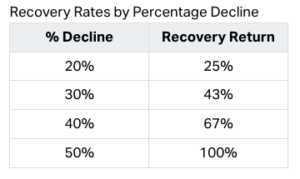
For every dollar invested when a portfolio is down 40%, that dollar achieves a 67% return when fully recovered. See below for the “recovery return” after various levels of decline.

This is not magic market timing or crystal balls, it’s just math!

Make an IP change

In the same vein as adding cash to the portfolio, adding stock exposure through a more aggressive investment policy accomplishes a similar result. Tanglewood’s investment policies range from 30% equity to 100% equity. Turning up the equity dial a notch after a significant decline will take advantage of a downturn with more equity growth during the recovery.

It’s very important to keep in mind that with either of these moves you never know where the bottom will be. You might initially feel good investing or getting more aggressive when down 20% or 30% but only to see it continue to fall further from there. Being too early can cause pain and/or regret in the short-term, but doesn’t change the math or advantage ultimately achieved when fully recovered.

Roth conversions

For someone considering a Roth conversion, a market decline may be the perfect time to pull the trigger. The greater the decline, the more a conversion is “on sale”. Remember the conversion is taxable income in the year it is converted. Most often, the goal is to target a specific conversion amount to fit within the client’s tax budget. When market prices are low, more shares get converted to reach the desired conversion amount.

The real payoff comes when the market (eventually) turns around and the conversion recovers tax free inside the Roth instead of the taxable IRA.

Accelerate gifts

Gifting is a simple and smart way to transfer wealth and reduce estate taxes over time. Whether using the annual gift exclusion ($16,000) or making a significant gift that uses some of the $12,060,000 per person lifetime exemption, a bear market provides additional leverage since the gift values are temporarily depressed.

Business owners may also find this to be a good opportunity to gift depressed company stock if their business has also been negatively impacted. Splitting the stock into voting and non-voting shares will further reduce valuations and provide an opportunity to give away value without losing control.

Diversify

A sharp decline in market value should reduce the tax impact of selling an investment with a large unrealized capital gain. We recommend not letting the “tax tail wag the dog” but if realizing that large gain was a barrier to diversifying, a bear market may open up that opportunity and lessen the tax pain.

Tax loss harvesting

This strategy is nothing new and one that Tanglewood implements when the right opportunities present themselves. Selling positions at a loss and simultaneously buying a similar security, pockets the loss to use against gains later while remaining invested. They never go to waste as any carryover losses from one tax year roll over indefinitely until fully utilized.

Accelerate IRA RMDs

Similar to a Roth conversion, taking an IRA RMD when the market is down can be a tax wise move. The reinvestment of the RMD in an after-tax account essentially “steals” appreciation from the IRA and shifts that growth from an ordinary income tax environment to a capital gain environment.

Tanglewood’s Wealth Advisors stand ready to discuss and analyze whether any of these moves make sense in your particular situation.

A Look at Schwab’s Advanced Beneficiary Designations

When it comes to asset transfers at death, beneficiary designations are just as important as a will, particularly when the beneficiary account (such as an IRA) is the largest single asset in the estate.

Because of the new shortened 10 year distribution period for Inherited IRAs, more people are forgoing naming trusts as beneficiaries and listing children directly.

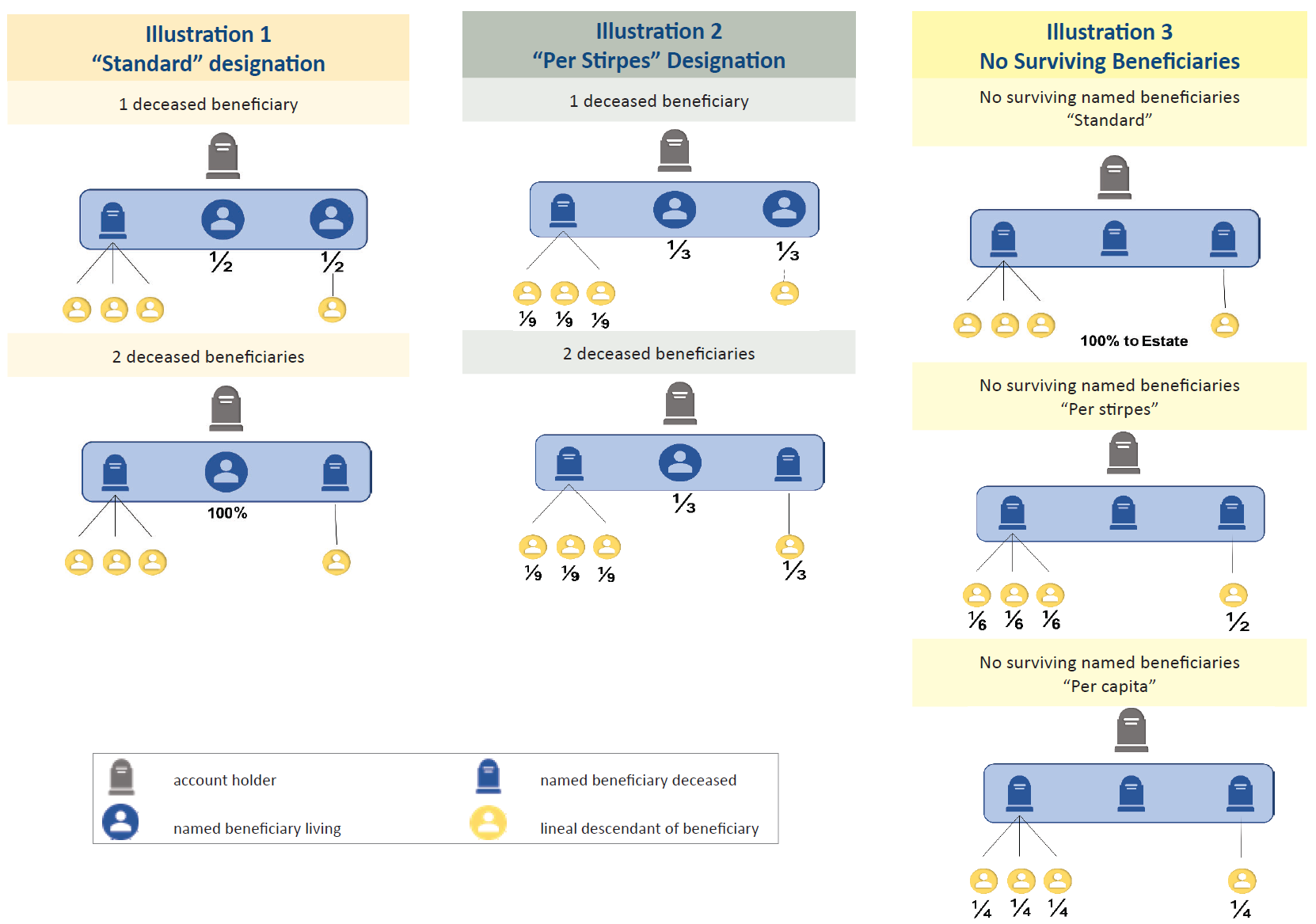
Many clients may be surprised to know that Schwab’s “default” beneficiary designation simply divides the assets among the surviving beneficiaries – with no consideration to their lineal descendants. For example, if there are three named beneficiaries and one dies, the account is divided among the two surviving beneficiaries. Under this standard “default” designation, nothing would pass to the children of a deceased beneficiary. See Illustration 1 below for two examples of the standard designation where 1 of 3 and 2 of 3 named beneficiaries are deceased.

An often overlooked and misunderstood beneficiary option is a “per stirpes” or “per capita” election. These elections include the lineal descendants of a named beneficiary in the event that beneficiary predeceases the account holder. It is like having a built in contingent beneficiary without specifically naming all the heirs.

With a per stirpes election, the lineal descendants of a deceased beneficiary split the portion that the deceased beneficiary stood to receive. See Illustration 2 below for two examples of per stirpes where 1 of 3 and 2 of 3 named beneficiaries are deceased.

Schwab’s per capita election is the same as per stirpes if any named beneficiary survives. The difference is how descendants are treated if ALL the named beneficiaries pass away. With per capita, all the descendants are treated equally. See Illustration 3 for an indication of the difference between the standard, per stirpes and per capita elections in the event there are NO surviving beneficiaries.

The easiest and preferred way to view and update your beneficiaries is online via the Schwab website under Service/Beneficiary. They can also be changed using a Schwab beneficiary update form.

Keep in mind, this applies specifically to Schwab, other custodians can have a different approach for their beneficiary designations.

Please reach out to your Wealth Advisor to review and ensure these designations align with your ultimate wishes.