Keith Fenstad, Director of Wealth Planning, discusses strategies for managing required minimum distribution taxes and navigating retirement withdrawals during periods of market volatility in Financial Planning.
Forget retirement buckets. Advisors prefer these withdrawal strategies
Should clients in the ‘retirement red zone’ reconsider withdrawal strategies?
Is a Family Loan the Right Wealth Transfer Strategy for You?
The Great Wealth Transfer is already underway. Sometimes it takes the form of carefully structured estate plans and inheritances. More often, it is through the Bank of Mom and Dad.
Parents are choosing to pass down wealth during their lifetime, actively supporting their children’s financial journeys. Many are stepping in as lenders, providing assistance when it’s needed most. They arrange intrafamily loans to help their children buy homes, start businesses, and invest in their future. This quiet shift is reshaping how wealth moves between generations, and it comes with both opportunities and risks.
More families are choosing to transfer wealth during their lifetime, often in the form of low-interest or no-interest loans. It allows them to:
-
Provide financial help when their children actually need it.
-
Avoid some of the red tape, underwriting headaches, and high interest rates that come with traditional lenders.
-
Retain some control over the money while still supporting their kids’ financial independence.
We often work with parents to define the structure and terms for these loans. There are agreed-upon interest rates and repayment periods, just like any other structured financial agreement. But unlike a loan with a financial institution, a family loan can pull double duty as a lower-stakes gauge of a child’s financial health, or a gift that is forgiven over time.
A Loan Today, a Gift Tomorrow
Many parents approach these loans as a way to start wealth transfer while still maintaining flexibility. They lend money at a low IRS-determined interest rate. If the loans are below that threshold they are potentially looked at as gifts. Children benefit from market growth in excess of the loan rates, keeping the wealth transfer tax-efficient.
For example, a parent might loan a sum of money to their child at a low fixed interest rate. The child reinvests that money and the long term growth stays with the child, outside of the parent’s estate. Over time, the parents may further forgive portions of the loan, effectively turning it into a tax-advantaged gift.
That said, parents need to be financially secure themselves before making these kinds of arrangements. The first priority in any wealth transfer discussion is ensuring that parents won’t jeopardize their own retirement by being too generous too soon.
The “Training Wheels” Strategy for Heirs
Another common reason families choose to lend first, rather than gift outright, is to test financial responsibility. Some parents worry about how their children will handle a sudden influx of money, especially if they haven’t managed large sums before.
Many of our clients use gifts or loans to fund investment accounts to introduce their heirs to wealth management. If a child mismanages the money, it gives parents time to reassess before passing down more significant assets.
We have found this approach also helps to introduce your children to the idea of working with a financial advisor. The hands-on guidance of an advisor creates an extra layer of support to guide your heirs toward better financial choices and outcomes.
Not every family should rush into intra-family loans. The best strategies depend on your financial situation, tax planning considerations, and family dynamics. But if you’re thinking about supporting your children while you’re still alive, it’s worth having a structured conversation about the best way to do it.
A financial advisor can help you evaluate:
-
Whether lending money aligns with your long-term financial security.
-
How to structure loans for maximum flexibility and tax efficiency.
-
What protections (like trusts or loan agreements) can help safeguard both parties.
If you’re considering helping your children now rather than waiting to pass down an inheritance later, we are always available to guide you through the options. Let’s make sure the next chapter of your family’s wealth story is built on a solid foundation.
Understanding Your Philanthropy: A Conversation with Your Wealth Advisor
As Wealth Advisors, our goal is to ensure that a client’s financial strategies align with their broader goals and objectives. For many clients, philanthropy is not just a way to give back but also a personal expression of their values and priorities.
To help us guide those charitable conversations in a meaningful and impactful way, the following are some ways for us to kickstart the discussion, serving as a springboard to explore how a client’s giving aligns with their values, family dynamics, and long-term plans.
Starting the Conversation
Philanthropy is as unique as each individual or family, and the first step is understanding your passions and current involvement. Here are some questions to start the conversation:
-
Are there causes or charitable organizations you currently support? This helps us establish whether philanthropy is already part of your life and provides a starting point for our discussion.
-
What issues are you (and your family) passionate about? Why? Knowing what matters most enables us to focus the conversation on areas that truly resonate with your values.
-
Is philanthropy important right now? Understanding how immediate your philanthropic goals are can help prioritize your giving.
Exploring Your Motivations and Decision-Making
Understanding why one chooses to give can provide valuable insights into their philanthropic vision. Here are some key questions we might explore together:
-
How do you decide who to give to? This can help identify the criteria or processes that guide your decisions.
-
What donations have given you the most satisfaction? Reflecting on those gifts that were most gratifying helps us understand what matters most to you and where you feel your impact has been greatest.
-
Are there any donations you have regretted? Why? Identifying lessons learned can guide more strategic decisions in the future.
Family Dynamics and Philanthropy
For many clients, philanthropy is closely tied to family values and collaboration with other family members. These dynamics can play an important role in shaping the client’s giving. Here are some questions we might explore:
-
Tell me about your family’s values. This provides a foundation for understanding how your philanthropy aligns with shared principles.
-
What values do you want to pass along to your family? Thinking about legacy can help us incorporate these ideals into your plan.
-
Do family members advise your giving decisions? If philanthropy is a collaborative effort, we can help ensure the strategy reflects everyone’s input and priorities.
Identity and Legacy
Philanthropy often reflects identity and the desire to leave a lasting legacy. Exploring these themes can help develop a plan that is authentic and impactful:
-
What aspects of your identity are important to you? Understanding how your personal history or cultural background influences your giving can influence your plan.
-
Have you thought about what kind of legacy you want to leave? Let’s discuss how your charitable efforts can align with the broader legacy you wish to create.
-
How might your values inform your wealth planning or charitable giving? Connecting your personal “moral compass” can make your giving even more meaningful.
-
Tell me about some important life experiences that have affected you. Personal milestones or challenges can often shape philanthropic motivations and priorities.
-
How might these experiences inform your wealth planning and/or charitable giving? We can discuss how these may impact your giving strategies.
Practical Considerations and Next Steps
To ensure that a client’s philanthropic goals are achievable and sustainable, we will also discuss the logistics of giving. Here are some areas to review:
-
What assets do you usually give? Whether it’s cash, stocks, or other assets, understanding this may help us structure your giving more efficiently.
-
Do you make recurring donations? Regular contributions indicate a commitment to certain causes.
-
Would you like to give more? If expanding your impact is a goal, we can explore ways to achieve that within your financial plan.
Let’s Explore This Together
Working through these questions, we can help our wealth management clients create a giving strategy that reflects their values, leaving a lasting legacy.
I’m a Financial Advisor: 3 Things My Wealthiest Clients Never Do
Don’t Miss This Social Security Benefit for Older Parents
Preserving Family Assets with a Limited Liability Company
Families who wish to retain legacy assets such as ranches, vacation homes, or other legacy property, face many challenges – delegating operational responsibilities; managing ownership; liability protection; to ensure smooth transition across generations. A Limited Liability Company (LLC) provides a legal and practical framework to address these challenges making it an ideal choice in many instances.
Over the years, Tanglewood has worked alongside clients and their estate planning attorney to assist with the formation and ongoing management of many LLCs. Here are some of the basics.
What is a Limited Liability Company? An LLC is a legal entity that combines the liability protection of a corporation with the flexibility and simplicity of a partnership. When an LLC is formed to hold an asset, the property is owned by the LLC rather than all the individual family members. Each family member who is part of the LLC is considered a “member” and holds an ownership interest in the entity.
The LLC operates and manages the asset—collecting income, handling expenses, and making decisions according to agreed-upon rules or the desires of the founding family members. Additionally, this structure helps to shield the personal assets of the members from potential liabilities associated with the property.
Why Hold Family Assets in an LLC? Forming an LLC for a family asset offers numerous benefits. Below are some of the key advantages:
-
Simplifying Management An LLC allows families to establish an operating agreement. This is a legally binding document that outlines how decisions will be made, who is responsible for day-to-day operations, and how profits or losses will be shared.
-
Clarifying Ownership Rights An LLC formalizes ownership by issuing membership interests to each family member. These interests clearly define each person’s share of the property, voting rights, and responsibilities.
-
Streamlining Generational Transfers Families can establish rules and guidelines for how ownership interests of the LLC will pass to the next generation. The rules for buying, selling, or gifting membership interests are clearly established ensuring that the asset remains in the family.
-
Protecting Personal and Family Assets An LLC separates personal assets from those of the entity. If a lawsuit is filed related to the family property – for instance, an accident on a ranch or vacation home – the liability is limited to the LLC’s assets. This protection goes both ways. If a family member faces personal financial issues, such as bankruptcy or lawsuits, their ownership interest in the LLC may be protected from creditors.
-
Facilitating Tax Efficiency An LLC offers flexibility in taxation. Income and expenses pass through to members’ personal tax returns. Additionally, holding the asset in an LLC may allow for deductions related to property expenses. LLC interests may be eligible for significant valuation discounts that can equate to a substantial reduction in estate taxes when passing to heirs.
Example: Holding a Ranch in an LLC Consider a ranch used by the family with the intention to pass it down for generations. Over time, as the family grows, questions or even disputes arise over who should manage the property, how expenses should be shared, and what happens when someone wants to sell their share. When forming an LLC, the family can:
-
Clearly define each member’s ownership interest.
-
Establish an operating agreement that dictates how decisions will be made, such as rules for leasing the property, approving major repairs, or handling disputes.
-
Simplify transfers to the next generation by gifting membership interests instead of dealing with complex title changes.
-
In addition, the current owners of the ranch can contribute additional capital to the LLC to be a long-term source of funds for ongoing costs.
This structure preserves the ranch as a cherished family asset but also reduces the burdens associated with its management and enjoyment.
Basic steps to Forming an LLC Key steps:
-
Choose a Name: Select a unique name that complies with your state’s rules and reflects the purpose of the LLC (e.g., “Smith Family Ranch LLC”).
-
File Articles of Organization: Submit this document to your state’s business office, providing basic details such as the LLC’s name, address, and members. Each state may have other required information.
-
Draft an Operating Agreement: This is one of the most critical steps. The agreement should outline ownership percentages, voting rights, management responsibilities, rules for transferring interests, and procedures for resolving disputes.
-
Obtain an EIN: An Employer Identification Number (EIN) from the IRS is necessary for tax purposes and opening a bank account.
If you would like to learn more or are considering an LLC for your situation, contact your Tanglewood Wealth Advisor to begin the conversation. We can also participate in conversations with your estate planning attorney to help tailor the structure to your specific needs.
Major Changes Coming in 2026 with the Expiration of the Tax Cuts and Jobs Act
The Tax Cuts and Jobs Act (TCJA) of 2017 brought significant changes to the U.S. tax code. Unfortunately, many of these provisions were temporary and sunset at the end of 2025 unless congress acts to make some or all of them permanent. This means that the 2024 and 2025 tax years may be the last opportunity to lock in the tax advantages of the current rules.
Here is a summary of the major components of the changes that would impact most clients:
Tax Rates Revert to Pre-2018 Levels. One of the most significant aspects of the TCJA was the lowering of income tax rates. The law reduced tax rates for nearly all income levels, resulting in lower taxes for millions of Americans.
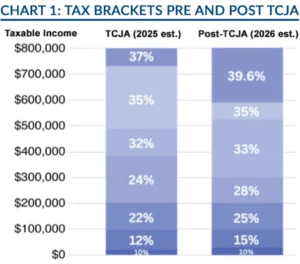
Chart 1 is an estimate of the 2025 vs. 2026 (post-TCJA) tax brackets and income thresholds. Note how the 24% bracket is eliminated completely. This is often our target for tactical Roth conversions.

Reduction in the Standard Deduction. The TCJA nearly doubled the standard deduction, which significantly simplified the tax filing process for many individuals and reduced the need to itemize deductions. For the 2024 tax year, the standard deduction is $14,600 for single filers and $29,200 for married couples filing jointly. In 2026, the standard deduction will revert to its pre-TCJA levels, which is estimated to be $8,300 and $16,600 respectively.
Many clients who have been taking the standard deduction may find themselves itemizing deductions once again to minimize their tax liability.
To that end, most “Miscellaneous Itemized Deductions” were disallowed due to the TCJA but will return in 2026. While still subject to the 2% of adjusted gross income phaseout, investment management fees and legal and tax advice fees are some of the more common deductions that would return.
The Return of the Personal Exemption. Prior to the TCJA, taxpayers could deduct a set amount for each household member – called the “Personal Exemption”. This provided additional tax savings for families with dependents. The personal exemption was set at $4,050 per dependent in 2017 but was eliminated as part of the TCJA reforms.
Starting in 2026, the personal exemption returns. The reinstatement of this exemption could offset some of the negative effects of the reduced standard deduction, particularly for larger families with multiple dependents.
State and Local Tax (SALT) Deduction Limits Uncertain. One of the more controversial aspects of the TCJA was the imposition of a $10,000 cap on the state and local tax deduction. Previously, taxpayers could deduct an unlimited amount of state and local taxes paid from their federal taxable income.
Although the SALT cap is set to expire in 2026, it remains unclear whether it will be allowed to lapse or if lawmakers will extend it on a standalone basis. If the cap remains, it will continue to limit deductions for clients with larger real estate and state income tax expenses.
Changes to the Alternative Minimum Tax (AMT). The AMT is intended to ensure that high-income taxpayers pay a minimum level of tax. The Tax Policy Center estimated that in 2017 over 5 million taxpayers were subject to AMT. The TCJA reduced the impact by increasing the income thresholds at which the AMT applies, leaving only an estimated 200,000 affected taxpayers in 2018.
In 2026, the thresholds will revert to their previous lower levels, bringing the AMT into more tax planning conversations with clients.
Reduction of the Estate and Gift Tax Exemption. As we’ve discussed on several occasions, the TCJA also significantly increased the estate and gift tax exemption, allowing individuals currently to pass up to $13.61 million tax-free. This change eliminated the estate tax for most individuals and families.
This higher exemption is set to expire in 2026, at which point the exemption will revert to around $7 million per person. This reduction will result in more estates being subject to the estate tax, which can be as high as 40% on the excess. We continue to work with high-net-worth clients and families in thoughtful estate planning conversations to assess the exposure and minimize their potential future estate tax liability.
The expiration of TCJA in 2026 will bring widespread changes to the U.S. tax landscape. While some of the provisions, such as the lower corporate tax rate, were made permanent, many of the individual tax cuts will sunset unless congress intervenes with new legislation. Careful tax planning with your Wealth Advisor over the next two tax years will be essential to navigate this changing landscape.
Major Changes Coming in 2026 with the Expiration of the Tax Cuts and Jobs Act
The Tax Cuts and Jobs Act (TCJA) of 2017 brought significant changes to the U.S. tax code. Unfortunately, many of these provisions were temporary and sunset at the end of 2025 unless congress acts to make some or all of them permanent. This means that the 2024 and 2025 tax years may be the last opportunity to lock in the tax advantages of the current rules.
Here is a summary of the major components of the changes that would impact most clients:
Tax Rates Revert to Pre-2018 Levels. One of the most significant aspects of the TCJA was the lowering of income tax rates. The law reduced tax rates for nearly all income levels, resulting in lower taxes for millions of Americans.
Chart 1 is an estimate of the 2025 vs. 2026 (post-TCJA) tax brackets and income thresholds. Note how the 24% bracket is eliminated completely. This is often our target for tactical Roth conversions.

Reduction in the Standard Deduction. The TCJA nearly doubled the standard deduction, which significantly simplified the tax filing process for many individuals and reduced the need to itemize deductions. For the 2024 tax year, the standard deduction is $14,600 for single filers and $29,200 for married couples filing jointly. In 2026, the standard deduction will revert to its pre-TCJA levels, which is estimated to be $8,300 and $16,600 respectively.
Many clients who have been taking the standard deduction may find themselves itemizing deductions once again to minimize their tax liability.
To that end, most “Miscellaneous Itemized Deductions” were disallowed due to the TCJA but will return in 2026. While still subject to the 2% of adjusted gross income phaseout, investment management fees and legal and tax advice fees are some of the more common deductions that would return.
The Return of the Personal Exemption. Prior to the TCJA, taxpayers could deduct a set amount for each household member – called the “Personal Exemption”. This provided additional tax savings for families with dependents. The personal exemption was set at $4,050 per dependent in 2017 but was eliminated as part of the TCJA reforms.
Starting in 2026, the personal exemption returns. The reinstatement of this exemption could offset some of the negative effects of the reduced standard deduction, particularly for larger families with multiple dependents.
State and Local Tax (SALT) Deduction Limits Uncertain. One of the more controversial aspects of the TCJA was the imposition of a $10,000 cap on the state and local tax deduction. Previously, taxpayers could deduct an unlimited amount of state and local taxes paid from their federal taxable income.
Although the SALT cap is set to expire in 2026, it remains unclear whether it will be allowed to lapse or if lawmakers will extend it on a standalone basis. If the cap remains, it will continue to limit deductions for clients with larger real estate and state income tax expenses.
Changes to the Alternative Minimum Tax (AMT). The AMT is intended to ensure that high-income taxpayers pay a minimum level of tax. The Tax Policy Center estimated that in 2017 over 5 million taxpayers were subject to AMT. The TCJA reduced the impact by increasing the income thresholds at which the AMT applies, leaving only an estimated 200,000 affected taxpayers in 2018.
In 2026, the thresholds will revert to their previous lower levels, bringing the AMT into more tax planning conversations with clients.
Reduction of the Estate and Gift Tax Exemption. As we’ve discussed on several occasions, the TCJA also significantly increased the estate and gift tax exemption, allowing individuals currently to pass up to $13.61 million tax-free. This change eliminated the estate tax for most individuals and families.
This higher exemption is set to expire in 2026, at which point the exemption will revert to around $7 million per person. This reduction will result in more estates being subject to the estate tax, which can be as high as 40% on the excess. We continue to work with high-net-worth clients and families in thoughtful estate planning conversations to assess the exposure and minimize their potential future estate tax liability.
The expiration of TCJA in 2026 will bring widespread changes to the U.S. tax landscape. While some of the provisions, such as the lower corporate tax rate, were made permanent, many of the individual tax cuts will sunset unless congress intervenes with new legislation. Careful tax planning with your Wealth Advisor over the next two tax years will be essential to navigate this changing landscape.