Thoughtful Charitable Giving

On December 9th, the Financial Times (FT) published an opinion titled Does the American dream foster inequality?

I had great difficulty with the central theme of this article as noted in the following quote “…while Americans may recognize their nation’s problems with inequality, they have less desire to do something about it than their counterparts in the west.” The article focused entirely on government social programs.

After reading this article, I felt the need to write a Letter to the Editor which they published on December 15th, excerpted here.

“I think there is one important piece of the inequality puzzle that went unreported in this article. That is the role of our non-profit organizations in America. There is a huge network of non-profits (funded mostly by the wealthy) that add focused support in areas where it is most needed – education, food security, shelter, job assistance, and healthcare.”

For many of our clients, charitable giving is essential. Some are deeply involved in community non-profits — participating as volunteers, serving on boards, and/or giving generously. Others make charitable gifts a central element of their estate planning.

Tanglewood’s role is to help our clients understand the many charitable strategies and vehicles they can use to accomplish their goals. Very often the charitable gift can be leveraged through appropriate tax planning.

The most basic tax leverage is the gifting of highly appreciated securities to get both a tax deduction and the elimination of long-term capital gains. This can be done directly to a charity or to a client’s own Donor Advised Fund (DAF). We have set up well over 100 DAFs among our clients and ourselves. They are a great way of involving young family members in the family’s charitable planning.

Charitable giving can also be tied into other family goals. For example, the income from an asset can be split from the remainder value (value at the end of a period or at death).

A Charitable Remainder Trust retains the income for the client but gives the remainder to the charity of their choice. A Charitable Lead Trust gives the income away to charity but retains the remainder interest for family members at a significant discount.

Thoughtful charitable giving is in our firm’s DNA and is an important part of our wealth planning process.

The Rising Clout of the “Blue Collar” Workforce

Since at least the 1970s, most Americans were brought up believing “white collar” jobs were preferable to “blue collar” jobs. This became so ingrained that many parents who held good blue-collar jobs wanted “better” for their children.

This was institutionalized in the late 1970s when liberal educators remolded our entire K-12 education system around the college preparatory track. The stated purpose was to prepare every student for college enrollment. The entire curriculum was rebuilt with this objective.

It is as if those in charge felt we no longer needed to prepare our kids for careers as factory floor workers, hairdressers, welders, waiters, sales clerks, or all the other trades that make up well more than half of our workforce.

Because of the elevated status of college degrees, many jobs that could be accomplished with far less formal training started to require a degree. This in turn led to a dramatic increase in college enrollment, college costs, and student debt.

Source: United States Bureau of Labor Statistics, GIS Reports

During this same period, there was a dramatic decline in union workers. See Chart 1. In the first half of the last century, it was the unionization of the blue-collar labor force – particularly in manufacturing – that provided wages and benefits that often exceeded those of many of the white-collar workers of that day.

The decline in private sector unions is closely tied to the decline in manufacturing employment. In the late 1940s, manufacturing accounted for 32% of all jobs compared to 8.5% today. Many of those remaining manufacturing jobs migrated to “right to work” states in the south. Employers in these states had much more flexibility in setting pay and benefits.

In the more recent decades, globalization and technology have also had a profound impact on the decline in U.S. manufacturing jobs. Private sector unions fought rearguard actions to preserve as many jobs as possible with pay packages that would not accelerate the union’s decline.

This multi-decade cycle of the ascendance of white-collar work over blue-collar work may be over. The pandemic shined a bright light on the so-called everyday people without whom life crawls to a standstill.

Private unions appear to be in the ascendancy as qualified blue-collar workers, after years of neglect, have become scarce! The recently passed legislation to boost infrastructure and manufacturing within the U.S. has run into this roadblock. For example, Taiwan Semiconductor had to push back plans for their new facilities outside of Phoenix citing a lack of skilled workers to build the facilities.

In addition, private unions have won major new concessions this year in a wide variety of companies and industries including UPS, longshoremen, and the airlines. The current UAW strike reflects new extremes in union demands.

Many companies such as Target, Amazon, and Kroger have seen the writing on the wall and have voluntarily raised wages dramatically. Virtually all frontline workers have received much more recognition and pay since the onset of the pandemic.

At the same time, white-collar workers may be going the opposite direction. The Challenger Report tracks all layoffs in the U.S. Recently it reported that we may be facing the first ever “white-collar recession”. They noted that most layoffs this past year have been among white-collar employees.

Source: The Wall Street Journal, Goldman Sachs Global Investment Research

Research from Goldman Sachs suggests that 25% of American jobs could be automated by AI, compared to approximately 18% globally. See Chart 2. A very high percentage of these lost jobs will be from white-collar employment. Whereas there is no AI replacement for your electrician, plumber, mechanic, delivery person, etc, those that work with and distribute data are much easier to replace.

Gifts are an Effective Way to Curb Estate Tax Exposure

Clients often employ annual gifting as a way to transfer assets (plus the future appreciation of those assets) to children or other individuals to provide them immediate financial assistance or as part of an overall estate tax planning strategy.

First, let’s take a minute to review the annual gift exclusion, lifetime exemption and the current estate tax landscape.

The annual gift exclusion is the max amount any individual can gift to any recipient per year without having to take further action. The amount for 2023 is $17,000. There’s no limit to the number of annual exclusion gifts that can be made each year staying within $17,000 limit. The cumulative amount gifted in excess of $17,000 to any person reduces the giver’s lifetime exemption.

The lifetime exemption is the amount an individual can gift during their lifetime (in excess of the annual exclusion) or pass at death free of gift or estate taxes. In 2023, the lifetime exemption is set at $12,920,000 per person.

The annual gift exclusion has remained fairly constant for decades, only increasing with inflation each year in one-thousand dollar increments. The lifetime exemption on the other hand has changed many times and is currently at its all-time highest amount of $12,920,000. The 2018 Tax Cuts and Jobs Act (TCJA) was the last piece of legislation that ushered in this historically high exemption amount.

A lot of uncertainty remains. The provisions related to most of the changes brought on by the TCJA will expire at the end of 2025. In 2026, it’s expected the exemption will revert to about $7 million. The estate tax rate itself will remain at the current 40% level.

“Gift splitting” is a way for married couples to consider the gifts made by one spouse as being made by both spouses.

This either allows them to give more each year or reduces the impact to only one spouse’s lifetime exemption. Splitting can be for annual exclusion gifts or for larger gifts made against one’s lifetime exemption.

The gift can be made with community property or a donor’s separate property. Texas along with eight other states are community property jurisdictions. Community Property means that property acquired during marriage (except through gift and inheritance) is equally owned by both spouses.

When giving community property, the automatic presumption is that the gift is one-half from each spouse. Only if the amount gifted is in excess of the combined annual exclusion limit of $34,000 ($17,000 x 2) would a gift tax return (Form 709) need to be filed to account for the excess made by each.

When gifting Separate Property, a gift tax return must be filed to make the split election and both spouses will need to sign the return to consent to the gift.

It’s important to note that when splitting gifts, ALL gifts made during the year must be split. Spouses cannot selectively split some gifts made during the year and not others.

For those clients facing taxable estates, gifting can be an effective way of “freezing” or stemming the future growth of the estate. The objective being to shift that growth elsewhere – whether that be another person or to a trust.

Of course, before making any gifts (which are generally irrevocable), your Wealth Advisor can perform a complete review of your wealth plan and capital sufficiency projections. This ensures that the client’s own needs will be met first and then factor in potential gifts made now or in the future.

Opportunities and Considerations for Roth IRA Conversions

Roth IRA conversions have become an excellent tax planning strategy in the wealth plans of many of our client families.

What is a Roth IRA Conversion?

A Roth IRA conversion occurs when you move funds from a Traditional IRA or a SEP/SIMPLE IRA into a Roth IRA. Since an account holder is making a distribution of tax deferred dollars during a conversion, the funds converted are taxed as ordinary income in the year of conversion.

However, funds in a Roth IRA continue to grow tax-free throughout the account holder’s lifetime. (A 5-year holding rule applies to each conversion).

What are key opportunities for conversion?

The current marginal tax bracket is lower today than at actual distribution. This could be the case when clients are living on investment income from taxable accounts and expect significant Required Minimum Distributions (RMD) in the future from Traditional/SEP/SIMPLE IRAs.

For married couples, one spouse expects to outlive the other spouse. A surviving spouse transitions to a “Single” taxpayer which is subject to higher tax rates at lower income levels. The converted Roth funds can serve as tax-free income to supplement taxable sources of income and maintain the survivor’s current standard of living.

Huge charitable deductions or carryforwards. A Roth conversion fills up the income that helps absorb a greater percentage of the charitable deduction. (Charitable deductions are subject to Adjusted Gross Income limitations).

Net Operating Loss (NOL) Carryforwards. Ordinary income taxes from a Roth conversion can offset NOL losses in years where businesses may be experiencing setbacks or did not generate any profits.

Roth IRA funds are an excellent vehicle to maximize funds for transferring wealth to the next generation. When non-spouse beneficiaries inherit Roth IRA accounts, the account can continue to grow tax free until the last day of the 10th year following the year of the decedent’s death. (Some exceptions apply.)

High income earners at top brackets can convert now before rates sunset at the end of 2025. Depending on a client’s overall financial situation, it may make sense for high-income earners to consider conversions at 37% today which is still more favorable than the anticipated top tax rate reversion back to 39.6% in 2026. (This provision within the Tax Cuts and Jobs Act of 2017 expires at the end of 2025.)

What are some important considerations when implementing a Roth conversion?

Cash is available for tax payment. Cash is available outside of qualified accounts and not needed for living expenses.

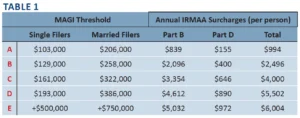
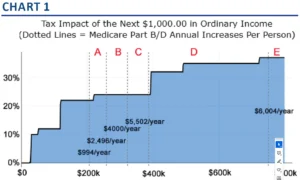
Higher taxable income can result in increased Medicare insurance premiums. For those who are paying Medicare premiums for Part B and D, a Roth conversion will increase taxable income which could affect the Income-Related Monthly Adjustment Amount (IRMAA) that future premiums are based on. Note – the benefits of tax-free compounding on a Roth IRA for an owner’s lifetime can outweigh the additional premium dollars that are spent.

Consider Net Investment Income Tax. Clients need to be aware that a conversion that increases their Modified Adjusted Gross Income (MAGI) levels over $200K (Single) or $250K (Married filing joint) will be subject to the 3.8% “net investment income tax” (Medicare surtax).

Our tax planning tools can help estimate the optimal amount for conversion based on each client’s unique situation. Please contact your Wealth Advisor to help evaluate a Roth conversion strategy that may enhance your wealth plan.

Education Funding with 529 Plans

In my experience providing financial counseling, I have fielded many questions with regards to the best ways to fund college education for a child or grandchild.

When it comes to selecting a vehicle for your education saving, there are a variety of options. However, often the best solution is a 529 plan. A 529 plan offers the benefit of tax-free growth and withdrawals for qualified education expenses.

A pre-paid in-state tuition plan is a specific type of 529 program. These plans have the most limited options for use and can have drawbacks if your student ends up not attending school or goes to an out-of-state school.

The 529 savings plan is the more flexible of the two accounts and can be used for a wider variety of costs, including associated expenses like room and board, and vocational apprenticeship programs. K-12 tuition expenses and student loan payments are also allowed up to $10,000.

Contribution limits are quite generous. In addition to an annual exclusion of $17,000 per person for 2023, one could also “superfund” a 529 plan by using up to 5 years’ worth of annual gift exclusions in one year. This could add up to $170,000 combined between spouses.

There are a variety of 529 plan providers available which offer a range of investments options, a common choice being a target enrollment fund which begins with more growth oriented strategies and becomes more conservative over time as your student approaches starting school. This provides the real advantage of potential long-term appreciation of your savings above and beyond the rising costs of education.

If your student does not use all of the 529 funds for whatever reason, the beneficiary could be changed to another family member including even yourself.

As a last resort, non-qualified distributions can be made for needs other than education, like helping your student with a home down payment. These distributions would be subject to taxation on the growth in the account plus a 10% penalty. A distribution as a result of receiving a scholarship would be an exception to this.

At Tanglewood, we are pleased to answer any questions you may have about how best to fund education for your student. Please reach out to your Wealth Advisor to begin the conversation.

Helping Adult Children Buy A Home

High home prices, high interest rates, low inventory, and tough competition have made many prospective buyers feel that home ownership is out of reach entirely or they can no longer afford the home they want.

This environment has prompted new ways of approaching a potential purchase and led to more conversations with clients about helping a child buy a home. There are several potential ways parents can help but only after addressing the first and most important question:”Do we have enough to help at all?” (As Keith discussed on the previous page, our Capital Sufficiency pillar is an excellent tool that can be used to find the answer.) Once that critical question is addressed, consider the following:

Outright Gift

If you are comfortable gifting money, you could give enough cash to your adult child to buy the home outright, assist with the down payment, or help with making mortgage payments. Depending on how large the gift is and how it is structured, you may need to file a gift tax return. You may also be asked to confirm that it is a gift and not a loan so as not to interfere with mortgage underwriting.

Intrafamily Loan / Landlord

In lieu of an outright gift, you could become the “family bank” and loan the money to your adult child. This works best when financing the entire purchase. As an alternative, you could buy the house and then rent it to your adult child. In both cases it is important that you properly document any loan or rental agreement and associated tax reporting on income.

Be On The Hook

If your adult child is struggling to meet mortgage loan underwriting requirements (e.g., they are self-employed), you could co-sign the mortgage or co-borrow. The co-signer is on the mortgage to guarantee the loan for the borrower. The co-borrower has equal responsibility to pay the mortgage.

Gift or Sell the Family Home

If you find yourself in a position of wanting to downsize and your adult child wants the family home, you could sell it or gift it to them. In both cases, it is wise to hire a real estate appraiser to determine and document the fair market value of the home, as well as hire an attorney to prepare and file any required paperwork to properly document the transfer of ownership.

Each of these has its unique advantages and disadvantages along with the potential impact on your taxes (income, gift, and estate), family dynamics, liability, financial independence, and estate planning.

Helping an adult child is an admirable goal and a big financial decision to make. We encourage you to contact your Wealth Advisor if it is something you are considering.

Disclosures

The Major Forces Molding Our Future

Daily changes within our economy are imperceptibly small except in highly unusual circumstances like the impact of Covid. Yet our economy is always in a state of change, driven by powerful long-term economic forces.

Today, the dominant factors steering our economy are demographics, social strains, government policies/debt, geopolitical realignment, technology, and climate change. These forces will shape our future.

Source: Yardeni Research, Inc.
Source: The WSJ, OECD & Moody’s Investor Service, Chart: Axios Visuals

Demographics. The world population is getting older as people live longer and have fewer children. The decline in the (traditional) working age population will continue. See Chart 1. Without a pickup in productivity, economic growth will slow, and standards of living will stagnate.

Social Strains. For much of the past three decades a disproportionate amount of income and wealth creation went to a smaller percentage of people, particularly those with capital in either the private or public markets. Most of today’s wealth resides within the Boomer generation (and this is concentrated in the wealthiest 10%). See Chart 2. Also, low income wages stagnated as many jobs moved offshore while minimum wages barely budged. This has strained social cohesion.


Government Policies/Debt. Government spending has skyrocketed. Given the flood of new money coming from the Infrastructure, Chips, and Clean Energy bills (on top of Entitlements and Defense increases), it is not likely to fall off. And of course, so much of it is borrowed (deficit spending) that the interest bill to the Federal government is soaring.

Geopolitical Realignment. Francis Fukuyama’s The End of History in 1989 suggested that after the fall of communism, Western liberal democracy had “won” and may be regarded as the final evolution of human government. For a time, this notion gained wide acceptance. Yet history did not end and there has been a rapidly growing divergence between liberal democracies and autocratic governments, particularly since Xi Jinping became president of China.

Technology. Advancements in technology over the past several decades have irrevocably changed the way we live and work. From the personal computer to the internet, email, smart phones, Zoom, and on and on. Now we are told that AI (artificial intelligence) will change our world even more dramatically than its precursors and at a faster pace.

Climate Change. Climate change is real although the causes extend far beyond fossil fuels. For example, just the increase in carbon dioxide from California’s 2020 wildfires was estimated in Environmental Pollution (10/22) to be twice the total of all California’s reductions over 15 years.

How might these disparate trends interact to mold our future?

Efficiency to Resilience. This is the force behind reshoring and increased defense budgets. Interest rates will be higher, inflation will likely be higher too as we turn from free markets and free trade toward industrial policies and managed trade. In addition, the impact of weather events – flooding, wind damage, extreme heat, droughts – will take ever greater resources just to fortify what is in place. This implies higher inflation and higher interest rates than we recently enjoyed.

Reductions in Inequality. Entitlement reform is essential if we are to pay for the increased demands on government. (Reduction in benefits to the wealthy and higher paid will be necessary.)

Wages will likely continue to rise across the bottom half of the income spectrum as a shrinking workforce increases labor’s bargaining power. Income taxes are likely to be even more progressive along with higher estate transfer costs.

New Global Powers. China may “hollow out” as it suffers from a rapidly aging workforce (a result of the one-child policy) along with the rise in capital flight and out migration by some of the wealthiest and brightest. The Middle East and Africa are likely to gain increasing power due to younger demographics and commodity wealth. India should benefit from its young, tech savvy workforce.

AI, the Wild Card. While many worry about a tragic Terminator type of outcome, there is real promise in areas like education, health care, and routine back-office services. If we are to have the long-awaited productivity boom, this will be the source.

The Next Generation of Comprehensive Planning Illustrations

Nearly 20 years ago I developed the first iteration of Tanglewood’s proprietary Retirement Illustration. This started the expansion of our comprehensive wealth planning initiative for Wealth Management clients.

The goal was to use the Illustration as a proprietary tool to quantify and visualize the alignment between a client’s invested assets and various future income streams (such as social security, pensions, etc.), with their projected future spending needs throughout their retirement years. It has served us very well.

Over the years the Illustration saw many enhancements from initial plan creation and updates to incorporating current tax laws, future tax law changes, Roth conversions, gifting and more.

I give credit to Victor Powell for advancing the spreadsheet’s capabilities and user friendliness. He took it to the next level after he joined the team in 2014.

Along with the advancements in the tool itself was the evolution of its delivery. It started with me bringing in a stack of printouts into a meeting considering various scenarios and assumptions. I now cringe at the thought of covering half the conference room table with a sea of paper reports. A major advancement was the development of an online presentation that provided the ability to make changes on the fly and immediately see the impact of those changes. Tanglewood uses tools like this to help enhance client awareness of lifetime resources and needs.

Having that level of interaction and immediate “what if” variability offered much more client confidence and ownership in the results. We want every wealth management client to see the final results as THEIR plan.

As good as it was in helping answer important questions regarding retirement timing, income and asset distribution planning, industry tools and technology were swiftly advancing as well. Over the past several years, we thoroughly evaluated several comprehensive planning programs and selected one that best supports the four pillars of Tanglewood’s wealth planning process.

Our new comprehensive program checked all the right boxes for us as it provides an exceptional balance between depth and detail without sacrificing ease of use and simplicity. Here are some of the highlights of what this advanced tool offers as part of our hands on wealth planning.

Goal Based Financial Planning:

A comprehensive goals-based approach with the capability to create comprehensive plans that incorporate retirement planning, investments, insurance, tax planning, college funding and more.

Scenario Modeling:

We can run multiple scenarios to analyze the impact of different variables in real-time. We can make adjustments to lifestyle spending, savings rates, retirement ages, investments and other factors to understand the potential change in outcomes.

We can also incorporate probability analysis that goes beyond traditional linear projections to understand the impact of variable returns over time.

Interactive Client Portal:

The software allows us to provide a secure and user-friendly client portal, enabling interactive access to a client’s financial plan as well as progress toward their goals. It is also capable of account aggregation to bring together all investment accounts, assets, and debts to build a balance sheet that automatically updates values over time.

Tax Planning and Optimization:

We find the tax planning features, including future tax projections, tax-efficient withdrawal strategies and Roth conversion analysis particularly helpful. Helping clients make wise decisions regarding their lifetime tax exposure not just year-over-year.

Cash Flow Management:

With its robust cash flow management capabilities we can track client’s income, expenses and debt repayments. It automatically categorizes these transactions from linked accounts, generates reports and offers insights into spending patterns for making better budgeting decisions. Detailed cash flow transactions are for the client’s eyes only and not seen by your Wealth Advisor unless shared by the client.

With this program we can provide greatly enhanced flexibility and “what if” capabilities and with it we can provide clients the confidence, clarity and definitive path to move forward in reaching their personal financial goals. Equally important is that as each client’s situation and goals change, the plan can easily change direction as well.

We are working with additional clients on this platform seemingly every day in preparation for Wealth Planning review meetings. Contact your Wealth Advisor to discuss this further or to set up a review meeting at your convenience.

Disclosures

Four Pillars of our Total Wealth Management® Relationship

The objective of our Total Wealth Management® is to make a positive and lasting impact on the financial wellbeing and outcomes of our clients. This is more than just a one-time exercise but a long-term partnership that aligns the firm and its wealth advisory team with our clients. We aim to know all the specific details of both our client’s financial situation as well as their personal goals and objectives, which puts us in a very unique position not held by other professional advisors.

While investment management has been a core expertise at Tanglewood since inception, our wealth planning capabilities truly stand out in our field. Tanglewood has and will continue to enhance our wealth planning resources adding to the depth and breadth of our services, our people and expertise as we grow.

We consider the following to be the four pillars of planning that are at the heart of every wealth management relationship. While these pillars are the foundation of our wealth planning, individual circumstances, needs, and goals often lead us into areas of importance to specific clients such as: business capitalization, ownership structures, and succession; special needs of children; corporate trusts; charitable foundations; and more.

Balance Sheet Creation and Maintenance

Creating a comprehensive and current balance sheet or personal net worth statement is the first planning pillar of our wealth management process. It is critical to establish this foundation for nearly all areas of planning with our clients.

The Balance Sheet offers a snapshot of a client’s financial resources and overall financial health. In order to establish a current financial position, all assets including, bank, investment and retirement accounts, real estate, and other illiquid assets should be included along side all liabilities including mortgages. This is a valuable report for both wealth accumulators and those in retirement looking to grow and preserve their assets.

We offer clients several ways to keep up with this information via PDF or excel templates (manual entry and updates) to digital balance sheet aggregators which will securely link financial account websites to provide updated values. We prefer the latter as once this “living” balance sheet is set up it automatically updates most “liquid” holdings.

Annual Tax Return Review and Analysis

The second planning pillar, tax return analysis, is a combination of annual tax planning within the context of a client’s lifetime potential tax exposure. It is an ongoing and recurring added value for clients in an ever-changing tax environment.

Understanding a client’s entire tax situation beyond what is attributable to their managed investments is critical to lifetime tax planning. This requires a detailed analysis and preview in tax years with material changes or opportunities. Every client’s tax situation is unique, there is no one size fits all approach.

Roth conversions, capital gain/loss management, deferring/accelerating income, estimated tax payments, IRA distributions, and deductions are just a few of the areas that offer opportunities.

As you complete and file your 2022 return, please send Tanglewood a copy. This can be uploaded to your document vault or you can request a secure upload link from your Wealth Advisor. Due to the sensitive information within a tax return, please do not send an unprotected return via regular email.

Upon receipt and review of your tax return, we will prepare and send a detailed Tax Report, which provides a comprehensive analysis and summary of your recently filed return. This report helps us understand the various components of your tax return, including an overview of your income, deductions, and credits. Among its many benefits are where you stand in terms of tax brackets and phase outs, along with some observations and strategies to consider going forward.

Capital Sufficiency Analysis

The third planning pillar, running a capital sufficiency analysis, takes time and effort up front to gather all the details needed to fully build out a projection. The balance sheet and tax review add valuable insights in the preparation of this analysis.

During client planning meetings, we are often asked questions, such as, “when can I retire”, “how much do I spend without the fear of running out too soon”, “how much do I need for my children’s education”, or “what are the most advantageous ways of making large gifts to family or charity”. These are just few of the goals and objectives that provide an important context to our wealth planning and investment decisions.

A well thought out plan helps answer these questions and greatly improves the chances of a successful outcome. Having a plan in place acts as a financial road map. When situations and goals change, as they often do, the plan serves as a baseline for comparison. New inputs such as an earlier retirement of increased spending can be quickly evaluated.

In times of market volatility, this big picture context helps many clients focus on their long term objectives rather than the short-term noise.

Estate / Legacy Plan

Having an appropriate and well thought out estate plan is the fourth planning pillar of Tanglewood’s wealth management process. For clients who do not have a plan, or cannot locate the documents, or it has not been looked at in 10 years, this should be a priority!

Our role is to define our client’s overall objectives and propose possible solutions that fit the composition of their estate. The balance sheet once again is a prerequisite to understanding the size and complexity of the estate.

Often unique family circumstances are as important as financial details. Personal conversations of any potential challenges should be thoroughly explored. While Tanglewood does not draft legal documents, we facilitate the process by spending as much time as needed to introduce and explore various planning strategies.

Another important aspect to the estate planning process is the coordination of beneficiary designations for life insurance and retirement accounts. The designations themselves if not aligned with the documents can work against an otherwise well thought out plan.

With the plan in place, Tanglewood will prepare a flowchart illustrating the overall disposition of the plan which includes the important provisions and people involved.

At Tanglewood we believe these four pillars of our planning provide a sound foundation on which to build a long-term partnership with each of our wealth management clients. Once in place, special planning needs or opportunities can be better evaluated. The collective experience and knowledge of all our wealth advisors supports our Total Wealth Management® mission.

It is the firm’s intent to engage with each wealth management client to maintain these pillars as a core responsibility of our partnership.

Interest Rates, Credit, and Climate Change

The earth’s climate has changed many times over its history from bitter ice ages to much warmer periods. One statistical relationship holds true through all these periods, the higher the temperature, the less ice in the arctics and the higher the ocean level. So one variable, temperature, changes the configuration of all land masses.

The level of interest rates plays a similar role throughout the economy and the markets. Higher or lower interest rates change the entire financial landscape.

Almost all lending rates are tied to the Fed Funds Rate, the rate for overnight lending by the Federal Reserve (Fed). One example of direct ties are margin loans for our clients at Schwab which are often quoted at 2.0% plus the Fed Funds Rate. An example of indirect ties are 30-year fixed mortgage rates which have no direct ties to the Fed Funds Rate, but have sharply risen for borrowers.

Source: The Wall Street Journal

Carrying Costs. Higher interest rates raise the carrying cost of anything bought with credit… homes, automobiles, commercial buildings, capital equipment, inventories and so forth. See Chart 1.

As rates go up, fewer things are either affordable or make economic sense thus dampening economic growth. For example, a new business expansion that made good sense when the prime rate was 3.0% no longer works with its current 8.0% rate.

Less growth means less demand for goods and services which reduces inflation. This was the stated goal of the Fed as it raised the Fed Funds Rate over the past 12 months from effectively zero to now 4.75%-5.0%. It is working as inflation has steadily declined.

Housing is a good example. Home sales plummeted in 2022. As a result, the average home price came down (over 12 months) for the first time since the financial crisis. The ripple effects of less new housing are extensive – appliances, landscaping, furniture, and much more, all rise or fall with the housing industry.

Rollover Costs. After a decade of extremely low interest rates, most individuals and companies had financed their debts at very low interest cost, whether that be mortgages, bond issues, or virtually any other type of loan.

After the steep rise in interest rates over the past year, any debt that comes due, and needs to be rolled over, will jump to a much higher rate. This will reduce the cash available for other purchases, salaries, or capital investment.

Source: Haver Analytics, Rosenberg Research

Commercial Real Estate (CRE) will have its highest dollar amount of rollovers in a generation this year. Already, major property owners such as PIMCO and Brookfield have walked away from properties they owned. Obviously, there will be more foreclosures and bankruptcies ahead. Banks will also be much more hesitant to rollover CRE loans. See Chart 2.

Hurdle Rates. Higher interest rates directly impact the risk/reward equation within investment choices. The higher the rate on “risk free” money market accounts, the more serious the competition (hurdle rate) they offer to other investments. Less risk taking by investors means less investment in economic activity.

Portfolio Declines. As the yields on newly issued bonds rise, the market value of previously issued bonds fall. It does not matter whether the bonds are super “safe” U.S. Treasury bonds, corporate bonds, mortgages, or municipals. This is what caused 2022 to be an especially bad year for virtually all bond investors.

Summary. The higher costs of carry and rollovers, as well as foreclosures, mostly occur when loans mature or new projects are deferred. This is why raising interest rates has a lagged impact of 6-12 months on economic activity. Even if the Fed is close to – or even at – the end of its rate rising, the impact of today’s rates will continue to slow the economy throughout 2023.

Fortunately, most of the economic impact is from the interest rate itself, not from the credit quality of the borrowers or the underlying investments. This means that as interest rates come down, much of the constrained economic activity can resume. The question then becomes, when does the Fed believe its inflation objective is achieved enough that it can begin that process.