Sometimes It’s OK to Feed the Bear

Market volatility is inevitable and a part of the investment experience. Since 1926 the S&P 500 has experienced 26 bear markets – defined as a decline of 20% or more from its previous high. These periods are unnerving and uncomfortable, but they should not be unexpected. Volatility (aka “taking risk”) is the price an investor pays for a superior return on their investment. For a well balanced diversified portfolio, committing to the investment process should ultimately lead to a full recovery and on to new highs.

With this as a backdrop, corrections and bear markets can be viewed as opportunities to enhance a client’s wealth planning objectives. This is not market timing in the traditional sense but simply reframing a temporary market downturn into a positive long-term planning opportunity. Let’s look at some of these opportunities.

Add sideline cash

When markets are down substantially from their all-time highs, it is a great time to add accumulated cash to a long-term investment portfolio. The deeper the decline, the more the reward on those contributed funds.

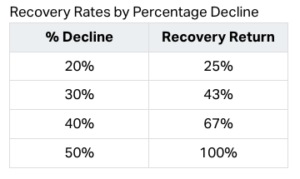
For every dollar invested when a portfolio is down 40%, that dollar achieves a 67% return when fully recovered. See below for the “recovery return” after various levels of decline.

This is not magic market timing or crystal balls, it’s just math!
Make an IP change

In the same vein as adding cash to the portfolio, adding stock exposure through a more aggressive investment policy accomplishes a similar result. Tanglewood’s investment policies range from 30% equity to 100% equity. Turning up the equity dial a notch after a significant decline will take advantage of a downturn with more equity growth during the recovery.

It’s very important to keep in mind that with either of these moves you never know where the bottom will be. You might initially feel good investing or getting more aggressive when down 20% or 30% but only to see it continue to fall further from there. Being too early can cause pain and/or regret in the short-term, but doesn’t change the math or advantage ultimately achieved when fully recovered.

Roth conversions

For someone considering a Roth conversion, a market decline may be the perfect time to pull the trigger. The greater the decline, the more a conversion is “on sale”. Remember the conversion is taxable income in the year it is converted. Most often, the goal is to target a specific conversion amount to fit within the client’s tax budget. When market prices are low, more shares get converted to reach the desired conversion amount.

The real payoff comes when the market (eventually) turns around and the conversion recovers tax free inside the Roth instead of the taxable IRA.

Accelerate gifts

Gifting is a simple and smart way to transfer wealth and reduce estate taxes over time. Whether using the annual gift exclusion ($16,000) or making a significant gift that uses some of the $12,060,000 per person lifetime exemption, a bear market provides additional leverage since the gift values are temporarily depressed.

Business owners may also find this to be a good opportunity to gift depressed company stock if their business has also been negatively impacted. Splitting the stock into voting and non-voting shares will further reduce valuations and provide an opportunity to give away value without losing control.

Diversify

A sharp decline in market value should reduce the tax impact of selling an investment with a large unrealized capital gain. We recommend not letting the “tax tail wag the dog” but if realizing that large gain was a barrier to diversifying, a bear market may open up that opportunity and lessen the tax pain.

Tax loss harvesting

This strategy is nothing new and one that Tanglewood implements when the right opportunities present themselves. Selling positions at a loss and simultaneously buying a similar security, pockets the loss to use against gains later while remaining invested. They never go to waste as any carryover losses from one tax year roll over indefinitely until fully utilized.

Accelerate IRA RMDs

Similar to a Roth conversion, taking an IRA RMD when the market is down can be a tax wise move. The reinvestment of the RMD in an after-tax account essentially “steals” appreciation from the IRA and shifts that growth from an ordinary income tax environment to a capital gain environment.

Tanglewood’s Wealth Advisors stand ready to discuss and analyze whether any of these moves make sense in your particular situation.

Take Your Tax Ceiling Ratio With You

If you are a Texas homeowner, you are likely familiar with the term “homestead exemption.” However, there may be a wrinkle you are unfamiliar with.

When you turn age 65, you can fill out an application with your appraisal district to qualify for the over-65 homestead exemption. This is an additional $10,000 homestead exemption from school district taxes (on top of the $40,000 exemption from school district taxes for all homeowners).

The year you qualify for the over-65 homestead exemption is called the “freeze year.” The freeze year is an important concept because it establishes your “tax ceiling.” The benefit of the tax ceiling is that it caps your future school district taxes to the amount you pay in the year you qualified for the over-65 homestead exemption. This means your school district taxes may not go above the tax ceiling amount, unless you make changes to your home that your appraisal district deems to be an improvement (e.g., adding a new room or second story).

We have been asked, what happens to my tax ceiling if I move; do my property tax values reset? The good news is you can take your tax ceiling ratio with you. For example, if your home is appraised at $1,200,000 today but was valued ten years ago at $600,000 when your school district taxes were frozen at age 65, you currently have a tax ceiling ratio of 50%. If you decide to move to a new home in the same or other district, you can apply your 50% tax ceiling ratio to your new home. Your school district taxes will be 50% less than what they would be without the tax ceiling ratio applied.

The bottom line: If you are age 65 or older and are moving within Texas, make sure you take your tax ceiling ratio with you. It is a simple process. You or your title company requests a Tax Ceiling Certificate from your former appraisal district and then file it with your new appraisal district when you apply for a residence homestead on your new home.

The End of Globalization…Again

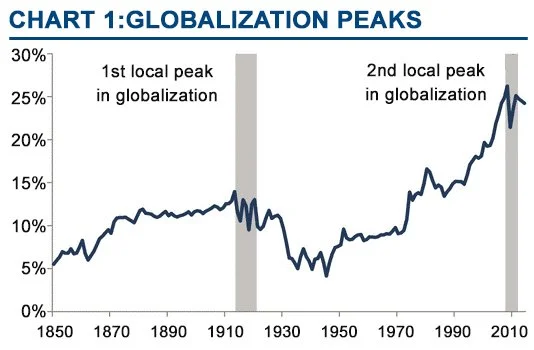
It took a pandemic, war, and surging inflation to end the great age of globalization…105 years ago.

Source: The Wall Street Journal, Fouquin and Hugot (CEPII 2016), Goldman Sachs GIR

The first modern age of globalization was the period between the 1850s and WWI. This was an exciting period when business leaders like J.P. Morgan, Andrew Carnegie, and Cornelius Vanderbilt connected America and the world with networks of steamships, railroads, and telegraphs. See Chart 1.

Leading economists of the day proclaimed war was “obsolete” because of the interdependence between countries that these businesses developed. Those economists were wrong, WWI brought a decisive end to that era of globalization.

The foundations of globalization were set out by Adam Smith in his famous Wealth of Nations (1776). His notion that through trade, each country should provide the rest of the world with what it does best, where it had inherent advantages of natural resources, unique talent or manufacturing prowess.

His ideas upended the historical economic model known as mercantilism, the principle of a fixed total value of global wealth (i.e. pie). The only way for one country to get a bigger slice was to take it by force. Thus, the incessant wars since time began.

Adam Smith’s capitalism provided another way…grow the pie…make each country richer without war. Globalization embodies the ideals of capitalism for all participating countries. But globalization requires rules of the road that are fair and respected by all.

This did not happen between the two World Wars. Nationalism and communism took center stage, beggar thy neighbor policies took root, and ruthless dictators rose to power.

Globalization did not pick up again until the formation of the United Nations and the General Agreement on Tariffs and Trade (GATT) in the aftermath of WWII. At first, globalization was only among the non-communist nations of the West. Despots such as Mao Zedong and Joseph Stalin continued the cruel subjugation of their peoples in the East.

This began to change with Deng Xiaoping’s new direction for China (1978) and the fall of the Berlin Wall (1989). Capitalism had defeated communism as an economic model! This brought these new entrants to enjoy its benefits.

For several decades this new era of globalization blossomed. Countries like Germany fully bought in, putting international business connections well above any security concerns. They were not alone as businesses in most participating countries benefitted from the lower material and labor costs that globalization provided.

The inter dependencies of this era of globalization far exceed those of the prior one. Computers, the internet, container ships, air travel, and education have integrated businesses at countless points. Relationships such as “just in time inventories” were born. Most business elites (the Davos men) have presumed that “this time, major wars must be obsolete.”

Yet one thing is clear from both the earlier period as well as the current one…in the end, political forces trump business connections. Political rivalries (hegemon) and yearning for past glories have given birth to authoritarian leaders who cast aside the former business elites in favor of their own agendas — Vladimir Putin in Russia and Xi Jinping in China.

Such bullies often get their way until some breaking point is reached, when the rest of the world finally responds…as with Ukraine, today. “The Russian invasion of Ukraine has put an end to the globalization we have known for the past three decades,” wrote Larry Fink, the CEO of Blackrock. This is notable as he has been perhaps the best-known cheerleader of globalization.

The world is breaking up into several “blocks” — the West (democracies, rule of law, independent judiciaries), the East (authoritarian, controlled media), and Non-Aligned (those with some features of each, trying to play both sides).

I believe strongly that the western principles will prove more resilient in the face of this new “competition” …just as capitalism won the Cold War. The people of Ukraine have demonstrated overwhelmingly that freedom, once achieved, is not something people give up lightly.

Opportunities within the West (potentially a new League of Democracies) are endless as this is where innovation thrives and people are free to make their own choices.

A Look at Schwab’s Advanced Beneficiary Designations

When it comes to asset transfers at death, beneficiary designations are just as important as a will, particularly when the beneficiary account (such as an IRA) is the largest single asset in the estate.

Because of the new shortened 10 year distribution period for Inherited IRAs, more people are forgoing naming trusts as beneficiaries and listing children directly.

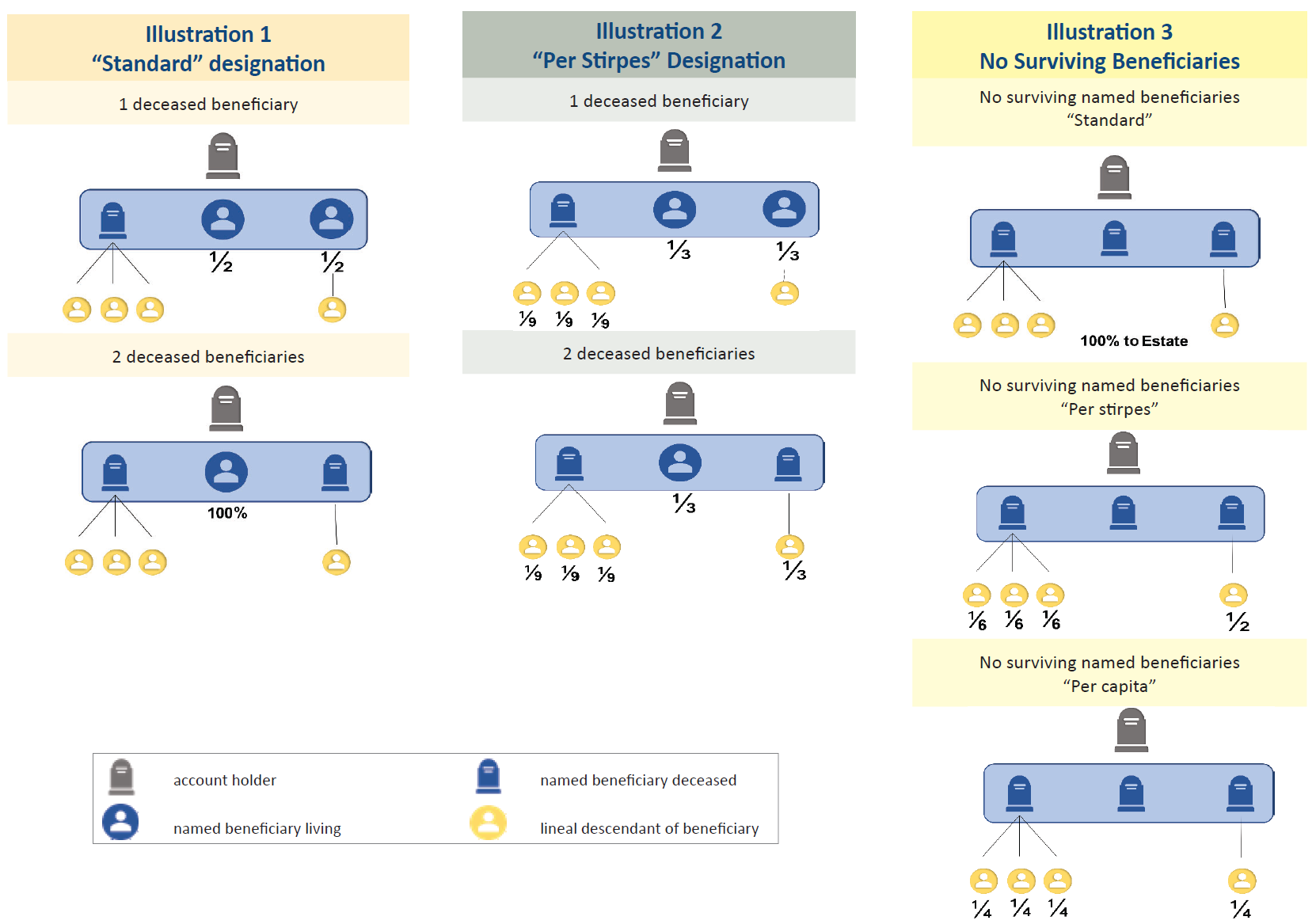
Many clients may be surprised to know that Schwab’s “default” beneficiary designation simply divides the assets among the surviving beneficiaries – with no consideration to their lineal descendants. For example, if there are three named beneficiaries and one dies, the account is divided among the two surviving beneficiaries. Under this standard “default” designation, nothing would pass to the children of a deceased beneficiary. See Illustration 1 below for two examples of the standard designation where 1 of 3 and 2 of 3 named beneficiaries are deceased.

An often overlooked and misunderstood beneficiary option is a “per stirpes” or “per capita” election. These elections include the lineal descendants of a named beneficiary in the event that beneficiary predeceases the account holder. It is like having a built in contingent beneficiary without specifically naming all the heirs.

With a per stirpes election, the lineal descendants of a deceased beneficiary split the portion that the deceased beneficiary stood to receive. See Illustration 2 below for two examples of per stirpes where 1 of 3 and 2 of 3 named beneficiaries are deceased.

Schwab’s per capita election is the same as per stirpes if any named beneficiary survives. The difference is how descendants are treated if ALL the named beneficiaries pass away. With per capita, all the descendants are treated equally. See Illustration 3 for an indication of the difference between the standard, per stirpes and per capita elections in the event there are NO surviving beneficiaries.

The easiest and preferred way to view and update your beneficiaries is online via the Schwab website under Service/Beneficiary. They can also be changed using a Schwab beneficiary update form.

Keep in mind, this applies specifically to Schwab, other custodians can have a different approach for their beneficiary designations.

Please reach out to your Wealth Advisor to review and ensure these designations align with your ultimate wishes.

Funding your Revocable Living Trust with Real Property

Tanglewood has long espoused the benefits of Revocable Living Trusts (RLT). An RLT allows you to transfer ownership of your assets into it while maintaining control over those assets during your lifetime.

Benefits of an RLT include:

  • Avoids probate

  • Flexibility and control

  • Privacy

  • Continuity of management

This article focuses specifically on the importance of including all real property (including your home) into an RLT.

Unlike a will that requires involvement from the probate courts, an RLT allows a successor trustee to immediately step in to make management decisions on the property without delay.

If you have an RLT, fund it

Many people who have a living trust never retitle their real property into it. If this is you, keep in mind the executor of your will cannot transfer property from your estate to your RLT until after the probate court names them as executor, something you wanted to avoid in the first place.

This is especially important for clients who own property in more than one state as probate in certain states (e.g. California) are more cumbersome than in others. Retitling out of state real property into an RLT will not only avoid the time and expense of ancillary probate, but it allows for continuous management of these assets.

Putting your residence and other assets into an RLT today saves time and resources later. As many people age, they risk potential incapacity and/or dementia; making it much more difficult to retitle assets.

Contact your insurance agent

Finally, after you retitle your real property into an RLT, contact your insurance agent to discuss adding the trust as an “additional named insured” on both your homeowner’s and umbrella policies. If a home is damaged by fire or flood, the individual persons have an insurable interest in the home contents, but the living trust technically has an insurable interest in the structure. If the trust is not also added to the policy, it is possible the insurance company will pay the claim on the contents, but not on the structure.

Titling Joint Assets – An Integral Part of an Estate Plan

How property is titled is a crucial part of any well-designed estate plan. The lack of coordination between asset ownership and estate planning documents can inadvertently lead to unwanted consequences.

Many of our clients own joint accounts that are either titled as Tenants in Common (TENCOM) or Joint Tenants With Rights of Survivorship (JTWROS). The difference can significantly affect the asset distribution outcome.

Tenants in Common

Assets that pass through a will are referred to as probate assets. A typical example is a TENCOM account. It is owned by multiple individuals who each have a separate, but undivided interest. At death, the decedent’s share must go through probate and follows the will’s instructions.

Joint Tenants with Rights of Survivorship

In a JTWROS account, each owner has an undivided interest and survivorship rights. This means a decedent’s share passes to the surviving owner(s) by “Operation of Law”, therefore – bypassing probate – and independent of the will’s instructions. For spouses, a JTWROS account can be an efficient way to pass assets to each other at the first death in the right circumstances, such as spouses who have no children or simple wills leaving assets outright to each other.

Effect on the Estate Plan

Oftentimes, one or both spouses want to ensure that their children (or children from a previous marriage) inherit assets. Their estate plan may incorporate the creation of a trust that provides income and/or principal to their surviving spouse and children. A TENCOM accomplishes this since the deceased spouse’s half of the account flows through the estate to fund the trust. The other half is distributed outright to the surviving spouse.

However, a JTWROS account may completely negate a planning strategy that called for the creation of trusts. Unless there are other funds earmarked. The JTWROS assets will transfer outright to the surviving spouse and not be available to fund the trust.

Avoiding probate at death is a goal that more people are incorporating in their estate plans. Accounts that transfer assets directly to their intended heirs can accomplish this. Should this be your goal, make sure a separate account is set aside which can be easily accessed by your executor. This is to provide funds for final bills, funeral expenses, costs, and taxes related to settling the estate.