Policies to Challenge China’s Global Ambitions

China was seen as a partner through most of the 1980s, 1990s, and early 2000s. They specialized in making everyday goods cheaper, which benefited most of our consumers and kept inflation (and interest rates) down around the world.

Yet not everyone benefited. After China was allowed to join the WTO in 2001, our manufacturing base slowed remarkably relative to economic growth. See Chart. Many working class Americans counted on manufacturing jobs for good pay and benefits.

Source: BEA, Federal Reserve, JPMAM, 2024

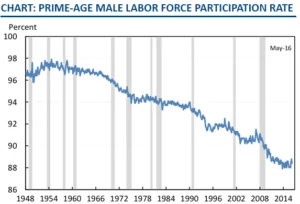
For a generation, both economists and politicians believed this was for the “greater good” as cheaper prices benefitted all Americans. Displaced workers were to find other jobs in other growing areas of our economy. Yet for many American workers, those opportunities never materialized. An ever-greater share of males between ages 18 and 54 are not even in the workforce and thus do not count in the unemployment figures.

When Xi Jinping came to power in 2012, China became much more nationalistic and began to undermine the post-WWII world order (free elections, rule of law, and independent judiciary) with its own communist ideology which subjugates minorities, imprisons opponents, steals intellectual property, controls the media, and rewrites history.

In 2015, China set national goals to dominate critical economic areas by 2025. They subsidized and overbuilt these industries so that they could lower prices when necessary to crush international competition. Profit has not been the motive, monopoly control was sought. This is how they achieved global dominance of rare earth mining and refining, solar panels, ship building, and electric cars.

At the same time, their “Belt and Road” initiative set out to control trade routes in Asia, the Middle East, Africa and even South America. They bought, built, or subsidized railways and ports around the world including both ends of the Panama Canal.

China’s “no limits” partnership with Russia gained them ready access to many raw materials they do not control – oil, natural gas, copper, uranium as well as agriculture products. In return, China has been essential to Russia’s ability to continue its war on Ukraine.

China insists on western rules when it suits their purposes but ignores them when they do not. Xi built military bases in the South China Sea after he explicitly promised President Obama he would not, then ignored the ruling from the World Court that negated their claim to almost the entire South China Sea. China abrogated its agreement with Great Britain to let Hong Kong remain free until 2047. They stonewalled the World Health Organization’s Covid 19 investigation.

How do we meet the challenge? While it took far too long to understand the breadth and depth of the challenge posed by Xi’s China, there are many things that can be done to either eliminate or offset further inroads:

  • Work toward eliminating our reliance on China for critical materials or production, especially those necessary for our defense – ship building, medicines, electric grid components, semiconductors, and both basic and rare earth materials.

  • Substantially reduce the stifling regulations that make both our costs and timelines uncompetitive (the average bridge takes 17 years from inception to completion).

  • Bring government expenses and debt under control. (Nothing else is possible if we lose our financial capacity for these investments.) This is also essential to maintain the enormous advantages of the Dollar as the reserve currency.

In addition, we should press our advantages in this competition. These include: the ingenuity and access to capital of our vast array of entrepreneurs; our huge advantage in higher education institutions (instruction and research); and our globally dominant tech and financial institutions.

Finally, the current administration’s support for the Oil & Gas industry — often referred to as “drill baby drill” — is much more than support for one industry that the opposing party was against. Energy is the lifeblood of economic growth!

Full-spectrum strategic energy dominance would facilitate the reinvigoration of America’s entire industrial and manufacturing sectors as we disentangle our economy from China. The low cost and abundance of energy is one of America’s greatest strengths.

One of the Best Investments You Can Make? Yourself.

A gym membership and a healthy diet are probably not the first things that come to mind when you consider investments for building wealth. Instead, most people think of stocks and bonds as ways to accomplish their financial goals. However, poor health impacts the ability of many Americans to achieve financial freedom. Smokers, for instance, have been found to have an average net worth 50% lower than non-smokers. Less obvious dangers like physical inactivity are estimated to cost thousands annually in lost productivity.

Rarely does one consider that the extra helping of pizza on game night slowly chips away at our physical health, and by extension, our finances. Obesity, one of the most prevalent health issues in the U.S., can result in significantly higher medical costs each year and a lower quality of life. Prioritizing a balanced diet and staying active, one will not only feel better but will also likely increase their earnings potential over more years, while saving on healthcare costs along the way.

Education is another key area where investing in oneself can pay off in a big way. According to a study by Georgetown University, individuals with an associate’s degree earn almost $500,000 more over their lifetime than those with a high school diploma. The results are even more stark for earning a bachelor’s or master’s degree, which increase lifetime earnings by $1 million and $1.7 million, respectively, over a high school diploma. With the average tuition of an in-state public university currently around $11,000 per year, attaining a bachelor’s degree results in an exponential return over one’s life.

Investing in oneself is often looked at as starting one’s own business. The dilemma here is often how to maintain a balance between the business and securing one’s financial future. Entrepreneurs starting a business should balance contributing to a SEP-IRA with investing more in their business upfront. If the business takes off, the returns could be multitudes of the initial startup costs. If the business fails, maintaining a solid retirement fund ensures one has a good foundation to fall back on.

Whether it’s for your health, education, or small business, investing in yourself could be the best decision you make for your long-term financial well-being.

Disclosures

Preserving Family Assets with a Limited Liability Company

Families who wish to retain legacy assets such as ranches, vacation homes, or other legacy property, face many challenges – delegating operational responsibilities; managing ownership; liability protection; to ensure smooth transition across generations. A Limited Liability Company (LLC) provides a legal and practical framework to address these challenges making it an ideal choice in many instances.

Over the years, Tanglewood has worked alongside clients and their estate planning attorney to assist with the formation and ongoing management of many LLCs. Here are some of the basics.

What is a Limited Liability Company? An LLC is a legal entity that combines the liability protection of a corporation with the flexibility and simplicity of a partnership. When an LLC is formed to hold an asset, the property is owned by the LLC rather than all the individual family members. Each family member who is part of the LLC is considered a “member” and holds an ownership interest in the entity.

The LLC operates and manages the asset—collecting income, handling expenses, and making decisions according to agreed-upon rules or the desires of the founding family members. Additionally, this structure helps to shield the personal assets of the members from potential liabilities associated with the property.

Why Hold Family Assets in an LLC? Forming an LLC for a family asset offers numerous benefits. Below are some of the key advantages:

  • Simplifying Management An LLC allows families to establish an operating agreement. This is a legally binding document that outlines how decisions will be made, who is responsible for day-to-day operations, and how profits or losses will be shared.

  • Clarifying Ownership Rights An LLC formalizes ownership by issuing membership interests to each family member. These interests clearly define each person’s share of the property, voting rights, and responsibilities.

  • Streamlining Generational Transfers Families can establish rules and guidelines for how ownership interests of the LLC will pass to the next generation. The rules for buying, selling, or gifting membership interests are clearly established ensuring that the asset remains in the family.

  • Protecting Personal and Family Assets An LLC separates personal assets from those of the entity. If a lawsuit is filed related to the family property – for instance, an accident on a ranch or vacation home – the liability is limited to the LLC’s assets. This protection goes both ways. If a family member faces personal financial issues, such as bankruptcy or lawsuits, their ownership interest in the LLC may be protected from creditors.

  • Facilitating Tax Efficiency An LLC offers flexibility in taxation. Income and expenses pass through to members’ personal tax returns. Additionally, holding the asset in an LLC may allow for deductions related to property expenses. LLC interests may be eligible for significant valuation discounts that can equate to a substantial reduction in estate taxes when passing to heirs.

Example: Holding a Ranch in an LLC Consider a ranch used by the family with the intention to pass it down for generations. Over time, as the family grows, questions or even disputes arise over who should manage the property, how expenses should be shared, and what happens when someone wants to sell their share. When forming an LLC, the family can:

  • Clearly define each member’s ownership interest.

  • Establish an operating agreement that dictates how decisions will be made, such as rules for leasing the property, approving major repairs, or handling disputes.

  • Simplify transfers to the next generation by gifting membership interests instead of dealing with complex title changes.

  • In addition, the current owners of the ranch can contribute additional capital to the LLC to be a long-term source of funds for ongoing costs.

This structure preserves the ranch as a cherished family asset but also reduces the burdens associated with its management and enjoyment.

Basic steps to Forming an LLC Key steps:

  • Choose a Name: Select a unique name that complies with your state’s rules and reflects the purpose of the LLC (e.g., “Smith Family Ranch LLC”).

  • File Articles of Organization: Submit this document to your state’s business office, providing basic details such as the LLC’s name, address, and members. Each state may have other required information.

  • Draft an Operating Agreement: This is one of the most critical steps. The agreement should outline ownership percentages, voting rights, management responsibilities, rules for transferring interests, and procedures for resolving disputes.

  • Obtain an EIN: An Employer Identification Number (EIN) from the IRS is necessary for tax purposes and opening a bank account.

If you would like to learn more or are considering an LLC for your situation, contact your Tanglewood Wealth Advisor to begin the conversation. We can also participate in conversations with your estate planning attorney to help tailor the structure to your specific needs.

Intrafamily Loans: Revisited

Intrafamily loans are a useful financial tool for helping adult children purchase real estate, invest in a business, or pay off high-interest debt. When interest rates were at historic lows, these loans made a lot of sense. With mortgage rates still double 2021 levels, it’s worth revisiting whether intrafamily loans are still practical. Before deciding to lend money to a child, parents should weigh both the financial and relational implications.

Financial Implications: The Numbers Still Work. Financially, the case for intrafamily loans remains compelling. This week, a 30-year mortgage is 7% for those with 740-760 FICO scores. In contrast, the IRS allows family members to loan money at the Applicable Federal Rate (AFR) without triggering tax penalties. The January 2025 AFR for long-term loans is 4.44%. This is a competitive bond like yield for the lender while a terrific yield advantage for the child.

Relational Considerations: Proceed with Care While the numbers may make sense, lending money within a family can be emotionally complex. To minimize potential misunderstandings, these are some basic considerations:

  • Put Everything in Writing: Be clear in the loan agreement. Specify the repayment schedule (include an amortization), due dates, late payment penalties, and consequences for non-payment.

  • Consider Relationship Dynamics: Reflect on whether you are prepared to enforce the loan terms in the event of non-payment.

  • Should you secure your loan? While filing a lien on the property for which the loan is made may offer some additional “protection”, it also may interfere with traditional mortgage underwriting.

Other considerations It is important that you evaluate the following:

Evaluate Long-Term Impact: Think about how lending money might affect your own financial goals and retirement plans. Do not compromise your own financial security.

  • Understand IRS Implications: Family loans are subject to additional IRS scrutiny. If your child cannot make payments, you may be required to: a) pay income tax on unpaid interest; and/or b) treat the unpaid portion of the loan as a taxable gift.

  • Consult Advisors: Work with financial and tax professionals to structure the loan properly and ensure compliance with IRS regulations.

As housing affordability declines, intrafamily loans remain a practical financial tool. However, careful planning, clear communication, and professional guidance are essential. If you are considering an intrafamily loan, discuss your options with your Tanglewood advisor to help determine whether it is the right choice for your situation.

Building Emotional Resilience in Your Retirement Plan

Some of the most rewarding work I do is with clients who are in or approaching retirement. I get to see my clients pursue their passions without distraction, deepen their relationships with family, and use the wealth they have earned to make the world around them a better place.

That is not to say it’s easy work.

With more than 11 years of advising Tanglewood clients, my experience has shown me that the emotional side of retirement planning cannot be separated from the financial side. The math has to work, yes. But emotional resilience plays a huge role in making that math work. When you are emotionally engaged in your retirement plan, you manage your wealth… but you also make sure the right decisions are being made, and the right people are involved at every stage.

Emotional resilience can also be seen as the capacity to prioritize what truly matters. That means maintaining a financially sustainable lifestyle, organizing everything you will need when life catches you off guard, and building trust and confidence in the people who support you.

We are approaching the end of the year as I write this. But no matter when you read this article, consider it an open invitation to run down your own emotional resilience checklist to stay on track with your own retirement plan. Here are a few suggestions:

Consolidate and simplify what you can.  Build your net-worth statement. How easy is it for you to access all your financial accounts? How many logins and passwords do you have to manage? No one has an easy, straightforward financial life. Throughout the course of your wealth-building years, you will inevitably have several banking, investment, and retirement accounts from different jobs, localities, and phases of your life.

Many of those accounts need to stay separate for good reasons. It is likely that your decumulation strategy will concentrate your wealth into different types of accounts to manage your long-term tax exposure. But you do not have to make it harder on yourself. Are there any accounts that you could consolidate? The more you can simplify and eliminate unnecessary accounts, the easier it will be for you and your advisor to manage your wealth as a unified whole.

That consolidation goes double for your subscription accounts. According to CNET, the average household sinks about $1,000 a year into subscription fees. That money adds up over time. I am not suggesting you cancel everything, but I would like you to think about how often you use your subscription services. For that matter, how much are you enjoying the services those subscriptions provide? Are they adding value to your life now, or is it a fee you pay because you might want the option to watch some shows on your “must watch list” or simply “too busy” to find the time to cancel them?

When you take control of where your money is located and how it is used, you lessen the cognitive load of managing your finances for the long haul. You build intentionality back into your finances.

Another way to build intentionality and emotional resilience is to check in with your team. Your advisor works with your estate and tax planning professionals. Are there any documents that need updating to better reflect your retirement plan and the legacy you want to create? Are your beneficiary designations up to date and consistent with your plans? How easy is it for you and your team to access the forms and information you need?

Verifying beneficiary designations is one of the simplest yet powerful steps you can take to secure your legacy. Ensuring that your designations are clearly identified and consistent with your overall retirement and legacy plan is more than just an administrative task–it is emotional reassurance. By taking the time to confirm that the right people will benefit from your life’s work, you gain peace of mind and clarity.

Your advisor and estate planning professionals can guide you through this process, making sure your designations reflect your intentions. Revisiting these decisions regularly with your team ensures they evolve alongside your financial and personal goals, further aligning with the legacy you wish to leave behind.

It might sound a little silly to call it “self-care” to talk to your advisors about your finances. But it can provide genuine emotional relief knowing that your loved ones are cared for and that your own financial path is headed in the right direction.

Proactive tax and investment planning is another way to build both financial security and emotional resilience. Collaborating with your wealth advisor and CPA not only ensures your tax situation aligns with your long-term goals but also reduces the stress often associated with tax season.  Your advisory team can suggest tax saving strategies you were unaware of that are complementary to your values and philanthropic goals, or take advantage of lower tax brackets at retirement to further legacy goals for your heirs.

Think of it as an investment in your peace of mind. Knowing that your finances are in order and that you are taking full advantage of available tax-saving strategies can provide a sense of control and empowerment. Regular planning meetings can feel like an act of self-care, helping you navigate financial complexities with confidence and focus on what matters most in your life.

Finally, check in with your family. No one is an island, no matter how wealthy they are. Your partner should be an active participant in your retirement plan. Your loved ones should know what your intentions are. It is likely that some of them want to broach the topic with you but are worried they might upset you or say the wrong thing. Instead, invite them into the conversation.

The more trusted people in your life who understand your intentions, the more likely they are to support you on your retirement journey, act in accordance with your wishes and contribute to the legacy you have worked to build.

Whether you verify beneficiary designations, simplify financial accounts, or proactively manage taxes, each step builds resilience into your financial plan and creates a stronger foundation for your future.

If you aren’t sure how to navigate these conversations or would like to discuss your retirement plan in greater depth, contact your wealth advisor or schedule an introductory meeting by contacting us here.

Happy holidays!

Remember Me? It’s Your Estate Plan, Calling.

For many people, the act of creating and implementing an estate plan is sometimes not easy and straightforward. For a lucky few, it is. Regardless of which camp you are in, getting it done is a big accomplishment to acknowledge—just remember to not let it grow stale. So, consider it a sign to review your estate plan if any of the following resonates with you:

It’s been awhile since you talked to the people (e.g., executor, trustee, agent) that you assigned important roles to in your estate plan. Have they moved far away? Has anyone passed away? Do they still want to serve? Are they capable of serving? Do they have a copy of your estate planning documents?

Your estate planning attorney has retired or is deceased. Do they have a successor? Have you talked to them? Do you know what happened to your client files? Do you have your signed original estate planning documents?

Your formerly minor children are now adults living their own lives. Are they financially responsible? Are you thinking about disinheriting or favoring a beneficiary? Are any of them on government assistance? Are you wondering if using a professional (corporate) trustee is right for your situation?

Charitable giving is of higher importance to you today. Are you unsure how much you can give without adversely impacting how much you want to go to your beneficiaries? Do you find yourself asking if it is better to give money while you are alive vs. after your death? What is the right giving strategy for you?

Your wealth has grown larger and more complex. Are you worried your existing estate plan is not appropriately structured to fulfill your wishes? Are you now concerned about gift, estate, and generation-skipping taxes?

Context can be helpful to others (e.g., beneficiary, executor, and trustees) to know why you structured your estate plan the way you did. In order to share your values and how you want them to think about your assets after your death, have you considered writing letters to the trustee (who will control and distribute the assets) and to your beneficiaries (who will receive them)? Although these types of letters carry no legal weight, they can provide a powerful message to their recipients.

If you find yourself wanting to review your estate plan, be sure to reach out to your Wealth Advisor to get together and discuss what, if any, changes or additions may be appropriate for your situation.

Major Changes Coming in 2026 with the Expiration of the Tax Cuts and Jobs Act

The Tax Cuts and Jobs Act (TCJA) of 2017 brought significant changes to the U.S. tax code. Unfortunately, many of these provisions were temporary and sunset at the end of 2025 unless congress acts to make some or all of them permanent. This means that the 2024 and 2025 tax years may be the last opportunity to lock in the tax advantages of the current rules.

Here is a summary of the major components of the changes that would impact most clients:

Tax Rates Revert to Pre-2018 Levels. One of the most significant aspects of the TCJA was the lowering of income tax rates. The law reduced tax rates for nearly all income levels, resulting in lower taxes for millions of Americans.

Chart 1 is an estimate of the 2025 vs. 2026 (post-TCJA) tax brackets and income thresholds. Note how the 24% bracket is eliminated completely. This is often our target for tactical Roth conversions.

Source: Manning-Napier, Married Filling Jointly

Reduction in the Standard Deduction. The TCJA nearly doubled the standard deduction, which significantly simplified the tax filing process for many individuals and reduced the need to itemize deductions. For the 2024 tax year, the standard deduction is $14,600 for single filers and $29,200 for married couples filing jointly. In 2026, the standard deduction will revert to its pre-TCJA levels, which is estimated to be $8,300 and $16,600 respectively.

Many clients who have been taking the standard deduction may find themselves itemizing deductions once again to minimize their tax liability.

To that end, most “Miscellaneous Itemized Deductions” were disallowed due to the TCJA but will return in 2026. While still subject to the 2% of adjusted gross income phaseout, investment management fees and legal and tax advice fees are some of the more common deductions that would return.

The Return of the Personal Exemption. Prior to the TCJA, taxpayers could deduct a set amount for each household member – called the “Personal Exemption”. This provided additional tax savings for families with dependents. The personal exemption was set at $4,050 per dependent in 2017 but was eliminated as part of the TCJA reforms.

Starting in 2026, the personal exemption returns. The reinstatement of this exemption could offset some of the negative effects of the reduced standard deduction, particularly for larger families with multiple dependents.

State and Local Tax (SALT) Deduction Limits Uncertain. One of the more controversial aspects of the TCJA was the imposition of a $10,000 cap on the state and local tax deduction. Previously, taxpayers could deduct an unlimited amount of state and local taxes paid from their federal taxable income.

Although the SALT cap is set to expire in 2026, it remains unclear whether it will be allowed to lapse or if lawmakers will extend it on a standalone basis. If the cap remains, it will continue to limit deductions for clients with larger real estate and state income tax expenses.

Changes to the Alternative Minimum Tax (AMT). The AMT is intended to ensure that high-income taxpayers pay a minimum level of tax. The Tax Policy Center estimated that in 2017 over 5 million taxpayers were subject to AMT. The TCJA reduced the impact by increasing the income thresholds at which the AMT applies, leaving only an estimated 200,000 affected taxpayers in 2018.

In 2026, the thresholds will revert to their previous lower levels, bringing the AMT into more tax planning conversations with clients.

Reduction of the Estate and Gift Tax Exemption. As we’ve discussed on several occasions, the TCJA also significantly increased the estate and gift tax exemption, allowing individuals currently to pass up to $13.61 million tax-free. This change eliminated the estate tax for most individuals and families.

This higher exemption is set to expire in 2026, at which point the exemption will revert to around $7 million per person. This reduction will result in more estates being subject to the estate tax, which can be as high as 40% on the excess. We continue to work with high-net-worth clients and families in thoughtful estate planning conversations to assess the exposure and minimize their potential future estate tax liability.

The expiration of TCJA in 2026 will bring widespread changes to the U.S. tax landscape. While some of the provisions, such as the lower corporate tax rate, were made permanent, many of the individual tax cuts will sunset unless congress intervenes with new legislation. Careful tax planning with your Wealth Advisor over the next two tax years will be essential to navigate this changing landscape.

Major Changes Coming in 2026 with the Expiration of the Tax Cuts and Jobs Act

The Tax Cuts and Jobs Act (TCJA) of 2017 brought significant changes to the U.S. tax code. Unfortunately, many of these provisions were temporary and sunset at the end of 2025 unless congress acts to make some or all of them permanent. This means that the 2024 and 2025 tax years may be the last opportunity to lock in the tax advantages of the current rules.

Here is a summary of the major components of the changes that would impact most clients:

Tax Rates Revert to Pre-2018 Levels. One of the most significant aspects of the TCJA was the lowering of income tax rates. The law reduced tax rates for nearly all income levels, resulting in lower taxes for millions of Americans.

Chart 1 is an estimate of the 2025 vs. 2026 (post-TCJA) tax brackets and income thresholds. Note how the 24% bracket is eliminated completely. This is often our target for tactical Roth conversions.

Source: Manning-Napier, Married Filling Jointly

Reduction in the Standard Deduction. The TCJA nearly doubled the standard deduction, which significantly simplified the tax filing process for many individuals and reduced the need to itemize deductions. For the 2024 tax year, the standard deduction is $14,600 for single filers and $29,200 for married couples filing jointly. In 2026, the standard deduction will revert to its pre-TCJA levels, which is estimated to be $8,300 and $16,600 respectively.

Many clients who have been taking the standard deduction may find themselves itemizing deductions once again to minimize their tax liability.

To that end, most “Miscellaneous Itemized Deductions” were disallowed due to the TCJA but will return in 2026. While still subject to the 2% of adjusted gross income phaseout, investment management fees and legal and tax advice fees are some of the more common deductions that would return.

The Return of the Personal Exemption. Prior to the TCJA, taxpayers could deduct a set amount for each household member – called the “Personal Exemption”. This provided additional tax savings for families with dependents. The personal exemption was set at $4,050 per dependent in 2017 but was eliminated as part of the TCJA reforms.

Starting in 2026, the personal exemption returns. The reinstatement of this exemption could offset some of the negative effects of the reduced standard deduction, particularly for larger families with multiple dependents.

State and Local Tax (SALT) Deduction Limits Uncertain. One of the more controversial aspects of the TCJA was the imposition of a $10,000 cap on the state and local tax deduction. Previously, taxpayers could deduct an unlimited amount of state and local taxes paid from their federal taxable income.

Although the SALT cap is set to expire in 2026, it remains unclear whether it will be allowed to lapse or if lawmakers will extend it on a standalone basis. If the cap remains, it will continue to limit deductions for clients with larger real estate and state income tax expenses.

Changes to the Alternative Minimum Tax (AMT). The AMT is intended to ensure that high-income taxpayers pay a minimum level of tax. The Tax Policy Center estimated that in 2017 over 5 million taxpayers were subject to AMT. The TCJA reduced the impact by increasing the income thresholds at which the AMT applies, leaving only an estimated 200,000 affected taxpayers in 2018.

In 2026, the thresholds will revert to their previous lower levels, bringing the AMT into more tax planning conversations with clients.

Reduction of the Estate and Gift Tax Exemption. As we’ve discussed on several occasions, the TCJA also significantly increased the estate and gift tax exemption, allowing individuals currently to pass up to $13.61 million tax-free. This change eliminated the estate tax for most individuals and families.

This higher exemption is set to expire in 2026, at which point the exemption will revert to around $7 million per person. This reduction will result in more estates being subject to the estate tax, which can be as high as 40% on the excess. We continue to work with high-net-worth clients and families in thoughtful estate planning conversations to assess the exposure and minimize their potential future estate tax liability.

The expiration of TCJA in 2026 will bring widespread changes to the U.S. tax landscape. While some of the provisions, such as the lower corporate tax rate, were made permanent, many of the individual tax cuts will sunset unless congress intervenes with new legislation. Careful tax planning with your Wealth Advisor over the next two tax years will be essential to navigate this changing landscape.

Disclosures

Another Case for Gold

Exactly six years ago, the title of my Perspective was A New World Order (October 2018). The main message of that piece was that the post-WWII world order was breaking apart. The rules formerly agreed for international trade, investment, and security were being undermined by China.

Since then, things have only gotten worse. Under President Xi Jinping, China has turned away from free market capitalism and rebuilt a Mao Zedong style of absolute communist rule. Along the way he has:

  • Purged all opponents to his absolute rule.

  • Reneged on the treaty with Great Britain for maintaining independent governance within Hong Kong through 2047.

  • Dismissed the World Court decision that held against their claim to almost all the South China Sea.

  • Made clear that China will take over Taiwan – either peaceably or by force – while Xi is in power.

  • China and Russia declared a “no limits” partnership in February 2022 (days before Putin invaded Ukraine).

  • National champions like Alibaba and Tencent were forced to accept communist board oversight to provide central party control.

Xi Jinping has focused on self-sufficiency and a large-scale military buildup. He has subsidized favored industries to build monopoly positions.

Many of the Chinese people who recognize this backsliding or feel threatened by the authoritarian rule are trying to leave the country. So far in 2024 over 24,000 Chinese have been apprehended crossing our border illegally.

China, Russia and other authoritarian countries are creating an alternate system based upon totalitarian government rule. They are determined to undermine Western freedoms of speech, religion, press and assembly.

They are rejecting the U.S. Dollar based monetary system and seeking alternatives. However, this process is greatly impeded by their unwillingness to let their own currencies float freely against other currencies – a condition necessary for “reserve status”. (Otherwise, governments can arbitrarily change the terms of trade.)

Source: Metal Focus, World Gold Council

Therefore, to avoid a build up of the Dollar (which is subject to sanctions by the U.S.) they have turned more to gold. See Chart 1. This chart shows the buying of gold by central banks since 2014. As the chart illustrates, their purchases ramped up significantly in 2022 and have continued through the first half of this year despite the strong increase in gold’s price.

Gold satisfies China’s desire to have a freely traded “reserve currency “ (gold) that is not controlled by the U.S.

China’s overall aim is to return to the past glory when for centuries China was the dominant country in the world. That period featured authoritarian rule, mercantilist economic policies, limited personal freedoms, and gold as the primary currency.

At the same time, Putin seeks to restore as much of the former Soviet Union as he can. He has stated that its fall and break up in 1989 was the largest geopolitical failure in history. Putin, Xi, along with Khomeini (Iran) all see the destruction of the U.S. led western system as critical to their aspirations.

Gold has traditionally been thought of as a hedge against inflation, a hedge against major disasters, a hedge against financial collapses, as well as its intrinsic demand for jewelry. All of these remain true today.

However, the overriding factor favoring gold today is the worsening geopolitical backdrop. The major push by China and its like minded authoritarians to reduce their Dollar holdings and build gold reserves. These are price insensitive buyers.

We have recommended a gold position since 2004. For most of that period we recommended either a 5% or 6% allocation. In October of last year, we increased our recommendation to 8% due to the deteriorating geopolitical climate. Because of gold’s exceptional performance again in 2024, it now represents about 9.5% of those portfolios.

The Right Things

Winston Churchill once stated, “Americans will always do the right thing after they have tried everything else.”

Of course, “the right thing” is in the eye of the beholder. Yet there is broad agreement on some very basic long-term guiding principles for our country, including:

  • Respect and support for the institutions that made this country the envy of the world: rule of law, equality of opportunity, first class public education, independent judiciary, free markets, and true democratic participation.

  • Building and maintaining a Department of Defense capable of defending our country against all adversaries.

  • Public debt that can easily be supported through all economic cycles without stressing other governmental responsibilities. We cannot continue to post enormous fiscal deficits.

  • Providing necessary help for those Americans, who through no fault of their own, cannot fully support themselves.

  • Build and maintain the infrastructure necessary to run a first class 21st century country.

  • Provide the regulatory backdrop necessary to support Americans’ general health and safety but not so much as to interfere with the growth and competitiveness of our economy.

Whereas there is general agreement on these principles, the devil is in the details of how to implement them. The Founding Fathers recognized that there would be disagreements, so they built into each of the three branches of government safeguards from tyrannical rule by a majority.

Perhaps what we most lack is reasonable debate on the matters of implementation and cooperative compromise. No side has all the right answers. This has never been easy but is even harder in this era of passions inflamed by social media and polarized television formats.

Many of you know that one of my passions is education, particularly today’s poor performing public education system. Certainly, there are many top performing school districts, but national scores are beyond dismal.

Our kids are our future. Poor performing public schools need accountability which necessitates more community and parental involvement and/or competitive alternatives such as charter schools.

I have also written many times in the past about the unsustainable path of our national debt obligations. For example, I wrote a Perspective piece titled, Debt, Taxes, Inflation, and Repudiation in January 2010 from which I take the following quote: Our government continues to increase its long-term spending commitments (relative to revenues) which were already on a collision course with its ability to pay.

Nothing has changed since then except we have gone from 60% to 100% debt to GDP and soaring interest costs. (On June 18th the CBO increased this year’s estimated deficit to $1.9 trillion – just shy of the all-time high posted in the worst of Covid – and this is with a strong economy!)

Real compromise starts at the intersection of fairness in taxes and fairness in benefits. While I am a fiscal conservative, I recognize the need to raise taxes as an essential element for reaching the goals stated at the beginning of this piece.

It is also apparent to me that the lion’s share of any tax increases must come from the wealthiest Americans. The drivers of our current economy reward this group far more than past generations and are causing social strains across our nation.

We came together after WWII to pay down the enormous government debt built up during that war. Income tax rates reached 90%! Can we come together and pay for the government we need to avoid WWIII?

Finally, a major compromise is now necessary for entitlements. This is the elephant in the room that almost all politicians have negligently avoided. As virtually everyone acknowledges in private, unanticipated increased longevity has made our current promises unsustainable.

Many very intelligent proposals have been made for entitlement reform. The easiest to implement would be means testing annually (progressive ineligibility for higher earning above some number); increasing the eligibility age for those now under say 50; CPI inflation adjustment instead of the current wage inflation number.

America today is based on past decisions; America tomorrow is based on today’s. Who is in charge? WE ARE! Let’s demand more from those in a position to make needed changes. It is about time we proved Winston Churchill right.