When to Consider An Independent 3rd Party Executor

Many people put their estate planning on the back burner. Sometimes it is just because it is a topic they don’t want to think about. But often it is because they are conflicted about who to put in charge of their estate when that time comes.

We encourage our clients to go deep when naming an executor. In addition to a primary, it is a good idea to name two or more back up persons in case the primary executor is unwilling or unable to serve. Typically, clients name their spouse as primary executor, followed by one or more of their children as successors. In most cases, this should suffice. However, in more complex estates, family or friends may not be the best way forward. For example:

  • The spouse maybe unwilling or unable to handle the complexity.

  • Adult children and friends are either too far away or they may lack the basic skills needed to do all that is required.

  • Friends also may be too close to your age to be relied upon.

The Independent 3rd Party Executor

If you are facing this dilemma, consider naming (and hiring) someone outside of your circle of family or friends to serve as your executor. Look for individuals with previous experience acting as a third party executor for estates with a similar level of complexity as yours. You may want someone with a key skill set, such as expertise in accounting or business operations.

Different Ways to Serve

These individuals work two ways. The most obvious is being named in your will as your primary executor. (Your executor may hire one or more third parties to assist the surviving spouse with an estate with many moving parts.) For instance, this outside person may take the lead on winding down a business operation, dividing and distributing trust assets, and/or overseeing the sale of real property, etc.

Independent executors charge in a variety of ways, from a flat fee to an hourly fee with a retainer to assist the estate over a period of months or years.

Although an independent third party will add a layer of expense to your estate, we believe naming an experienced person(s) may be the best for your beneficiaries.

The Value of an Aging Life Care Manager

Recently we spoke with a group here in Houston that employs Aging Life Care Managers to assist individuals and their families through the complexities of elder care.

Care Managers provide expert guidance and support to ensure that older adults receive necessary and appropriate care to maintain a high quality of life. Until meeting with them, we did not fully appreciate the value and breadth of their services.

These professionals differ from other elder care service providers through their comprehensive expertise and advocacy across several key areas:

Health and Disability: Aging Life Care Managers have extensive knowledge of healthcare services, covering physical health, mental health, and dementia-related issues. They can act as advocates by attending medical appointments with their clients and facilitating communication between healthcare providers, the client and their family.

Financial Management: Life Care Managers help manage bills, insurance claims, and other financial matters. They can work with accountants and financial advisors to ensure financial affairs are in order, thus alleviating a family’s burden of managing finances during a challenging time.

Housing: Deciding on the best living arrangement for an aging family member is often complicated. These professionals have in-depth knowledge of local in-home care options and residential facilities. They assist families in understanding these options and finding uniquely suitable living arrangements. This includes the physical move to a new living arrangement to promote a smooth transition or in the case of those remaining in their home, recommending additions or modifications for elder safety, mobility and function.

Family Mediation: Families often face conflict and disagreements when making decisions about an aging loved one’s care. Aging Life Care Managers can serve as mediators to help resolve these conflicts. Their goal is to create a collaborative environment where the family can agree on the best course of action for their loved one’s care.

Local Resources: These professionals possess extensive knowledge of local community resources and programs. They can easily connect aging adults and their families to valuable services, such as community centers, senior programs, transportation services, home healthcare agencies and senior living facilities.

Crisis Intervention: During times of crisis, such as emergency room visits or hospital stays, Aging Life Care Managers can provide 24/7 support. They can design personalized care plans based on comprehensive assessments and recommend modifications as circumstances change. This support is especially helpful for families who live further away and cannot be present during emergencies.

Many families realize they need help when they become overwhelmed taking care of an aging family member.

It is generally time to look for help when the older adult:

  • Has multiple medical or psychological issues.

  • Cannot safely manage their current living environment.

  • Is unhappy with the care they are receiving.

  • Is unable to manage their financial or legal affairs.

  • Has limited family support.

Families may also seek assistance when:

  • They are new to caregiving and need expert advice about available services.

  • They are exhausted or lack the time, expertise, or resources to manage chronic care needs.

  • They need guidance in dealing with dementia.

  • They live far away or are in conflict over caregiving decisions.

Aging Life Care Managers typically charge an hourly rate. Costs vary but typically are in the $100 – $200 per hour range. They can be hired for a single consultation or assessment or for as much care and help as desired.

These costs are not covered by Medicare nor most private health insurance or gap policies. Some long-term care insurance policies, however, may cover some of the costs.

Aging Life Care Managers can play a vital role in elder care. They provide comprehensive support across various areas, ensuring that older adults receive the care they need while offering families peace of mind. Their expertise, advocacy, and coordination of services make them an invaluable resource for families navigating the complexities of aging and elder care.

If you would like to learn more, we would be happy to discuss further and make an introduction to a provider. Situations like these and others related to aging are a growing focal point of Tanglewood’s planning and services. This is such an important area that we are planning client meetings this fall to introduce several of the providers and discuss options in more detail.

Disclosures

Tanglewood’s Thoughts on “Alternative Investments”

“Should I be investing in ‘alternative investment’ funds?” “If so, then what is Tanglewood’s potential role in that process?” Several clients have posed such questions to us recently. I will address them after giving a brief history of alternative investments.

Alternative Investments Over the Years.

Over my 22-year investment career, different strategies of “alternative investments” have been “hot”. Perhaps you remember them.

In the early 2000s it was Venture Capital (VC). They raised money to get in early on the next Dot Com mega success. Then we had the tech crash, poor returns, and VCs fell out of favor.

In the mid-2000s, it was Private Real Estate which ended poorly during the Global Financial Crisis (GFC).

Hedge Funds gained prominence during the GFC for their exceptional returns when other asset classes fell. This fostered a scramble for these funds as many investors were convinced it should be a permanent holding to hedge risk in their portfolios.

What worked spectacularly in the GFC did not work nearly so well for investors in the following years when markets rose sharply. With some notable exceptions, those hedged investments became anchors on investors’ returns.

As the bull market continued, Private Equity and Private Real Estate took over as the most popular alternative investments. These investments took advantage of the cheap money available because of the Federal Reserve’s zero interest rate policy. This “leveraging” worked remarkably well so long as the underlying asset values went up and interest rates remained low.

But now the attractive environment that Private Equity and Private Real Estate took advantage of is reversing. With interest rates spiking over the last couple of years, the cost of their leverage has increased dramatically and the multiples on exit are smaller than expected.

The most recent “must have” alternative investment category is Private Credit (private loans). The big hurdle here is taxation.

Unlike pensions and endowments, the traditional investors in alternative investments, high net worth investors pay income tax. As the return is ordinary income, investors end up giving a significant portion of the return to Uncle Sam.

Should I be Investing in Alternative Investment Funds?

We believe that your “safe capital” (see page 8) should be sufficient before considering alternative investments. Also, the history of private investments makes us more than a little cautious about recommending such investments as they tend to run hot and cold and are not liquid.

Of course, there are outstanding private investments. However, finding them requires a great deal more due diligence because of the opaqueness of their regulatory filings, potential leverage and lack of liquidity.

At the end of the day, the decision should be almost exclusively based on the specific investment and the investment manager (sponsor’s team) that employs the investment strategy.

Proper due diligence should focus on prior performance and how they achieved that track record. Other important factors that will play in that decision are fees, other costs, level of leverage, liquidity, and correlation with other investments.

There is certainly a place for private investments in some high net worth investor portfolios. They can provide some added level of diversification through access to opportunities that are not available in the public stock or bond markets.

These are some considerations for those interested in looking further:

  1. It should not alter your lifestyle if you lose the entire sum invested.

  2. Make sure you are working with a knowledgeable professional with a verifiable track record.

  3. Ideally, you will outlive the investment. These investments can be a nightmare in an estate settlement.

  4. Be prepared for the extra paperwork and filing at tax time.

  5. You should have the time and “bandwidth” to follow your alternative investments.

  6. You should consider special industry or regional knowledge that complements this investment.

What is Tanglewood’s Role?

Until recently, most alternative investment companies were only open to pensions, endowments and insurance companies. Over the last five years almost all of the major alternative investment companies have created “Private Wealth Solutions” (PWS) groups to work with wealth advisors like Tanglewood.

PWS groups did two things that made investing more palatable for individuals. First, their new offerings have been designed to be somewhat more liquid than traditional private funds. Second, they qualified them to be acceptable to platforms like Schwab.

The final hurdle for them was administrative. Knowing the subscription system and the number of K-1s would face some resistance from individual investors, systems were developed to mitigate some of the tax and paperwork issues.

Given the ever evolving alternative investment world, we have almost unlimited options for what we can invest in, and the ways that we can invest in them. We intend to explore this further with interested Wealth Management clients this fall.

Disclosures

Disclosure Requirements for Entities in Effect…for Now.

The Corporate Transparency Act (CTA) was originally passed back in 2020 and went into full effect on January 1 of this year. CTA represents a significant effort by the United States Congress to combat money laundering, terrorist financing and tax fraud, among other illicit activities.

Nearly every business entity formed or registered to do business in the United States, excluding sole proprietorships and general partnerships, is subject to these requirements – an estimated 30 million entities!

In this article, we will review at a high-level the reporting requirements, compliance deadlines, fines, exemptions, and the impact on various stakeholders. And, as you might expect, the CTA has not gone unchallenged.

Objectives:

The primary objective of the CTA is to enhance transparency by requiring companies to disclose information about their “beneficial owners” and “company applicants” to the Financial Crimes Enforcement Network (FinCEN). A beneficial owner is someone who exercises substantial control over the entity or owns 25% or more of an entity. A company applicant is the individual involved with filing the formation or registration documents of the company. By collecting, storing, and maintaining this information in a centralized database, the FinCEN and other agencies gain valuable insights to investigate and prosecute illegal activities they uncover within these corporate structures.

Reporting Requirements:

The CTA mandates reporting companies to file a “Beneficial Owner Report” with FinCEN, containing detailed information about the individuals who ultimately own or control the entity. This includes their full legal name, date of birth, residential address, identifying number from a valid document (e.g., driver’s license or passport) along with uploading an image of the identification document.

After the initial report is filed, it must also be kept current. Should there be any change to this information (or a change of beneficial owners altogether), it’s the company’s responsibility to update their filing within 30 days from when it became first aware of the new information.

The Beneficial Owner reporting is accomplished online through the FinCEN website. They intend to maintain this information in a secure database that will only be accessible by certain law enforcement agencies, taxing authorities and a limited number of other potential users who can apply for access upon request.

Compliance Deadlines and Fines:

There are important deadlines for compliance. Reporting companies formed on or after January 1, 2024 are required to report beneficial ownership information within 30 days of formation. Those formed prior to this year must file their initial report before January 1, 2025.

Failure to comply with these requirements can result in significant fines of up to $500 per day and (in some cases) criminal penalties, including up to 2 years imprisonment.

Exemptions and Exceptions:

While the CTA casts a wide net, there are a few exemptions and exceptions. The new rules do not apply to charities, publicly traded companies and large private operating companies (defined as those with more than 20 full-time employees, revenue greater than $5 million, and have a physical presence within the U.S.). There are more exemptions for companies where disclosure and reporting requirements already exist such as banks, credit unions, accounting firms, broker dealers, investment advisors, etc.

It is important to note that trusts by themselves do not have to file under the new law. However, if a trust is a beneficial owner of a reporting company such as an LLC or corporation, that company’s registration will need to disclose information about the trust’s grantor, trustees and beneficiaries.

Legal Challenges:

On March 1st a U.S. District Court of Alabama found the CTA to be unconstitutional and “cannot be justified as an exercise of Congress’s enumerated powers.” The ruling thus far seems to only cover the plaintiffs in this particular case – the 65,000 members of the National Small Business Association (NSBA). The Justice Department promptly filed an appeal. The argument could ultimately make its way to the Supreme Court if not addressed or repealed by Congress.

In the meantime, FinCEN is enforcing the filing requirement. We recommend filing within the prescribed 30 day deadline for any newly formed entities this year. For those existing entities that have until Jan 1st to file, waiting a little longer (until we know more) would be prudent.

Tanglewood is not making these filings on behalf of clients. However, your Wealth Advisor stands ready to work with your Estate Attorney or other legal advisor to help determine filing requirements and to provide necessary information.

What is a Spousal Lifetime Access Trust (SLAT)?

A Spousal Lifetime Access Trust (SLAT) is an irrevocable trust established by one spouse (grantor) for the benefit of the other spouse, children and grandchildren (beneficiaries). It has become a popular estate planning strategy in the face of an unknown future for estate and gift taxes.

Benefits of a SLAT

Estate and Gift Tax Benefits. One of the primary advantages of a SLAT is the ability to potentially reduce or eliminate future estate taxes. With the estate tax exclusion at $13.61M for 2024 (set to revert to about $7M in 2026), gifting assets to a SLAT can capture the current high exemption. In addition, the appreciation of the SLAT assets (over time) is effectively removed from the grantor’s taxable estate at death. (Of course, irrevocable gifts must total over $7M in order to improve on the status quo exemption after 2025.)

Grantor’s Continued Access to Assets. Though a SLAT is irrevocable, it can also be flexible. The grantor spouse has indirect access to trust income (and in some cases, trust principal) through the distributions made to the beneficiary spouse which is available, if needed, for as long as the beneficiary spouse remains alive. It enhances the couple’s ability to maintain their desired standard of living.

Asset Protection. Assets in a SLAT are typically shielded from the claims of the beneficiary’s creditors.

Key Considerations for SLATs

Grantor’s Tax Status. Though the SLAT is a separate legal entity, the grantor is responsible for paying taxes on trust income. In essence, this is an additional “gift” to the trust beneficiaries and another way to minimize the grantor’s estate tax exposure.

Assets Gifted to a SLAT. Assets transferred to a SLAT by a spouse must be the grantor’s separate property. In community property states, this can be effectively done by partitioning assets.

Note that there is no step-up in basis for assets gifted to a SLAT at the death of either the grantor or beneficiary. However, they are excluded from the grantor’s and beneficiary’s estates.

Reciprocal Trust Doctrine. The IRS has a set of rules that need to be considered in the planning process. Reciprocal SLATs may be disallowed. That is where each spouse funds a nearly identical SLAT trust for the other. Differences can be implemented by varying the distribution terms, powers, or year of creation for each SLAT.

Spousal Relationship. The full advantages of a SLAT are best maintained if the spouses remain married throughout the existence of the trust. In the event of a divorce, complications may arise. Discuss with an Estate Attorney and your Wealth Advisor if this strategy is appropriate for your family’s wealth transfer plans.

Disclosures

Wealth Planning Insights | Capital Gains on Selling Your Residence

If you are thinking of selling your residence in 2024, it is good to keep in mind the capital gains considerations before you put it on the market.

As mortgage interest rates continue to drop, we anticipate a pickup in both home buyers and home inventory in 2024. For the past 18 months, anyone with a <4% mortgage on their home has not been keen on moving to a new house with a 8+% mortgage, unless it is out of necessity. As mortgage rates continue to decline, the gap between the new and existing mortgage rates is decreasing.

Personal exemption

The IRS gives a sizeable capital gains tax exemption for the sale of a primary residence, if certain conditions are met. For instance, homeowners may take an exemption of up to $250,000 (single filers) and up to $500,000 (married filing jointly). The exemption is available to those who meet two conditions: 1) they owned their home at least two years and 2) they lived in that home (as their primary residence) for at least 2 of the 5 years prior to the sale.

Exemption example

A married couple purchased their primary residence in 2015 for $800,000. They have lived in the home continually since purchase and made $200,000 of improvements. If they net $2,000,000 from the sale after selling costs, their gain on the home sale is $1,000,000. Since they owned their home at least 2 years and lived in it for more than 2 of the past 5 years, the IRS allows them to reduce their taxable capital gain from $1,000,000 to $500,000.

Caveats and considerations

While many homeowners meet the basic requirements listed above, there are other caveats. The capital gains exemption can only be used once every two years AND for one home at a time.

With the notable appreciation in home values since Covid-19, this exemption can significantly reduce your tax bill in the year of the sale.

Additionally in Texas, beginning at age 65, the school portion of your property tax is capped. If you purchase and move to a new home, you do not have to start over. Instead, your over 65 exemption ratio from your previous home is portable and can be applied to your new homestead. Typically done at closing, you will want to make sure you fill out a county appraisal district form to elect your new home as your homestead.

As always, talk with your advisor to discuss how this may apply to your particular situation.

Disclosures

Navigating Medicare Premium Surcharges

Tanglewood performed more income tax reviews and projections for our Wealth Management clients in 2023 than any other year.

Areas that proved most beneficial include Roth conversion opportunities and uncovering more efficient charitable gifting strategies. In a surprising number of cases, we discovered errors and omissions in client tax returns that either saved money or reduced the likelihood of an audit. We are further expanding this and other planning “pillars” in 2024.

Many of these tax planning discussions revolved around analysis of converting traditional IRA funds into a Roth IRA. The conversion is considered taxable income, so the decision on the appropriate amount is unique for each client. Variables such as current year income, income tax rate, expected future tax rate, client ages, size of the IRA, client health, beneficiaries etc. impact the decision making process.

For clients on Medicare, there was one element of the analysis that almost always seemed to strike a particularly sensitive nerve – the “Income-Related Monthly Adjusted Amount” (IRMAA).

Perhaps IRMAA is so disliked because it is visible each month (as a reduction of social security retirement benefits). A higher IRMAA bracket means paying more for the same benefits.

What is IRMAA Exactly?

IRMAA represents an increase to the monthly Part B and Part D premium over the base amount as determined by Medicare each year. Simply put, it is a surcharge that increases the premium for those with higher incomes. The higher the income, the greater the surcharge.

IRMAA increases are calculated every year based on Modified Adjusted Gross income (MAGI) as reported on your tax return from the two years prior. 2024 Medicare premiums are based on your 2022 return and the recently completed 2023 tax year will affect 2025 premiums.

Specifically, MAGI is your reported Adjusted Gross Income plus any tax-free interest or dividends received that year. The IRMAA surcharge is determined by both the MAGI number and a taxpayer’s filing status. Here’s a summary of the thresholds for 2024. See Table 1.

Chart 1 shows how IRMAA aligns with ordinary income tax rates for a joint filer. Taxable income is across the bottom and tax rate percentage is along the vertical axis. The dotted lines represent the IRMAA surcharge thresholds. Unfortunately just one dollar across the threshold incurs the full annual adjustment – no tiering or phase-in.

We help optimize a client’s income within the 22% and 24% ordinary tax rate, while also navigating three levels of IRMAA surcharges. This planning is most critical for those clients with large IRA accounts facing significant required minimum distributions in the future.

It is Just Another Tax.

Depending on the starting point, the surcharge viewed as a percentage might not be as onerous as it seems on the surface.

Source: Holistiplan

For example, a couple starting from the first threshold “A” considering a Roth conversion to fill the 24% bracket is looking at an incremental surcharge of $3,006 per person (A to C). As a percentage of the incremental income of $180,000, it’s a 3.3% equivalent tax.

If that couple started from the second IRMAA threshold “B”, the incremental cost would be $1,504 per person (B to C) and a conversion of up to $128,000 would be possible to get to the same point – a 2.3% equivalent tax.

These are not inconsequential dollar amounts but should be looked at in the broader context of lifetime tax planning. Meaningful Roth conversions forever reduce RMDs and taxable distributions. IRMAA surcharges should not be the only factor in determining how much to convert or whether a Roth conversion makes sense.

As you file your 2023 tax return, this is an early reminder to send Tanglewood a copy for review and use as the basis for 2024 tax planning. Your Wealth Advisor and team stand ready to help.

Thoughtful Charitable Giving

On December 9th, the Financial Times (FT) published an opinion titled Does the American dream foster inequality?

I had great difficulty with the central theme of this article as noted in the following quote “…while Americans may recognize their nation’s problems with inequality, they have less desire to do something about it than their counterparts in the west.” The article focused entirely on government social programs.

After reading this article, I felt the need to write a Letter to the Editor which they published on December 15th, excerpted here.

“I think there is one important piece of the inequality puzzle that went unreported in this article. That is the role of our non-profit organizations in America. There is a huge network of non-profits (funded mostly by the wealthy) that add focused support in areas where it is most needed – education, food security, shelter, job assistance, and healthcare.”

For many of our clients, charitable giving is essential. Some are deeply involved in community non-profits — participating as volunteers, serving on boards, and/or giving generously. Others make charitable gifts a central element of their estate planning.

Tanglewood’s role is to help our clients understand the many charitable strategies and vehicles they can use to accomplish their goals. Very often the charitable gift can be leveraged through appropriate tax planning.

The most basic tax leverage is the gifting of highly appreciated securities to get both a tax deduction and the elimination of long-term capital gains. This can be done directly to a charity or to a client’s own Donor Advised Fund (DAF). We have set up well over 100 DAFs among our clients and ourselves. They are a great way of involving young family members in the family’s charitable planning.

Charitable giving can also be tied into other family goals. For example, the income from an asset can be split from the remainder value (value at the end of a period or at death).

A Charitable Remainder Trust retains the income for the client but gives the remainder to the charity of their choice. A Charitable Lead Trust gives the income away to charity but retains the remainder interest for family members at a significant discount.

Thoughtful charitable giving is in our firm’s DNA and is an important part of our wealth planning process.

Gifts are an Effective Way to Curb Estate Tax Exposure

Clients often employ annual gifting as a way to transfer assets (plus the future appreciation of those assets) to children or other individuals to provide them immediate financial assistance or as part of an overall estate tax planning strategy.

First, let’s take a minute to review the annual gift exclusion, lifetime exemption and the current estate tax landscape.

The annual gift exclusion is the max amount any individual can gift to any recipient per year without having to take further action. The amount for 2023 is $17,000. There’s no limit to the number of annual exclusion gifts that can be made each year staying within $17,000 limit. The cumulative amount gifted in excess of $17,000 to any person reduces the giver’s lifetime exemption.

The lifetime exemption is the amount an individual can gift during their lifetime (in excess of the annual exclusion) or pass at death free of gift or estate taxes. In 2023, the lifetime exemption is set at $12,920,000 per person.

The annual gift exclusion has remained fairly constant for decades, only increasing with inflation each year in one-thousand dollar increments. The lifetime exemption on the other hand has changed many times and is currently at its all-time highest amount of $12,920,000. The 2018 Tax Cuts and Jobs Act (TCJA) was the last piece of legislation that ushered in this historically high exemption amount.

A lot of uncertainty remains. The provisions related to most of the changes brought on by the TCJA will expire at the end of 2025. In 2026, it’s expected the exemption will revert to about $7 million. The estate tax rate itself will remain at the current 40% level.

“Gift splitting” is a way for married couples to consider the gifts made by one spouse as being made by both spouses.

This either allows them to give more each year or reduces the impact to only one spouse’s lifetime exemption. Splitting can be for annual exclusion gifts or for larger gifts made against one’s lifetime exemption.

The gift can be made with community property or a donor’s separate property. Texas along with eight other states are community property jurisdictions. Community Property means that property acquired during marriage (except through gift and inheritance) is equally owned by both spouses.

When giving community property, the automatic presumption is that the gift is one-half from each spouse. Only if the amount gifted is in excess of the combined annual exclusion limit of $34,000 ($17,000 x 2) would a gift tax return (Form 709) need to be filed to account for the excess made by each.

When gifting Separate Property, a gift tax return must be filed to make the split election and both spouses will need to sign the return to consent to the gift.

It’s important to note that when splitting gifts, ALL gifts made during the year must be split. Spouses cannot selectively split some gifts made during the year and not others.

For those clients facing taxable estates, gifting can be an effective way of “freezing” or stemming the future growth of the estate. The objective being to shift that growth elsewhere – whether that be another person or to a trust.

Of course, before making any gifts (which are generally irrevocable), your Wealth Advisor can perform a complete review of your wealth plan and capital sufficiency projections. This ensures that the client’s own needs will be met first and then factor in potential gifts made now or in the future.

Opportunities and Considerations for Roth IRA Conversions

Roth IRA conversions have become an excellent tax planning strategy in the wealth plans of many of our client families.

What is a Roth IRA Conversion?

A Roth IRA conversion occurs when you move funds from a Traditional IRA or a SEP/SIMPLE IRA into a Roth IRA. Since an account holder is making a distribution of tax deferred dollars during a conversion, the funds converted are taxed as ordinary income in the year of conversion.

However, funds in a Roth IRA continue to grow tax-free throughout the account holder’s lifetime. (A 5-year holding rule applies to each conversion).

What are key opportunities for conversion?

The current marginal tax bracket is lower today than at actual distribution. This could be the case when clients are living on investment income from taxable accounts and expect significant Required Minimum Distributions (RMD) in the future from Traditional/SEP/SIMPLE IRAs.

For married couples, one spouse expects to outlive the other spouse. A surviving spouse transitions to a “Single” taxpayer which is subject to higher tax rates at lower income levels. The converted Roth funds can serve as tax-free income to supplement taxable sources of income and maintain the survivor’s current standard of living.

Huge charitable deductions or carryforwards. A Roth conversion fills up the income that helps absorb a greater percentage of the charitable deduction. (Charitable deductions are subject to Adjusted Gross Income limitations).

Net Operating Loss (NOL) Carryforwards. Ordinary income taxes from a Roth conversion can offset NOL losses in years where businesses may be experiencing setbacks or did not generate any profits.

Roth IRA funds are an excellent vehicle to maximize funds for transferring wealth to the next generation. When non-spouse beneficiaries inherit Roth IRA accounts, the account can continue to grow tax free until the last day of the 10th year following the year of the decedent’s death. (Some exceptions apply.)

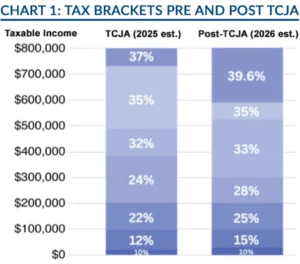
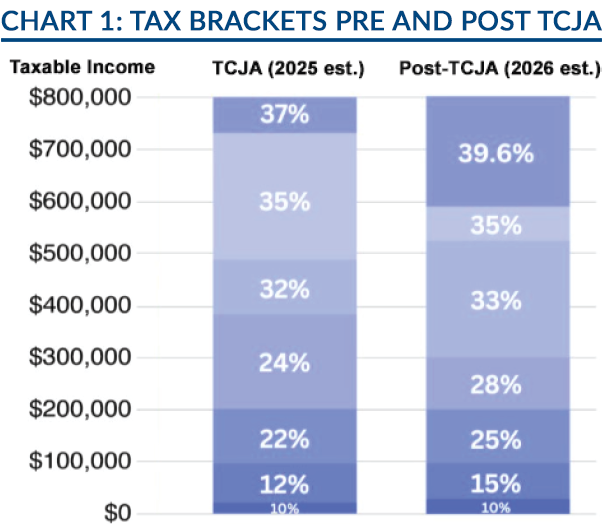
High income earners at top brackets can convert now before rates sunset at the end of 2025. Depending on a client’s overall financial situation, it may make sense for high-income earners to consider conversions at 37% today which is still more favorable than the anticipated top tax rate reversion back to 39.6% in 2026. (This provision within the Tax Cuts and Jobs Act of 2017 expires at the end of 2025.)

What are some important considerations when implementing a Roth conversion?

Cash is available for tax payment. Cash is available outside of qualified accounts and not needed for living expenses.

Higher taxable income can result in increased Medicare insurance premiums. For those who are paying Medicare premiums for Part B and D, a Roth conversion will increase taxable income which could affect the Income-Related Monthly Adjustment Amount (IRMAA) that future premiums are based on. Note – the benefits of tax-free compounding on a Roth IRA for an owner’s lifetime can outweigh the additional premium dollars that are spent.

Consider Net Investment Income Tax. Clients need to be aware that a conversion that increases their Modified Adjusted Gross Income (MAGI) levels over $200K (Single) or $250K (Married filing joint) will be subject to the 3.8% “net investment income tax” (Medicare surtax).

Our tax planning tools can help estimate the optimal amount for conversion based on each client’s unique situation. Please contact your Wealth Advisor to help evaluate a Roth conversion strategy that may enhance your wealth plan.