New Wealth – Strategies for Financial Windfalls

National Championships, Inheritances and Retirement have One Thing in Common

In January 2026, Fernando Mendoza, the Indiana Hoosiers’ Heisman–winning quarterback, led an historic run to a National Championship. While the victory secured his place in the record books, it also fundamentally shifted his balance sheet. Overnight, his NIL (Name, Image, and Likeness) valuation spiked to an estimated $2.6 million. This can already be seen in the new partnerships he’s secured with Taco Bell, LinkedIn, and Adidas, among others.

To the casual observer, this is a sports story. To a Wealth Manager, this is a Liquidity Event that results in Sudden Wealth.

Whether it is a $2.6 million endorsement deal, a $3 million inheritance, the sale of a business or retirement, the challenge remains the same: A substantial increase in one’s investable wealth is not spendable income like a salary – it is finite investable income producing capital that will benefit from a comprehensive Wealth Planning strategy.

The Anchor of Every Plan: A Planned Withdrawal Rate

The most common mistake after receiving a windfall is viewing the lump sum as a “spending fund” rather than an “income engine.” To determine if a windfall can support a lifestyle, wealth recipients and their advisor can use either the Traditional Withdrawal Rate (TWR) or the Perpetual Withdrawal Rate (PWR).

Traditional Withdrawal Rate (TWR)

  • The Traditional Withdrawal Rate sets the highest distribution of dollars that one can withdraw in the first year of retirement (or other source of new wealth) which can be adjusted for future inflation through a preset time period (30 years, 40 years, etc.) with high confidence (greater than 90% achievable based on history).

  • This is often referred to as the “4% Rule” as the initial dollar amount was thought to be 4% of the total wealth supplying the income withdrawals. However, Tanglewood’s research shows that the initial percentages vary with both the time period for which the income is intended and the strategic asset allocation (Investment Policy) that one chooses to govern the investments.

  • Many of those experiencing sudden wealth gravitate to the TWR for its predictability of inflation–adjusted income.

Perpetual Withdrawal Rate (PWR)

  • This method of withdrawing income from a portfolio is more ideal for multi–generational wealth. The goal is not to maximize a stable inflation adjusted income for a set time period but to ensure that the wealth itself is maintained indefinitely with appropriate withdrawals.

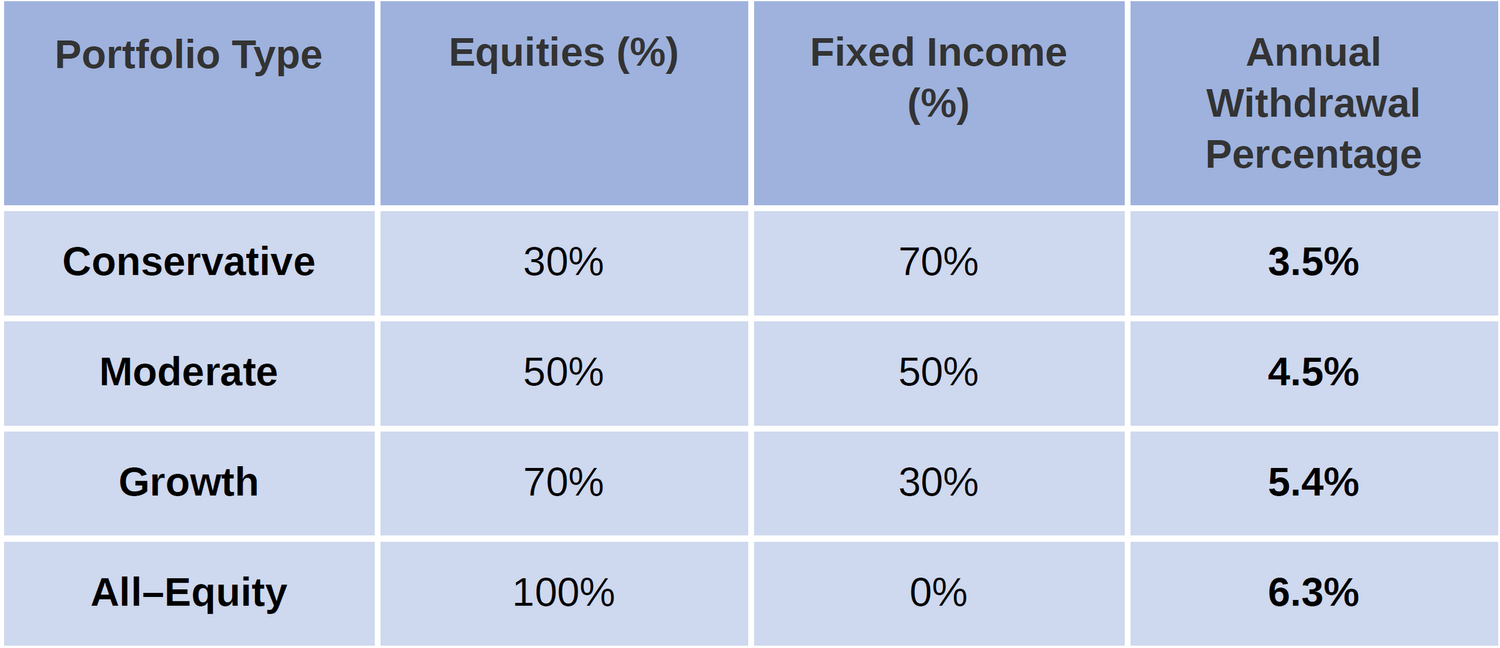
  • This method sets an annual percentage that can be distributed from the portfolio. The percentage is determined by the strategic asset allocation chosen. Because the portfolio value changes annually with market conditions, the percentage withdrawal in any particular year is set by the past year’s investment performance of that asset allocation. The annual withdrawals from this method are more variable but also more sustainable over long, indefinite time periods.

  • In Tanglewood’s most recent book, Perpetual Wealth: Strategies for Financial Freedom, the annual percentage withdrawal rates for four of our Investment Policies based on the beginning portfolio value are:


Why Windfalls Threaten Portfolio Integrity

A windfall often provides a false sense of security. If no plans are made for how much can be safely withdrawn from the total portfolio – based on either TWR or PWR – the overwhelming tendency is to spend too much money and deplete the portfolio (and its earning capacity) over time.


Disclosures

Grandparent-Owned 529 Plans

A 529 plan is a popular savings vehicle that is used to save for future college expenses. It offers the benefit of tax-deferred growth and tax-free withdrawals for qualified education expenses. Typically, a parent owns the 529 plan for the benefit of their children. Less common are grandparent-owned 529 plans for the benefit of their grandchildren.

Increasingly, though, we are having conversations with grandparent-clients who are interested in setting funds aside for their grandchildren’s college. Changes over the past couple years have reduced the negative effects grandparent-owned 529 plans on financial aid, and scholarships.

Financial Aid

Federal financial aid includes grants, work-study, and loans. The Free Application for Federal Student Aid (FAFSA) form is completed annually and used by most public colleges to determine how much federal financial aid a student is eligible to receive. Many private colleges also require the College Board’s College Scholarship Service Profile (CSS Profile) for their own financial aid.

What Changed?

Previously, the grandparent-owned 529 plan assets were not reportable on FAFSA, but when distributions were made to the student to pay for college expenses, the distribution was counted as the child’s income, which consequently had the greatest negative impact on financial aid.

Under current federal rules, neither the account balance nor distributions from a grandparent-owned 529 plan are reportable on FAFSA. This is a big benefit for students who attend public colleges with the intention of using some form of financial assistance.

Things to Consider

  • If you have a grandchild who attends a private college that requires the CSS Profile, the grandparent-owned 529 plan—similar to parent-owned 529 plans—will be treated as an available resource, resulting in a reduction of the school’s own financial aid offer.

  • Grandparents keep full legal ownership and control of the grandparent-owned 529 plan, allowing them to decide when and how much to contribute, direct investments, choose withdrawal timing, and even change the beneficiary.

  • Contributions to a 529 plan can reduce the grandparent’s taxable estate since 529 plans are excluded from estate tax. Also, depending on the state a grandparent lives in, they may be eligible for state income tax benefits (e.g., tax credit or deduction) for contributions they make to their grandparent-owned 529 plan.

  • As owner of the 529 plan, the grandparent can take back the money by distributing it to themselves. However, the earnings portion on distributions—that are not used for qualified education expenses— is subject to ordinary income taxes plus a 10% penalty.

  • Saving for your grandchildren’s education can potentially give their parents the opportunity to focus more on saving for their own retirement and other financial goals. However, a natural concern is that parents could consciously or subconsciously dial back their own saving efforts.

Striking the Right Balance

Grandparent-owned 529 plans are one of the more tax-efficient and legacy oriented tools available. The key is treating them as a coordinated piece of a broader family wealth strategy rather than a standalone solution. That starts with conversations between grandparents and parents, setting clear expectations, transparency, and integration with the parents’ own educations savings efforts.

As always, reach out to your Tanglewood Wealth Advisor if you would like to discuss a grandparent-owned 529 plan to help save for your grandchildren’s education.

Disclosures

Staying Safe from AI Scams

One of the fastest-growing risks today is fraud made more convincing by artificial intelligence, or AI.

Obviously, scams are nothing new. What IS new is how real they can feel. Technology now allows scammers to sound polished, personal, and even familiar. Messages that look like they came from a bank, phone calls that sound like a family member, or even missed-delivery text messages seem harmless at first glance.

The good news is you don’t need to deeply understand the technology to protect yourself.

Almost every scam we see has one thing in common…pressure. The message might say your account or PC is at risk, a loved one is in trouble, or something needs to be handled immediately.

If you ever feel pushed to act quickly, that’s your sign to stop. Take a moment to slow down and contact a trusted family member or reach out to us so we can help you think it through.

One of the more unsettling changes we are seeing is just how convincing messages can be. AI can now mimic writing styles and even voices, which means a call may sound exactly like a relative who seems to be in trouble. In those instances, hang up and call them back using the number already saved in your phone.

It can also help to put a few simple safeguards in place ahead of time. With how quickly technology has evolved over the last decade, there are now many ways to stay connected with friends and family. Location-tracking features like Apple’s Find My or apps such as Life360 allow you to see real-time locations and check in for added peace of mind.

Another helpful strategy is to create a simple family “safety word,” something only your family knows to use if a situation ever feels urgent or unusual. Most importantly, have these conversations ahead of time. As AI continues to develop, staying connected and prepared as a family makes a real difference.

Strong passwords are one of the easiest ways to protect your accounts, but we know they can be a pain to remember. That’s where password managers can help. A password manager securely stores your passwords and can create strong, unique ones for each account, so you don’t have to remember them all or reuse the same password everywhere.

You can use built-in options from Apple or Google, or third-party apps like Dashlane or 1Password. Each has its pros and cons, but the most important thing is choosing one and consistently using it to create unique passwords for every account.

When used alongside two-factor authentication, password managers add an extra layer of protection and reduce the stress of keeping track of logins.

Another login method you may start hearing more about is something called passkeys. Passkeys are designed to replace traditional passwords altogether. Instead of creating a password that a website has to store and protect, your device (like your phone or computer) creates a unique, highly secure digital key that never leaves your device. When you log in, you simply confirm with Face ID, Touch ID, or your device PIN, and the key securely verifies it’s really you. Because there’s no password to type, steal, reuse or store, passkeys are more resistant to phishing scams and data breaches. They can feel unfamiliar at first and aren’t available on every website yet, but when offered, they offer a greater level of login protection and security.

If you ever receive a message or call that raises questions, please reach out. Protecting your financial security means protecting you, and we take that responsibility seriously.

Charitable Giving Rules Are Changing in 2026

Tanglewood clients are an incredibly charitable group. I can honestly admit I have grown to be a more cheerful and generous giver after working with clients over the past two decades.

Our conversations with clients encompass not only the client’s overall purpose and goals for giving but the detailed strategies to accomplish them in a financially smart way within an ever-changing tax environment.

In July, we discussed some of various tax law changes that came about due to the One Big Beautiful Bill Act (OBBBA). This article focuses on those changes directly related to charitable giving. There are a number of new rules taking effect this year and next year that may be meaningful as we approach planning for the end of the year and into 2026.

A Deduction for Non-Itemizers

This provision was first introduced in 2020 and 2021 under the CARES Act, but starting in 2026, taxpayers who do not itemize will be able to claim a universal “above-the-line” charitable deduction.

  • $1,000 for single filers
  • $2,000 for married couples filing jointly

This deduction applies only to cash gifts made directly to qualified charities (not to donor-advised funds or private foundations). It creates a meaningful incentive for more households to give, even if they take the standard deduction.

Itemizers Face a 0.5% AGI Floor

Starting in 2026, itemized charitable deductions must exceed 0.5% of Adjusted Gross Income (AGI) before a deduction can be applied.

Example: A client with $300,000 of AGI, the first $1,500 of their charitable giving will not count toward their deduction.

This may make “bunching” donations — grouping multiple years’ gifts into one tax year — a more valuable strategy.

Cap on Tax Savings for High Earners

Starting in 2026, taxpayers in the top 37% bracket will see the value of their itemized deductions (including charitable contributions) capped at 35%, reducing the tax benefit on each deductible dollar.

QCDs Retain their Benefits

Qualified Charitable Distributions (QCDs) from IRAs remain untouched and become a more valuable strategy moving forward. Taxpayers age 70½ and older can still distribute up to $108,000 annually per person (2025) directly from an IRA to charity. These gifts avoid AGI limits and provide a very tax efficient way to give. Especially for those clients subject to Required Minimum Distributions. Since the QCD is excluded from AGI, it is beneficial all the way to the 37% tax bracket.

Planning Opportunities

  • 2025 Advantage: Current rules allow unrestricted deductions, with no AGI floor or cap on deduction value (with the exception of the % AGI limitations on gifts of appreciated assets.) That makes 2025 an attractive year for clients to “front-load” larger gifts or fund donor-advised accounts to maximize itemized deductions.
  • 2026 & Beyond: Non-itemizers will gain a new incentive, while higher-income donors face reduced tax benefits on gifts. Strategies like QCDs, donor advised funds, and bunching donations will play a bigger role.

The changes expand charitable giving tax breaks for many households while limiting benefits for others. If charitable giving is part of your annual tax planning, 2025 may be the right year to act on larger gifts before the new limits take effect.

As always, reach out to your Tanglewood Wealth Advisor to discuss how to approach charitable giving strategies specific to your situation.

What Estate Planning Documents Do I Need?

Estate planning is often pushed to the bottom of the to-do list. If you are in your thirties or even twenties, focusing on your career or starting a family is often your primary focus.  The idea of building and passing along a legacy sounds like an abstract, far-off idea.

Regardless of where you are in life, there are steps you can take today that will protect you and your loved ones.

As a financial advisor and a former teacher, I work with a wide range of clients, many of them younger professionals. One of the most common misunderstandings I see is the belief that estate planning is only for people with significant wealth or those nearing retirement. But the fact of the matter is, if you’re an adult, you need some essential documents.

It’s important to note that financial advisors do not draft these documents ourselves. That is the estate attorney’s job. Our job is to educate and help you start thinking about the decisions that need to be made.   We take all the time needed to collaborate to make sure your estate planning strategy accurately reflects your family relationships, what you value most, and what you wish to leave behind.

Start with the Basics

In an ideal world, virtually everyone over 18 should have a last will and testament.

This is the foundation of most estate plans. A will is a legal document that lays out your instructions for what should happen to your assets when you die. It names the people or organizations you want to receive your property and appoints someone to carry out your wishes.

Your will can name guardians for your minor children, outline how debts and taxes should be handled, and even leave specific instructions for sentimental items or charitable gifts. But it doesn’t govern everything you own. Certain types of accounts and assets, like retirement plans, life insurance policies, or jointly owned property, pass automatically to the people listed as beneficiaries or co-owners, regardless of what your will says. That’s why it’s so important to make sure your beneficiary designations match your intentions and are kept up to date.

Without a will, the state decides who gets what according to its default rules. Writing a clear, legally valid will gives your loved ones a roadmap.

In addition, your estate plan should include the following documents:

Advance Directive or Living Will. This outlines your preferences for medical treatment if you’re in a terminal or irreversible condition and can’t communicate your wishes. It tells your healthcare providers and loved ones whether you would want life-sustaining treatment to continue or be withdrawn, and whether you want comfort care instead. This document supports your medical power of attorney by removing guesswork from deeply personal decisions.

Medical Power of Attorney. This appoints someone to make healthcare decisions for you when you’re unable to make them yourself. That includes choosing between treatment options, approving surgeries, or making end-of-life care decisions with your medical team. Like financial powers of attorney, you can name co-agents or successors if your first choice is unavailable. This is one of the most important documents for young adults. Parents are often surprised to learn they can’t legally make medical decisions for their college-aged children without one.

Durable Financial Power of Attorney. This document lets you appoint an agent to manage your financial affairs if you can’t. That could mean paying bills, handling taxes, managing investment accounts, or buying or selling property on your behalf. You can name more than one person to serve together or separately. Some documents are written to take effect immediately, while others become active only if you’re declared incapacitated. You can also limit what your agent is allowed to do or give them wide authority, depending on your situation and level of trust.

HIPAA Authorization. This gives the people you name the ability to access your private medical information and communicate with your doctors. Unlike the medical power of attorney, which gives decision-making authority, this is about sharing information. You can choose what types of information to release and who can receive it. It’s helpful if you want a family member or friend to be informed but not necessarily in charge of your care.

Guardianship Designation. If you have minor children or dependents with special needs, this document lets you name who should care for them if something happens to you and your co-parent. You can also specify how those children will be financially supported, whether through a trust, a designated account, or other resources. Without this document, the courts will decide who steps in, which may not align with your wishes.

Without these important “living documents”, your loved ones could run into legal and logistical roadblocks during the kind of medical emergencies that can happen at any age.

If you don’t have these documents at hand, don’t panic. I or another advisor on the Tanglewood team would be happy to talk you through what to consider. And don’t worry if you don’t yet own a lot of property or have a fairly straightforward financial life. Anyone will benefit from having a plan set ahead of time.

Even those who have these documents still need to keep them up to date. When I talk to new clients who have already created estate documents, they are often years or decades old. Estate planning isn’t a one-and-done activity. Life changes. Families grow. You might get married, have kids, change jobs, or accumulate new types of assets. Each of these moments is a good opportunity to check in on your estate plan.

The Best Time To Start Is Today

I try to encourage my clients to think of estate planning as a conversation that remains open and that we can return to at any time. You are making your wishes known and easing the burden on your loved ones. You may not think you have much to sort out right now, but your family still needs direction. Your estate plan is as much for them as it is for you.

Estate planning is a living process that changes with your life. If you have questions about how to get started, my door is always open.

One Big Beautiful Bill

The One Big Beautiful Bill (OBBB) was signed into law by the president on July 4th after making its way through congress. There are many new provisions regarding income taxes and some important updates to the estate tax laws that will impact many Tanglewood clients. Below is a summary of that we think are some of the most impactful.

  • The current seven tax brackets (10%, 12%, 22%, 24%, 33%, 35%, 37%) that were introduced by the Tax Cuts and Jobs Act of 2017 and set to expire in 2026 are made permanent. There’s also a small extra inflation adjustment for only the lowest three brackets.

Now of course it goes without saying that NOTHING is “permanent” when it comes to tax law. In this context permanent means there is no sunset or future expiration until some future Congress votes to change it.

  • On the deduction front, the standard deduction is slightly enhanced. Starting this year, it will be $31,500 for joint filers, $23,625 for head of household, and $15,750 for all other filers, inflation adjusted thereafter. An increase of $1,500 / $1,125 / $750 respectively.

  • The Pease Limit which took a 3% “haircut” on total itemized deductions for high income earners cancelled by the TCJA is now permanently repealed.

  • The use of Miscellaneous itemized deductions (primarily unreimbursed employee expenses, tax prep fees, investment-related expenses) is permanently repealed.

  • Mortgage interest deduction cap remains at $750,000 of principal.

  • The OBBB raises the controversial State And Local Tax (SALT) deduction cap to $40,000 for tax years 2025 through 2029. The cap gets only a 1% annual inflation adjustment each year over that period. However, the SALT deduction gets reduced back toward $10,000 as Adjusted Gross Income (AGI) exceeds $500,000. It is fully phased out at $600,000 of AGI. For those in that $500k to $600k AGI range, this becomes a very important planning threshold. The additional $100k of income can effectively raise taxable income by $130K.

  • There is a new 0.5% floor on itemized charitable contributions. This is like the phaseout for deductible medical expenses where you have to be above the floor to start taking a deduction.

Regardless of whether a taxpayer is taking the standard deduction or itemizing, there are several new “above-the-line” deductions.

  • A new $1,000 per taxpayer above-the-line deduction for charitable contributions ($2,000 for joint filers). We had a similar provision for a $500 deduction in 2020 to spur giving during COVID era.

  • Starting in 2025 and continuing through 2028, seniors age 65 and older will be allowed to deduct $6,000 per person ($12,000 for married filing joint). This too starts to get phased out when income exceeds $75,000 single / $150,000 joint filers and becomes fully phased out at $175,000 individual and $250,000 joint. Essentially the backdoor way of alleviating the tax on Social Security income. Essentially the backdoor way of alleviating the tax on Social Security income.

  • A maximum deduction of $25,000 applicable to “Qualified Tips”.  The IRS plans to publish eligible occupations within 90 days. This tip income however is still subject to employment taxes. The deduction is phased out at $300,000 AGI for married filers and $150,000 for others It’s fully phased out at $550,000 for married, $400,000 for others.

  • A tax deduction against overtime pay is also included. “Qualified Overtime,” is defined straightforwardly as pay in excess of a worker’s regular rate. The deduction is to $25,000 for joint filers and $12,500 for all others. This too gets phased out at $300,000 AGI for MFJ, $150,000 for others, fully phased out at $550,000 for MFJ, $275,000 for others.

Both the deduction applicable to Tips and Overtime is effective for 2025 and expires at the end of 2028.

Other notable changes include.

  • The increase in the Alternative Minimum Tax exemption amounts were made permanent, however exemption phaseout thresholds were reset back to what they were in 2018 – $500,000 for singles and $1,000,000 for married filing joint. It also doubled the rate of phase out from 25% to 50% steepening the claw back for higher income earners.

  • The OBBB allows a deduction up to $10,000 of interest paid on new car loans for US-assembled vehicles purchases made in 2025 through 2028.

  • The bill expands qualified 529 expenses doubling the K-12 withdrawal limit from $10,000 to $20,000. It also adds new categories of qualified expenses including online resources, tutoring, high school dual-credit fees, educational therapies for students with disabilities, and exam costs, such as SAT fees. Also, workforce training, on-the-job training, apprenticeships supporting students pursuing vocational or alternative educational paths.

  • A new tax-preferred savings account dubbed “MAGA Program” allows for the creation of a new account for qualifying children born between January 1, 2025 and January 1, 2029.  Up to $5,000 per year is allowed by a parent or guardian for children until 8 years old. The government will add $1,000 to see the account. There are specific qualifications for investing in broad market US Index stock funds.

Finally on the estate planning side of things the big news here is the lifetime estate and gift tax exemptions which were facing a significant reduction at the end of 2025 was permanently increased to $15,000,000 per person indexed to inflation beginning in 2026. That’s a combined $30,000,000 for spouses putting the threat of estate tax exposure for many clients further out on the horizon.

These new rules present new and meaningful planning opportunities for nearly all clients. At Tanglewood we are prepared to help – using advanced modeling tools and an experienced team of Wealth Advisors. Together we can develop a personal, multi -year plan to not only look year by year, but over a lifetime.

Disclosures

What To Do with Excess 529 Plan Funds

529 education savings plans are one of the most effective tools for funding future education expenses. But what happens when there’s money left over?

Maybe your child received a scholarship, chose a less expensive school, or simply didn’t use the full balance.  Whatever the reason, we often hear from clients who are wondering what to do with those unused 529 plan funds.

Thanks to evolving legislation and flexibility in 529 rules, there are several ways to repurpose these dollars—without triggering excessive taxes or penalties.

Here are some of the most practical options:

Change the Beneficiary

One of the built-in advantages of a 529 plan is the ability to change the beneficiary to another qualifying family member—income tax and penalty free. This can include:

  • Siblings

  • Cousins

  • Parents or grandparents

  • Even yourself (the account “owner”)

This is often the simplest solution if you have more than one child or want to help a relative with their education expenses. Note that there are gifting implications if the new beneficiary is in a lower generational level.

Use for Graduate School or Future Learning

Just because undergraduate studies are done doesn’t mean their education is. 529 funds can be used for graduate or professional degrees, trade schools, certain certifications, and even some continuing education.

Some families hold on to remaining balances for future learning opportunities, especially if the beneficiary is still early in their career.

Pay-Down Student Loans

The Secure Act of 2019 approved the use of up to $10,000 per beneficiary (and another $10,000 per sibling) to repay student loans. This lifetime cap was introduced to provide families with a tax-free way to reduce debt, even if traditional education expenses are complete.

Rollover to a Roth IRA

This is a really interesting new possibility. Thanks to the SECURE Act 2.0, beginning in 2024, 529 balances can be rolled into a Roth IRA for the 529 beneficiary, subject to a few important rules:

  • The 529 must have been open for at least 15 years.

  • Any contributions made in the last five years are ineligible for rollover.

  • The beneficiary must have earned income in the year of the rollover.

  • Rollovers are subject to the annual Roth IRA contribution limit ($7,000 in 2025).

  • There is a lifetime rollover limit of $35,000 per beneficiary.

While $35,000 may not seem like a lot, if invested early and allowed to grow tax-free over decades, it can grow to a meaningful number. In many ways, this option turns unused education dollars into a powerful jumpstart for retirement.

Use the Funds Yourself

If you (the account owner) are contemplating a return to school—whether for career growth or personal enrichment—you can change the beneficiary to yourself. It’s a creative but completely allowable use of the funds. An art collection course in Paris might be in your future.

Withdraw the Excess (Last Resort)

If none of the above options make sense, you (or the beneficiary) can always simply withdraw the unused money. Only the earnings portion of a non-qualified withdrawal is subject to income tax and a 10% penalty. The original contributions are never taxed or penalized.

The income tax responsibility falls with whoever receives the funds – either the account owner or beneficiary. If early in their working career, a non-qualified distribution to the beneficiary may be taxed in a very low tax bracket.  

Note however, if the funds are being withdrawn because the beneficiary received a scholarship, the 10% penalty is waived (though taxes still apply to earnings).

Many clients are unaware of the flexibility they have with leftover 529 balances. Whether it’s helping other children in the family, supporting financial independence, or maximizing long-term wealth opportunities there are several options to consider.

As always, your Tanglewood advisor is here to help evaluate those options and create a plan that fits your unique situation.

Empowering Women Through Private Wealth Management

Financial freedom means having the clarity and confidence to make decisions that reflect your life, not just your balance sheet. Private wealth management can help women navigate life’s transitions and shape their future on their terms.  

When I sit across the table from a woman stepping into full control of her finances for the first time, I see someone who wants to know if she will be okay.

Through years of helping women with life’s big transitions, whether divorce, widowhood, or retirement, I have seen that true financial freedom goes well beyond a specific dollar amount in an investing account. Freedom means knowing you have options, knowing you have support, and most importantly, knowing you do not have to face the future alone.

Financial freedom is having enough to choose your future, not just survive. Women navigate financial challenges that are fundamentally different from those that men face. Mothers must balance raising children against their careers. They are also disproportionately called on to care for aging parents. Every woman makes their own choices about these realities. I work with women who strategically plan for longer careers to ensure they can support the retirement lifestyles they envision, as well as those who are committed to maintaining their financial independence should they outlive their partners.

There are no wrong choices. But well-managed private wealth empowers these women to shape their lives on their terms instead of being pushed down paths they would not have chosen.

Our job is to listen to those choices and share whatever guidance or resources women need to make their goals a reality. And part of that is building trust and making room for questions. I never want one of my clients to feel embarrassed about asking a question. Whether it is about a type of investment, required minimum distributions, margin loans, or just how to read or understand a statement, every question deserves respect.

Women are savvy, financially disciplined investors. But until recently, we were not always prioritized in financial education and family discussions around money. My female clients often come to me unsure of what they do not know. Empowering them is creating an environment where they feel secure enough to ask the important questions they have and gain the clarity they need.

Women influence financial outcomes more than they realize. Women’s opinions and instincts matter even in couples where the husband leads the conversations. I always make a point of paying attention to the wife in meetings, even when she is quiet. Women are often the ones guiding family decisions behind the scenes. Understanding that unspoken influence and ensuring women feel equally heard and respected is a key part of good and effective advising.

Over the last few years, more of my work is with women – highly successful professionals facing the complex demands that come with growing wealth, and some who are navigating the complexities of inherited wealth after losing a spouse. By helping them understand what they have, what steps to take, and the decisions ahead – at a pace that feels right for them – I provide them the clarity and confidence to move forward with peace of mind.

Is a Family Loan the Right Wealth Transfer Strategy for You?

The Great Wealth Transfer is already underway. Sometimes it takes the form of carefully structured estate plans and inheritances. More often, it is through the Bank of Mom and Dad.

Parents are choosing to pass down wealth during their lifetime, actively supporting their children’s financial journeys. Many are stepping in as lenders, providing assistance when it’s needed most. They arrange intrafamily loans to help their children buy homes, start businesses, and invest in their future. This quiet shift is reshaping how wealth moves between generations, and it comes with both opportunities and risks.

More families are choosing to transfer wealth during their lifetime, often in the form of low-interest or no-interest loans. It allows them to:

  • Provide financial help when their children actually need it.

  • Avoid some of the red tape, underwriting headaches, and high interest rates that come with traditional lenders.

  • Retain some control over the money while still supporting their kids’ financial independence.

We often work with parents to define the structure and terms for  these loans. There are agreed-upon interest rates and repayment periods, just like any other structured financial agreement. But unlike a loan with a financial institution, a family loan can pull double duty as a lower-stakes gauge of a child’s financial health, or a gift that is forgiven over time.

A Loan Today, a Gift Tomorrow

Many parents approach these loans as a way to start wealth transfer while still maintaining flexibility. They lend money at a low IRS-determined  interest rate. If the loans are below that threshold they are potentially looked at as gifts. Children benefit from market growth in excess of the loan rates, keeping the wealth transfer tax-efficient.

For example, a parent might loan a sum of money to their child at a low fixed interest rate. The child reinvests that money and the long term growth stays with the child, outside of the parent’s estate. Over time, the parents may further forgive portions of the loan, effectively turning it into a tax-advantaged gift.

That said, parents need to be financially secure themselves before making these kinds of arrangements. The first priority in any wealth transfer discussion is ensuring that parents won’t jeopardize their own retirement by being too generous too soon.

The “Training Wheels” Strategy for Heirs

Another common reason families choose to lend first, rather than gift outright, is to test financial responsibility. Some parents worry about how their children will handle a sudden influx of money, especially if they haven’t managed large sums before.

Many of our clients use gifts or loans to fund investment accounts to introduce their heirs to wealth management. If a child mismanages the money, it gives parents time to reassess before passing down more significant assets.

We have found this approach also helps to introduce your children to the idea of working with a financial advisor. The hands-on guidance of an advisor creates an extra layer of support to guide your heirs toward better financial choices and outcomes.

Not every family should rush into intra-family loans. The best strategies depend on your financial situation, tax planning considerations, and family dynamics. But if you’re thinking about supporting your children while you’re still alive, it’s worth having a structured conversation about the best way to do it.

A financial advisor can help you evaluate:

  • Whether lending money aligns with your long-term financial security.

  • How to structure loans for maximum flexibility and tax efficiency.

  • What protections (like trusts or loan agreements) can help safeguard both parties.

If you’re considering helping your children now rather than waiting to pass down an inheritance later, we are always available to guide you through the options. Let’s make sure the next chapter of your family’s wealth story is built on a solid foundation.

The Power of a Personal Letter in Your Estate Plan

The passing of a beloved family member is often an emotional and stressful time. By adding a personal letter to your estate plan, it can offer your loved ones valuable insight, comfort, and clarity when carrying out your wishes. It is an opportunity to convey both practical instructions and your personal sentiments in a meaningful way. Here are some key items to consider:

Personal Message or Reflections

This is often the most heartfelt section, where you express your love, pride, and gratitude toward your family and loved ones. This can also include a reflection of your life, lessons you want to impart, and shared memories that you cherish.

Purpose of the Estate Plan

Explain how your estate plan was designed and why certain decisions were made. Reassure your family that these were made with careful consideration. For example, if a Corporate or Co-Trustee was incorporated to act with a child until they reach a certain age, your intentions could be to help build guardrails so that they learn how to manage their inheritance wisely before they become Sole Trustee of their own Trust.

Family and Relationship Guidance

Some people state their intentions and ask families to support one another, resolve any conflicts peacefully, or remind them to honor longstanding traditions and family values. For example, one client specifically expressed his desire for his children to consider investing a portion of their inheritance on experiences that will allow them to spend time together and invest in physical property that will routinely bring the family together. For another, instructions were made to ensure that a disabled child is included in family events and regular visitation in the facility where they reside.

Philanthropic Wishes

This is where you can express what charities or organizations had a special significance or positive impact on your life, if named in your Will or through an existing Donor Advised Fund or Family Foundation.

Funeral and Burial Instructions

You can provide guidance on how you would like your funeral or memorial to be handled, whether you prefer to be buried in a cemetery, or cremated and have your ashes scattered, as well as include music or service preferences.

Executor and Trustee Notes

You can provide a list of appointed individuals and financial professionals who can assist your family in properly settling your estate per your plan and wishes.

Disclosures