Is the Message of Gold’s Meteoric Rise Concerning?

It is a great feeling to own an asset when its price surges. Gold may at least partially be an exception. Most everyone knows that gold serves as a disaster hedge…or a severe inflation hedge…so does gold’s explosive gains signal something we should be concerned about?

While anything is possible, gold’s rise today is troubling primarily in the context of geopolitical rivalries.

America has been the dominant power in the post-cold war period. Much of that power is economic in that we are the largest economy and hold the primary reserve currency, the Dollar. This gives us enormous leverage in international trade as almost 80% of all cross-border transactions are priced in Dollars (even when the U.S. is not on either side of the trade.)

International trade in Dollars is conducted via the Society for Worldwide Interbank Financial Telecommunication (SWIFT) system. The willingness of America to provide liquidity to this system is of immeasurable importance to the world. Cutting off countries from SWIFT – as the West did with Russia after it invaded Ukraine – is an enormous handicap to their ability to trade.

China has long thought that this system gave the U.S. too much power (even to sanction China itself in a trade battle.) Their financial system lacks the depth and openness required, and the yuan remains too tightly controlled by the state to serve as a significant reserve currency. Yet they want another option to conduct trade rather than relying on the SWIFT system.

Enter gold, already the second biggest reserve “currency” behind the Dollar. In the last two years, China has become the world’s marginal buyer of gold according to Bloomberg. David Kotok of Cumberland Advisors points out that the Chinese have set up an alternate to the SWIFT system known as CIPS. CIPS issues tradeable warrants backed up by China’s growing hoard of gold.

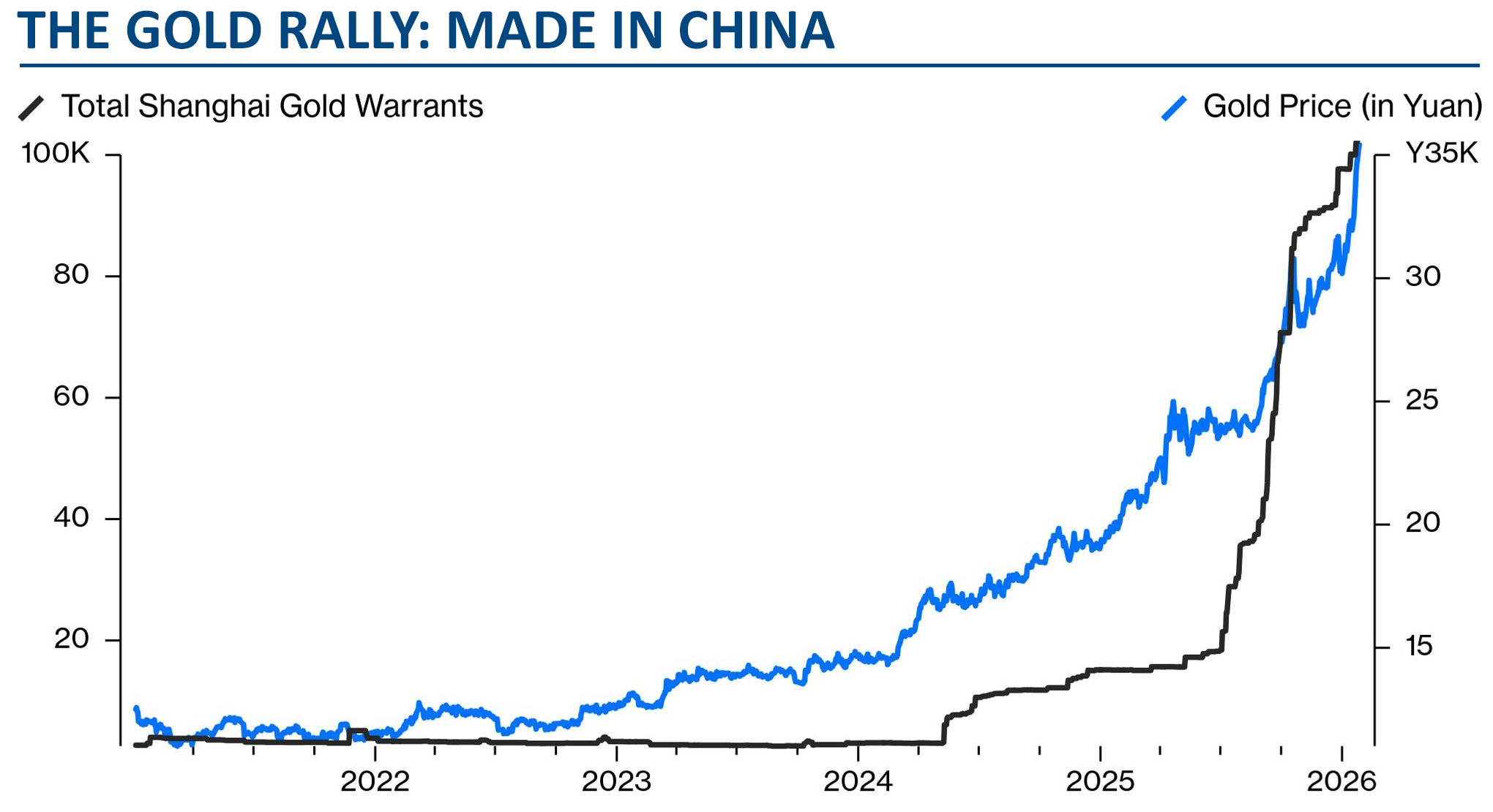
Use of the CIPS system is growing fast and is now used in 30 countries. Its only limitation is the amount of gold in its vaults. That is why China keeps buying. The big price gains also increases their CIPS capacity. In other words, they are not price sensitive. As shown on the chart below, both the price of gold in Yuan and the number of warrants issued have gone ballistic.

This allows China to influence and control more international trade which provides more security for them. It also supports Dollar weakening which has been occurring for over a year. U.S. protectionism (tariffs) accelerates the process.
It is a great feeling to own an asset when its price surges. Gold may at least partially be an exception. Most everyone knows that gold serves as a disaster hedge…or a severe inflation hedge…so does gold’s explosive gains signal something we should be concerned about?

While anything is possible, gold’s rise today is troubling primarily in the context of geopolitical rivalries.

America has been the dominant power in the post-cold war period. Much of that power is economic in that we are the largest economy and hold the primary reserve currency, the Dollar. This gives us enormous leverage in international trade as almost 80% of all cross-border transactions are priced in Dollars (even when the U.S. is not on either side of the trade.)

International trade in Dollars is conducted via the Society for Worldwide Interbank Financial Telecommunication (SWIFT) system. The willingness of America to provide liquidity to this system is of immeasurable importance to the world. Cutting off countries from SWIFT – as the West did with Russia after it invaded Ukraine – is an enormous handicap to their ability to trade.

China has long thought that this system gave the U.S. too much power (even to sanction China itself in a trade battle.) Their financial system lacks the depth and openness required, and the yuan remains too tightly controlled by the state to serve as a significant reserve currency. Yet they want another option to conduct trade rather than relying on the SWIFT system.

Enter gold, already the second biggest reserve “currency” behind the Dollar. In the last two years, China has become the world’s marginal buyer of gold according to Bloomberg. David Kotok of Cumberland Advisors points out that the Chinese have set up an alternate to the SWIFT system known as CIPS. CIPS issues tradeable warrants backed up by China’s growing hoard of gold.

Use of the CIPS system is growing fast and is now used in 30 countries. Its only limitation is the amount of gold in its vaults. That is why China keeps buying. The big price gains also increases their CIPS capacity. In other words, they are not price sensitive. As shown on the chart below, both the price of gold in Yuan and the number of warrants issued have gone ballistic.

This allows China to influence and control more international trade which provides more security for them. It also supports Dollar weakening which has been occurring for over a year. U.S. protectionism (tariffs) accelerates the process.

Source: Cumberland Advisors, Bloomberg

Gold is not the only asset impacted by this rivalry of great powers and the systems that support them. The recent trade negotiations with China showed that they also have leverage over the U.S. and the rest of the world with rare earth mining and refining. This has led to an all-out campaign by America and others to increase our supply and refining capabilities.

This sudden change from efficient, just-in-time supply chains toward self-sufficiency and security has also impacted the price of semi-precious metals like silver, platinum, and palladium where year-on-year price gains have greatly exceeded that of gold.

Base or industrial metals such as copper, nickel, and aluminum have also experienced huge price gains over this period. These are fundamentally important materials for domestic manufacturing — in peacetime but more importantly in any war or threat of war.

In summary, the massive gain in the price of gold appears to be part of a larger story of a new global order where each side believes it must provide self-sufficiency for its own security. China led the world down this path with its 2015 plan that called for Chinese dominance and/or self-sufficiency by 2025 in the 10 major areas it believes critical. Much of this has already been achieved. This accompanied a massive military buildup.

Gold is a major part of China’s plan. Higher prices for the reserve currency metal are a plus, not a minus, as it builds its reserves faster and with less capital actually spent. That does not mean they will not from time to time pull back their buying, but the price will likely remain on an upward path so long as this plan continues in place. Ed Yardeni last year’s appreciation dinner speaker, has forecasted (since 2023) that gold will reach $10,000/oz by the end of 2029.
Source: Cumberland Advisors, Bloomberg

Gold is not the only asset impacted by this rivalry of great powers and the systems that support them. The recent trade negotiations with China showed that they also have leverage over the U.S. and the rest of the world with rare earth mining and refining. This has led to an all-out campaign by America and others to increase our supply and refining capabilities.

This sudden change from efficient, just-in-time supply chains toward self-sufficiency and security has also impacted the price of semi-precious metals like silver, platinum, and palladium where year-on-year price gains have greatly exceeded that of gold.

Base or industrial metals such as copper, nickel, and aluminum have also experienced huge price gains over this period. These are fundamentally important materials for domestic manufacturing — in peacetime but more importantly in any war or threat of war.

In summary, the massive gain in the price of gold appears to be part of a larger story of a new global order where each side believes it must provide self-sufficiency for its own security. China led the world down this path with its 2015 plan that called for Chinese dominance and/or self-sufficiency by 2025 in the 10 major areas it believes critical. Much of this has already been achieved. This accompanied a massive military buildup.

Gold is a major part of China’s plan. Higher prices for the reserve currency metal are a plus, not a minus, as it builds its reserves faster and with less capital actually spent. That does not mean they will not from time to time pull back their buying, but the price will likely remain on an upward path so long as this plan continues in place. Ed Yardeni last year’s appreciation dinner speaker, has forecasted (since 2023) that gold will reach $10,000/oz by the end of 2029.
Recognizing Reality…and Responding to it NOW

Is there anyone left in the country who still believes that we can continue the social benefit promises currently in place without change? Today, over 60% of all federal tax collections go to the major social programs including Social Security, Medicare, and Medicaid. Based on current projections, that percentage will keep rising until eventually exceeding 100%.

Those like myself that have preferred limited government and staying close to the historic percentage of government taxes have to deal with this reality (in addition to the significant increase needed in defense spending).

Either benefits must be reduced, or taxes must go up, or some combination of the two to avoid a financially destabilizing debt crisis and severe cuts to benefit programs. Either of which could easily lead to severe social unrest, even worse than that experienced in France today over these issues.

The Republican party refuses to raise taxes while the Democratic party refuses to reduce benefits. And so, despite a building crisis, we have a stalemate. While a crisis is unlikely this year, at some point ahead it will happen without major changes. A bipartisan compromise is the better course. Such a compromise was reached once before with the Greenspan Commission in 1983.

What might such a compromise look like? Here are some of the realities that would have to be addressed.

  • The over age 65 segment of our population was the poorest demographic group in 1960 yet is now the richest.

  • Those retired are growing rapidly compared to our workforce growth. This will continue for years ahead due to the advances in longevity and our below replacement birth rate.

  • The spread between the top 10% of wage earners and the other 90% is now the highest in history while the highest income tax rate is lower than its post WWII average.

  •  Social Security’s annual benefit increases have risen far more than inflation over time and continue to do so.

  • Asset owners (homes, equities, others) have done far better than non-asset owners yet have more favorable tax treatment.

Based on these realities, the following would be among the realistic changes called for in a grand bargain.

  • Means-test Social Security (SS) Benefits. Reduce benefits paid to high-income recipients. (Eliminate the fiction that SS is a pension.)

  • Change the inflation calculation. Currently, the annual increase in Social Security is based on the average increase in prices for a certain subset (30%) of workers. Replacing it with the BLS’s “chained CPI” reflects the substitution effect of consumers switching to lower priced products when prices rise. This better reflects the inflation experienced by retirees.

  • Move the age for Medicare to 67 (at some point ahead). Medicare should recognize the same reality of longevity as SS. Pass legislation allowing private insurance to provide options to this age.

  • Reduce favorable tax breaks available mainly to the wealthy. The tax code is full of special tax incentives to the members of our society that need it least.

    • Eliminate carried interest rules that allow conversion of earned income to more favorable capital gains.

    • Return the top personal income tax bracket to 39.6% (from the current 37%). Our economy has shown it can perform well with taxes at that level.

    • Cap the step up in basis at death at no more than the estate tax exemption. (Eliminates the free ride on billions of capital gains avoidance.)

    • Cap charitable contributions to say $10m in any one year and $100m at death. The mega rich fund hundreds of billions of dollars into foundations for their interests whereas taxes are needed for the public interest, particularly to fund our obligations for social benefits, defense, and interest on the debt.

The American public will rebel against any changes to their benefits unless they are considered modest and fair compared with the changes to the wealthy.

The wealthy have done much better than the rest of the public, which accelerated after Covid. Although they already pay a disproportionately large share of taxes, their share of consumption continues to grow. This implies that their share of disposable income continues to outpace the non-wealthy even with today’s tax load.

We are moving steadily toward being an oligarchy where the “1% (or 0.1%)” controls the means of production, the distribution of incomes, and most capital investment. This is unhealthy for civil society and gives rise to the acceptance of socialist ideologies in our universities, our institutions (including foundations), and political candidates like Mamdani in NYC.

At one point, this was just the political fringe that deemed socialism an acceptable alternative. Yet this acceptance is growing rapidly among our young people—not because it has earned this acceptance anywhere it has been tried, but because of loss of faith in capitalism to share its benefits across the entire population.

In order for such a grand bargain to have staying power beyond one presidential administration, it would have to have large bipartisan majorities in both houses of congress. To achieve this, the wealthy from both parties would have to speak out in favor of it (both publicly and privately). Why would they support it? Because they are the biggest long-term losers if there is a civil or fiscal breakdown.

Of course, some provisions would need to be phased in over a period of years to allow both individuals and the economy to adjust without major disruption. In addition, the new revenues would need to be directly or indirectly applied to reduce deficit spending through budget and social benefit controls agreed to by a large bipartisan majority.

There is no doubt that most observers will contend that a grand bargain could never happen. Certainly, others have tried to craft a grand bargain and failed. But time is running out on our having control over the meaningful changes needed before unplanned and unwanted changes are forced upon us by a social and fiscal crisis.

New Geopolitical Realities Require Change

The geopolitical backdrop has radically changed from the one dominated by America and the other Western powers after WWII. Fukuyama’s End of History (1992), after the fall of the Berlin Wall and the U.S.S.R, declared that communism/mercantilism had forever been “defeated” by democracy/capitalism. That celebratory mood left us overconfident and unprepared for a highly competitive future.

The return of the communist/mercantilist ideologies by today’s triumvirate of authoritarian rulers (Xi Jinping in China, Vladimir Putin in Russia, and Kim Jong Un in North Korea) along with their combined military might and economic power has forced a reevaluation of our relationship with the world as well as our most basic expectations from our government, our educational institutions, and corporate America.

Such changed expectations are not new. In fact, we have lived through several periods of major change over the last century.

President Calvin Coolidge (1923-1929) once said, “The business of America is business.” This was consistent with how America saw itself into the early 1960s. In 1953, President Dwight Eisenhower’s Vice President, Charles Wilson (former CEO of GM), famously said, “What is good for GM, is good for America”.

During that period, America’s industrial might was seen as a benefit to all Americans – employees, communities, and shareholders…and supported American’s pride in the country. The 1960s brought on many changes. Social issues rose to center stage including racial tensions, women’s rights, unease with the war in Vietnam, air and water quality, and the “war on poverty”. America began to question itself and its values, including the roles played by business, government and education.

Our federal government focused at home on the “Great Society Programs” that greatly expanded benefits for those considered in need. As time went by, most of these programs expanded well into the middle class and even the upper class.

At the same time, American businesses began to change in other ways. The new interstate highway system allowed business the freedom to move to more desirable locations – mainly away from the unionized states in the north to the “right to work” states in the south. The northern industrial base became the so-called “rust belt” as manufacturing relocated.

As the industrial base was leaving, the focus in northern states shifted to white collar jobs. This in turn led educators (mostly from universities in the northeast) to develop a new educational curriculum referred to as the “college preparatory track”. Under this curriculum, every child would be prepared to go to college.

As unrealistic as this was, it was adopted country wide. It led to a new societal attitude that white collar careers were superior to blue collar ones. Traditional trade jobs lost educational support for the decades that followed which eventually depleted the supply of skilled trades. (This bias continues even though many trade jobs pay 2 times to 3 times that of the average college graduate and without the corresponding cost/debt.)

America’s businesses became less and less associated with specific communities. Corporations were no longer “the local employer”. Instead, businesses became a means to an end. Communities started competing for new businesses while shareholders began evaluating companies by how well they navigated this new landscape through their earnings growth.

The late 1960s became known as the “go-go era” with companies forming conglomerates in a race for profit growth. Stock investors turned away from the industrial powerhouses of the past generation toward the most successful at delivering profits. The most successful became known as the “Nifty Fifty”.

Nobel prize winning economist and market observer Milton Friedman codified this new approach to shareholding with his famous dictum on free market capitalism, “the sole purpose of a public company is to benefit its shareholders” (the owners). From that time forward, stocks have been evaluated primarily on the growth of their earnings and dividends.

The 1970s and 1980s were characterized by the rapid growth of Japan and the Asian tigers (South Korea, Taiwan, Hong Kong, and Singapore). They had a low-cost labor force that benefitted from another innovation in transportation (like the interstate highway system earlier) – the packaged ocean carrier. This innovation allowed a product to be packed once (in a pod container) and travel by ocean, train, and truck to be opened only at the end of its journey by its final user. This dramatically reduced international shipping costs.

American corporations, with only the mandate to increase earnings growth, jumped on the opportunities that globalization offered.

Once China joined the Asian tigers, the possibilities from their massive population seemed limitless. This time, American businesses hollowed out much of the southern manufacturing base as they invested abroad…particularly in China.

(Our government took a laissez faire attitude that it was best for the economy. However, Ross Perot received 10% of the vote for president in the 1992 election – the most ever for an independent candidate – on the grounds that such moves would hollow out our entire economy.)

For its part, China did not play fairly. They forced technology transfers from their American “partners”, put an array of restrictions on our ability to penetrate their local market, and heavily subsidized their state-owned enterprises (SOEs) in industries they wanted to dominate.

This was made clear in 2015 with the introduction of their “Made in China 2025 Policy”. This was a state led industrial policy whose goals were to have their domestic companies dominate ten key industries including high tech manufacturing, aerospace, energy equipment, and critical materials by this year. This program has been highly effective in those areas.

American consumers did benefit from the lower costs available from Asian manufacturers. However, the former American employees that lost their jobs were forced to find new ones. In many cases, the only replacement jobs available were in service industries such as finance, health care, leisure and travel, technology, engineering, etc. Many who lost their jobs had no background, training, or desire to enter such fields.

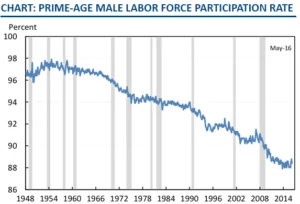
Discontent with this changing job and social environment has grown in the twenty-first century. Many displaced workers that did not find jobs fell out of the U.S. workforce. The percentage of men in the prime ages of 25-54 not working jumped from 2.0% in 1954 to about 11% in 2024 (approximately 12 million men). See Chart.

Source: Bureau of Labor Statistics, Current Population Survey; CEA calculations

In addition, we discovered during the pandemic that many of the health care supplies, car parts, and computer chips we depend on were no longer available when China shut down as there were few U.S. manufacturers still in those businesses.

This was a wakeup call which drew overdue attention to basic questions of national security. If global supplies were cut off because of a confrontation with China, how well and for how long could we defend ourselves or our allies? Would we have the needed access to all the components that make our economy run?

Corporate America’s almost sole focus on the consumer benefits, lower costs, and higher profits from globalization had done wonders for our overall economy, high income earners, and stock market but left us exposed to the growing risks from the authoritarian triumvirate.

America needs the workforce and basic manufacturing capabilities within our shores or those of our closest allies to maintain our basic needs for self-reliance and national defense. These must be priorities of our government, educational institutions, and corporate leaders.

Government. Federal tax, regulatory, and spending policies must focus on the specific goals of self-sufficiency and national security. The litmus test for any legislation should be… does it enhance our security? Those needs include cyber security, a secure electric grid, a technologically advanced military, stable finances, and secure access to all the parts and materials that keep our economy running.

Educational Institutions. It will be impossible to achieve these national goals without the workforce necessary to perform the necessary functions. Many of the jobs require highly specialized technical training within specific trades. Our K-12 public education system needs a much broader brush than the college preparatory track. The recent initiatives within some school districts to develop or expand trade training programs should be accelerated.

Business. The business of America is still business, but the goalposts have moved. No longer can focus on consumers, the lowest cost, and highest profit growth be the sole determinants of success. Securing America, and our way of life, must be the highest priority. Corporate leaders across all sectors should have this at the top of their mission statements. Business leaders must not allow the Vladimir Lenin quote to come true, “The Capitalists will sell us the rope with which we hang them.”

These changes needed in our government policies, education institutions, and business priorities rivals that of the 1960s. The changes from that period forward have focused on expanding our social programs, becoming much more inclusive, and growing profits and national wealth. We have had unquestionable success in each of these.

However, in various ways, government, educators, and business have gone too far.

  • The extent of our social programs on their current trajectories will overwhelm everything else our government provides.

  • Many university educators have fought harder for various inclusion metrics than for teaching the value and importance of western philosophy and institutions.

  • Both the higher incomes and the wealth created in our current economic structure have skewed disproportionately to the top 10% or even 1%.

The geopolitical backdrop has changed dramatically in the twenty-first century. China, Russia, and North Korea have eschewed working cooperatively within the post WWII economic system, particularly in the past decade.

They do not recognize, desire, or respect the democratic freedoms we enjoy: the rule of law, independent judiciary, freedom of the press and speech, assembly, and the separation of church and state. Instead, they agitate for their authoritarian, communist form of governing across the world. America, along with the rest of the free world, must act on the changes necessary to be self-reliant and secure in the face of this reality.

No one wants a hot war with China, the likely consequences of which would be a staggering change in everyday life, both here and there. Yet our intelligence agencies tell us that China is preparing the capabilities for war with the goal of being able to “win” (if there is such a thing) by 2027.

The best way to prevent a war is for your opponent to know you have the capability to “win”. In today’s world, we cannot just look at our military for that comfort. War in the twenty first century could take place on many fronts and we need to be prepared for all. Artificial Intelligence adds a whole new dimension to this challenge.

(The recent back and forth on tariffs is in part inspired by this adversarial competition with China. However, after 40 years the integration, our economies are so deeply connected that a complete decoupling today poses an existential threat to many American businesses. The moderation of tariffs is more a nod to the economic necessities of our current relationship than a change in the long-term needs for our national security.)

As investors, we also need to be prepared for a wide range of outcomes. Well diversified portfolios, like those we have at Tanglewood, are essential when changes and outcomes are unknown. Key ingredients include:

  • Technology stocks (and other productivity enhancers) – as they will lead into the future

  • U.S. Treasury bills and bonds – as they provide stability during economic setbacks

  • Infrastructure – as upgrades become a new means of competition

  • International stocks (outside of China) – as defense, technology, and utilities get much more funding than in the past

  • Real Estate – residential, REITs, and rental property as they offer non correlated benefits

  • Gold – as the ultimate disaster hedge as well as a growing reserve currency not issued by a single government

When the goals are well understood, American democracy and capitalism can meet any recognized challenge. Our entrepreneurs are the best in the world. The vast research potential of our higher education institutions is second to none. Our financial markets are by far the deepest in the world. Our economy is larger and more resilient than any other. We have all the building blocks necessary to accomplish the needed changes.

Policies to Challenge China’s Global Ambitions

China was seen as a partner through most of the 1980s, 1990s, and early 2000s. They specialized in making everyday goods cheaper, which benefited most of our consumers and kept inflation (and interest rates) down around the world.

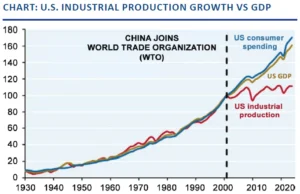
Yet not everyone benefited. After China was allowed to join the WTO in 2001, our manufacturing base slowed remarkably relative to economic growth. See Chart. Many working class Americans counted on manufacturing jobs for good pay and benefits.

Source: BEA, Federal Reserve, JPMAM, 2024

For a generation, both economists and politicians believed this was for the “greater good” as cheaper prices benefitted all Americans. Displaced workers were to find other jobs in other growing areas of our economy. Yet for many American workers, those opportunities never materialized. An ever-greater share of males between ages 18 and 54 are not even in the workforce and thus do not count in the unemployment figures.

When Xi Jinping came to power in 2012, China became much more nationalistic and began to undermine the post-WWII world order (free elections, rule of law, and independent judiciary) with its own communist ideology which subjugates minorities, imprisons opponents, steals intellectual property, controls the media, and rewrites history.

In 2015, China set national goals to dominate critical economic areas by 2025. They subsidized and overbuilt these industries so that they could lower prices when necessary to crush international competition. Profit has not been the motive, monopoly control was sought. This is how they achieved global dominance of rare earth mining and refining, solar panels, ship building, and electric cars.

At the same time, their “Belt and Road” initiative set out to control trade routes in Asia, the Middle East, Africa and even South America. They bought, built, or subsidized railways and ports around the world including both ends of the Panama Canal.

China’s “no limits” partnership with Russia gained them ready access to many raw materials they do not control – oil, natural gas, copper, uranium as well as agriculture products. In return, China has been essential to Russia’s ability to continue its war on Ukraine.

China insists on western rules when it suits their purposes but ignores them when they do not. Xi built military bases in the South China Sea after he explicitly promised President Obama he would not, then ignored the ruling from the World Court that negated their claim to almost the entire South China Sea. China abrogated its agreement with Great Britain to let Hong Kong remain free until 2047. They stonewalled the World Health Organization’s Covid 19 investigation.

How do we meet the challenge? While it took far too long to understand the breadth and depth of the challenge posed by Xi’s China, there are many things that can be done to either eliminate or offset further inroads:

  • Work toward eliminating our reliance on China for critical materials or production, especially those necessary for our defense – ship building, medicines, electric grid components, semiconductors, and both basic and rare earth materials.

  • Substantially reduce the stifling regulations that make both our costs and timelines uncompetitive (the average bridge takes 17 years from inception to completion).

  • Bring government expenses and debt under control. (Nothing else is possible if we lose our financial capacity for these investments.) This is also essential to maintain the enormous advantages of the Dollar as the reserve currency.

In addition, we should press our advantages in this competition. These include: the ingenuity and access to capital of our vast array of entrepreneurs; our huge advantage in higher education institutions (instruction and research); and our globally dominant tech and financial institutions.

Finally, the current administration’s support for the Oil & Gas industry — often referred to as “drill baby drill” — is much more than support for one industry that the opposing party was against. Energy is the lifeblood of economic growth!

Full-spectrum strategic energy dominance would facilitate the reinvigoration of America’s entire industrial and manufacturing sectors as we disentangle our economy from China. The low cost and abundance of energy is one of America’s greatest strengths.

Half a Century of Independence–And Why it Matters More than Ever

Most formerly independent wealth management firms have been sold to big institutions. Tanglewood Total Wealth Management remains independent. That means a lot to me, our team, and especially our clients. I believe it should be to you, too.

When I say “independent,” I mean that Tanglewood does not have to meet the sales goals or use the investment products set out by some other institution. We control every aspect of the total wealth management service Tanglewood provides for our clients – the friends, families, and businesses that rely on us. We can always put Clients First!

We are free to serve our clients the way we know best. There are no outside “owners” pushing higher cost products so they make more money. Nobody is telling us to cut back on service, or compromise on the people we hire, or on the quality or extent of the fee-only, fiduciary advice that has been the backbone of our client relationship since day one.

Tanglewood is independent because it allows us to meet the ever-changing needs of our clients. We have taken on the responsibility of advising our clients on the continuous flow of new laws that govern areas such as inherited IRAs, RMDs, Roth conversions, donor-advised funds, QCDs, and Medicare Part B premiums. We educate our clients about the tremendous value of lifetime tax planning. We have developed our talent and adapted our technology to keep pace with work that has, candidly, become more complex at an almost geometric rate.

We are independent because we understand what it means to be responsible for our clients’ total well-being. In just the past year we have put on events for our clients on cybersecurity, aging advocacy, evaluating Medicare alternatives, and much more. Our clients can expect a lot more events like this in 2025. There is so much more to wealth management than just a balance sheet. Money touches every part of our clients’ lives in one way or another, and we’ll continue to help them make the right choices on their own journeys.

We are independent because of our wonderful clients. Thanks to their trust in our services, we don’t need to scramble to handle an internal succession crisis. We don’t need to sell a piece of ourselves to modernize a business that hasn’t kept up with its clients.

I’ve been at this now for nearly half a century. And in that time, I’ve found that I’m happiest when clients tell me how important Tanglewood has been to their financial stability and peace of mind. I have watched the families we serve come of age. Some of the young children of my original clients are now retiring (amazing!) and we are helping them with their retirement needs as well as the planning needs of their kids.

That means the world to me. And that is why we are proud to say Tanglewood Total Wealth Management is independent. No catch, no asterisk or disclaimer. We couldn’t do this without being there with our clients every step of the way. This is what independence has meant to me.

We can’t wait to show you even more of what our independence allows us to do for you and the people you care about.

Another Case for Gold

Exactly six years ago, the title of my Perspective was A New World Order (October 2018). The main message of that piece was that the post-WWII world order was breaking apart. The rules formerly agreed for international trade, investment, and security were being undermined by China.

Since then, things have only gotten worse. Under President Xi Jinping, China has turned away from free market capitalism and rebuilt a Mao Zedong style of absolute communist rule. Along the way he has:

  • Purged all opponents to his absolute rule.

  • Reneged on the treaty with Great Britain for maintaining independent governance within Hong Kong through 2047.

  • Dismissed the World Court decision that held against their claim to almost all the South China Sea.

  • Made clear that China will take over Taiwan – either peaceably or by force – while Xi is in power.

  • China and Russia declared a “no limits” partnership in February 2022 (days before Putin invaded Ukraine).

  • National champions like Alibaba and Tencent were forced to accept communist board oversight to provide central party control.

Xi Jinping has focused on self-sufficiency and a large-scale military buildup. He has subsidized favored industries to build monopoly positions.

Many of the Chinese people who recognize this backsliding or feel threatened by the authoritarian rule are trying to leave the country. So far in 2024 over 24,000 Chinese have been apprehended crossing our border illegally.

China, Russia and other authoritarian countries are creating an alternate system based upon totalitarian government rule. They are determined to undermine Western freedoms of speech, religion, press and assembly.

They are rejecting the U.S. Dollar based monetary system and seeking alternatives. However, this process is greatly impeded by their unwillingness to let their own currencies float freely against other currencies – a condition necessary for “reserve status”. (Otherwise, governments can arbitrarily change the terms of trade.)

Source: Metal Focus, World Gold Council

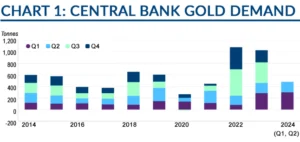
Therefore, to avoid a build up of the Dollar (which is subject to sanctions by the U.S.) they have turned more to gold. See Chart 1. This chart shows the buying of gold by central banks since 2014. As the chart illustrates, their purchases ramped up significantly in 2022 and have continued through the first half of this year despite the strong increase in gold’s price.

Gold satisfies China’s desire to have a freely traded “reserve currency “ (gold) that is not controlled by the U.S.

China’s overall aim is to return to the past glory when for centuries China was the dominant country in the world. That period featured authoritarian rule, mercantilist economic policies, limited personal freedoms, and gold as the primary currency.

At the same time, Putin seeks to restore as much of the former Soviet Union as he can. He has stated that its fall and break up in 1989 was the largest geopolitical failure in history. Putin, Xi, along with Khomeini (Iran) all see the destruction of the U.S. led western system as critical to their aspirations.

Gold has traditionally been thought of as a hedge against inflation, a hedge against major disasters, a hedge against financial collapses, as well as its intrinsic demand for jewelry. All of these remain true today.

However, the overriding factor favoring gold today is the worsening geopolitical backdrop. The major push by China and its like minded authoritarians to reduce their Dollar holdings and build gold reserves. These are price insensitive buyers.

We have recommended a gold position since 2004. For most of that period we recommended either a 5% or 6% allocation. In October of last year, we increased our recommendation to 8% due to the deteriorating geopolitical climate. Because of gold’s exceptional performance again in 2024, it now represents about 9.5% of those portfolios.

The Right Things

Winston Churchill once stated, “Americans will always do the right thing after they have tried everything else.”

Of course, “the right thing” is in the eye of the beholder. Yet there is broad agreement on some very basic long-term guiding principles for our country, including:

  • Respect and support for the institutions that made this country the envy of the world: rule of law, equality of opportunity, first class public education, independent judiciary, free markets, and true democratic participation.

  • Building and maintaining a Department of Defense capable of defending our country against all adversaries.

  • Public debt that can easily be supported through all economic cycles without stressing other governmental responsibilities. We cannot continue to post enormous fiscal deficits.

  • Providing necessary help for those Americans, who through no fault of their own, cannot fully support themselves.

  • Build and maintain the infrastructure necessary to run a first class 21st century country.

  • Provide the regulatory backdrop necessary to support Americans’ general health and safety but not so much as to interfere with the growth and competitiveness of our economy.

Whereas there is general agreement on these principles, the devil is in the details of how to implement them. The Founding Fathers recognized that there would be disagreements, so they built into each of the three branches of government safeguards from tyrannical rule by a majority.

Perhaps what we most lack is reasonable debate on the matters of implementation and cooperative compromise. No side has all the right answers. This has never been easy but is even harder in this era of passions inflamed by social media and polarized television formats.

Many of you know that one of my passions is education, particularly today’s poor performing public education system. Certainly, there are many top performing school districts, but national scores are beyond dismal.

Our kids are our future. Poor performing public schools need accountability which necessitates more community and parental involvement and/or competitive alternatives such as charter schools.

I have also written many times in the past about the unsustainable path of our national debt obligations. For example, I wrote a Perspective piece titled, Debt, Taxes, Inflation, and Repudiation in January 2010 from which I take the following quote: Our government continues to increase its long-term spending commitments (relative to revenues) which were already on a collision course with its ability to pay.

Nothing has changed since then except we have gone from 60% to 100% debt to GDP and soaring interest costs. (On June 18th the CBO increased this year’s estimated deficit to $1.9 trillion – just shy of the all-time high posted in the worst of Covid – and this is with a strong economy!)

Real compromise starts at the intersection of fairness in taxes and fairness in benefits. While I am a fiscal conservative, I recognize the need to raise taxes as an essential element for reaching the goals stated at the beginning of this piece.

It is also apparent to me that the lion’s share of any tax increases must come from the wealthiest Americans. The drivers of our current economy reward this group far more than past generations and are causing social strains across our nation.

We came together after WWII to pay down the enormous government debt built up during that war. Income tax rates reached 90%! Can we come together and pay for the government we need to avoid WWIII?

Finally, a major compromise is now necessary for entitlements. This is the elephant in the room that almost all politicians have negligently avoided. As virtually everyone acknowledges in private, unanticipated increased longevity has made our current promises unsustainable.

Many very intelligent proposals have been made for entitlement reform. The easiest to implement would be means testing annually (progressive ineligibility for higher earning above some number); increasing the eligibility age for those now under say 50; CPI inflation adjustment instead of the current wage inflation number.

America today is based on past decisions; America tomorrow is based on today’s. Who is in charge? WE ARE! Let’s demand more from those in a position to make needed changes. It is about time we proved Winston Churchill right.

ETF Revolution in Investment Management

Exchange Traded Fund (ETF).

In 1993, State Street Global Advisors introduced a new structure for housing an investment portfolio, the Exchange Traded Fund (ETF). The first ETF was the SPDR S&P 500 Trust (SPY).

What is an Exchange Traded Fund? ETFs are a type of pooled investment security that can be bought and sold much like an individual stock. The main difference between an ETF and a mutual fund is that though a mutual fund is also a pooled investment, it trades only once a day after the market closes.

Benefits of ETFs.

ETFs offer several advantages over mutual funds, including:

  • More Transparency.

  • Lower cost.

  • Tax efficiency.

  • Certainty.

Transparency. Traditional mutual funds only report their underlying security positions on a quarterly basis. ETF holders, on the other hand, can view the fund’s holdings more frequently.

Low cost. Although the costs of purchasing and owning mutual funds have come down tremendously over the past several decades, they still cannot compete with the low cost of most ETFs. Many of the larger ETFs have ongoing operating costs of below 0.1% per year.

In addition, as ETFs trade like stocks, they are mostly bought and sold with no costs. (Most mutual funds can also be bought with no front-end costs by the fund, but the custodian may charge a fee for making the transaction. Schwab charges $12 to Tanglewood clients for many mutual fund transactions.)

Tax efficiency. ETFs are extremely tax efficient. Partly this is due to the passive nature of their approach – like index mutual funds. In addition, ETFs have a cooperative structure with the offering institution that “exchanges” some security trades before a taxable sale.

Certainty. ETFs were originally designed to be passive index vehicles. Whatever index the ETF was following was exactly the securities it intended to hold. The underlying investments only changed as the index changed.

These advantages are attractive to both institutional and individual investors. ETFs meet the need for broad market exposure with a single trade.

Evolution of ETFs.

During the 1990s and early 2000s, ETFs remained primarily broad asset class vehicles.

Source: Statista 2024

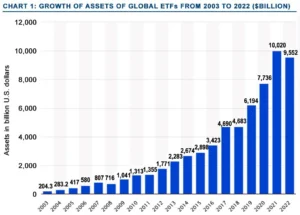
However, as their tax efficiency, low costs, ease of use and advancement in trading technology was validated, ETF usage expanded rapidly, from $204 billion in 2003 to over $10 trillion in 2021. See Chart 1. (The decline in 2022 was due to the bear market in stocks and bonds.)

This rapid increase in popularity was led by the introduction of more focused areas of investment, including single sectors (technology, energy, etc.), value or growth only, single countries and much more. These offerings have been dubbed factor funds.

This evolution has given investors, including Tanglewood, the ability to further define the criteria for both our equity and bond holdings. For example, one of our factor ETF holdings invests only in a “quality” subset of the S&P 500 index – those stocks that meet stringent earnings and balance sheet tests.

Until recently, the holdings within factor ETFs were held passively according to the criteria of the “factor”. Rebalancing is typically done on a set schedule, often annually.

The very latest innovation is actively managed ETFs. This removes the final major distinction between most mutual funds and ETFs. This brings truly active management into the low cost, tax efficient, transparent world of ETFs.

Two of the great managers that we have used in a mutual fund format have opened active ETF funds which we have invested in.

I have had a long enough career to have experienced each change along the way. It is incredibly satisfying to have the range of options and efficiencies of today’s marketplace.

Is There a New Normal for Inflation and Interest Rates?

We have experienced a dramatic seesaw in both inflation and interest rates since the onset of Covid.

Both inflation and interest rates plummeted in early 2020 in reaction to the steep drop in economic activity from the government enforced shutdowns and Covid-instilled fears.

In early 2021, inflation changed direction. It began to rise in reaction to shortages in goods that stay-at-home consumers demanded. The Federal Reserve (Fed) was slow to respond with higher rates in 2021, believing inflation was “transitory”…that it would end quickly when supply chains were repaired.

Yet when inflation continued its upward momentum into 2022, the Fed relented and began to raise rates in April of that year. Inflation peaked at over 9% in July of 2022, but the Fed, way behind the inflation curve, continued its steep rise in interest rates all the way to July of 2023. By then it was obvious that inflation was trending down.

This allowed the Fed to pause further rate increases and assess if they had already done enough. They have maintained their rate target of 5.25%-5.5% ever since. Until Chairman Powell’s press conference on December 13th, the Fed maintained a “hawkish” tone that it was ready to raise rates again.

At that meeting, Powell surprised the world by discussing rate cuts in 2024. It was an indication that holding rates above 5% for much longer may do more harm to the economy than good for inflation.

Throughout this entire seesaw of inflation and interest rates, the Fed predicted that the long-term neutral rate was 2.5%. In other words, once this bout of inflation is in the rear-view mirror, the Fed Funds rate would likely average around this level.

A base rate of 2.5% is 0.5% above their inflation target of 2%. This spread over inflation is close to its average spread since 1926 according to Stocks, Bonds, Bills, and Inflation Yearbook (2023). This would provide a return slightly greater than inflation yet not be so high as to discourage economic activity.

Of course, the rate would likely go much lower during periods of economic stress and much higher in periods where the economy is growing well above its non-inflationary potential.

With a stable base rate of 2.5% on short-term deposits, bond yields should also normalize. In other words, yields on Treasury bonds would increase as maturities lengthened. Again, turning to Ibbotson, a normal spread for the benchmark 10-year U.S. Treasury bond would produce an average yield of just above 4% if the base rate was 2.5%. (As noted in our December 2023 Commentary, the long-term average of that bond since 1790 is 4.35%!)

All of this hinges on the Fed hitting its inflation target of 2% (on average). How realistic is that? After all, the Fed could not get inflation up to its 2% target for over a decade before Covid (it hovered between 1% and 2%). Then, it went way above its target with the dislocations of Covid. Inflation peaked in mid-2022 and has trended down ever since.

While there are no guarantees, there is room for optimism that the 2% inflation target will be more easily met over the next decade than it was over the last.

In my Perspective, Inflation and Interest Rates (January 2021), I noted the three forces that restrained inflation over the prior decade were demographics, digitization, and globalization. These were powerful deflationary forces in that prior decade.

Source: The Wall Street Journal, BofA Research Investment Committee, Haver

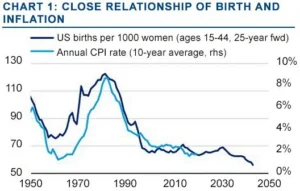
Both demographics and digitization (technology, including AI) remain potent deflationary forces. Chart 1 illustrates the close relationship over time between the US birth rate and the inflation rate (averaged over 10-year periods).

On the other hand, globalization has greatly diminished in favor of re-shoring and near-shoring. While this new direction is overdue to secure needed resources, the higher costs associated with these are inflationary.

Other longer-term inflationary forces have arisen in the last several years including higher real wages and the costs of mitigating climate change. (Keep in mind that most of the costs of building a renewable energy source to replace an existing fossil fuel energy source are inflationary. They do not add to ec1onomic output, they simply replace what already exists.)

In other words, there may be a balance between inflationary and deflationary forces that gives rise to a slightly higher but stable inflation rate (2%) in the future. This would allow for the interest rate picture that the Fed envisions.

Is There a New Normal for Inflation and Interest Rates?

We have experienced a dramatic seesaw in both inflation and interest rates since the onset of Covid.

Both inflation and interest rates plummeted in early 2020 in reaction to the steep drop in economic activity from the government enforced shutdowns and Covid-instilled fears.

In early 2021, inflation changed direction. It began to rise in reaction to shortages in goods that stay-at-home consumers demanded. The Federal Reserve (Fed) was slow to respond with higher rates in 2021, believing inflation was “transitory”…that it would end quickly when supply chains were repaired.

Yet when inflation continued its upward momentum into 2022, the Fed relented and began to raise rates in April of that year. Inflation peaked at over 9% in July of 2022, but the Fed, way behind the inflation curve, continued its steep rise in interest rates all the way to July of 2023. By then it was obvious that inflation was trending down.

This allowed the Fed to pause further rate increases and assess if they had already done enough. They have maintained their rate target of 5.25%-5.5% ever since. Until Chairman Powell’s press conference on December 13th, the Fed maintained a “hawkish” tone that it was ready to raise rates again.

At that meeting, Powell surprised the world by discussing rate cuts in 2024. It was an indication that holding rates above 5% for much longer may do more harm to the economy than good for inflation.

Throughout this entire seesaw of inflation and interest rates, the Fed predicted that the long-term neutral rate was 2.5%. In other words, once this bout of inflation is in the rear-view mirror, the Fed Funds rate would likely average around this level.

A base rate of 2.5% is 0.5% above their inflation target of 2%. This spread over inflation is close to its average spread since 1926 according to Stocks, Bonds, Bills, and Inflation Yearbook (2023). This would provide a return slightly greater than inflation yet not be so high as to discourage economic activity.

Of course, the rate would likely go much lower during periods of economic stress and much higher in periods where the economy is growing well above its non-inflationary potential.

With a stable base rate of 2.5% on short-term deposits, bond yields should also normalize. In other words, yields on Treasury bonds would increase as maturities lengthened. Again, turning to Ibbotson, a normal spread for the benchmark 10-year U.S. Treasury bond would produce an average yield of just above 4% if the base rate was 2.5%. (As noted in our December 2023 Commentary, the long-term average of that bond since 1790 is 4.35%!)

All of this hinges on the Fed hitting its inflation target of 2% (on average). How realistic is that? After all, the Fed could not get inflation up to its 2% target for over a decade before Covid (it hovered between 1% and 2%). Then, it went way above its target with the dislocations of Covid. Inflation peaked in mid-2022 and has trended down ever since.

While there are no guarantees, there is room for optimism that the 2% inflation target will be more easily met over the next decade than it was over the last.

In my Perspective, Inflation and Interest Rates (January 2021), I noted the three forces that restrained inflation over the prior decade were demographics, digitization, and globalization. These were powerful deflationary forces in that prior decade.

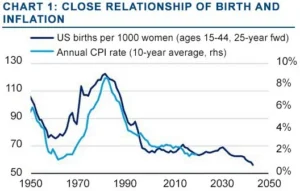
Both demographics and digitization (technology, including AI) remain potent deflationary forces. Chart 1 illustrates the close relationship over time between the US birth rate and the inflation rate (averaged over 10-year periods).

On the other hand, globalization has greatly diminished in favor of re-shoring and near-shoring. While this new direction is overdue to secure needed resources, the higher costs associated with these are inflationary.

Other longer-term inflationary forces have arisen in the last several years including higher real wages and the costs of mitigating climate change. (Keep in mind that most of the costs of building a renewable energy source to replace an existing fossil fuel energy source are inflationary. They do not add to ec1onomic output, they simply replace what already exists.)

In other words, there may be a balance between inflationary and deflationary forces that gives rise to a slightly higher but stable inflation rate (2%) in the future. This would allow for the interest rate picture that the Fed envisions.