
Declines, Losses, and the Path of Travel

There is a big difference between a “loss” from investments and a “decline” in current market value. Yet while a portfolio is experiencing a steep drop, like the one during the first half of this year, they both may feel the same.

I define a loss as a permanent impairment of market value whereas a decline is a lower market value that is temporary and fully recovered within a reasonable period. A portfolio loss often requires a change in lifestyle or a reduction of (anticipated) spendable income. A portfolio decline should require no adjustment to current plans.

One of the characteristics that often distinguishes the two is diversification. For example, owning one real property is subject to many local considerations, all of which can change and become more detrimental. Many single properties have experienced permanent losses in value over time.
Source: The WSJ, Market Tools, Value Square Asset Mgmt, Yale University

On the other hand, owning a portfolio of real properties that includes many property types (apartment, office, retail, self-storage, etc.) – particularly if over several geographic areas — has rarely led to permanent loss unless excessive debt was used to purchase the properties.

This leads to a second source of losses, leverage. Many a worthwhile investment has turned into a loss for the holder because of too much debt on the asset. Leverage is a double-edged sword. It enhances returns during good times but can destroy them in down cycles. Limiting or avoiding leverage may be the single best way to avoid a permanent loss.

Owning the total U.S. stock market, despite its periodic declines, has provided enviable long-term returns, averaging roughly a 6% annualized return above inflation in every 35 year period over the past two centuries according to Jeremy Siegel’s Stocks for the Long Run.

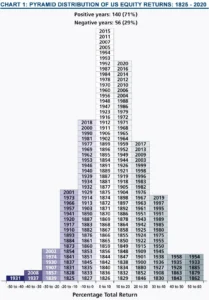
Chart 1 illustrates the U.S. stock market’s annual returns from 1825 through 2020. The annual returns are categorized by ten percent increments. For example, on the bottom left of the chart is the year 1931 over the -50% to -40%. This indicates that it is the only year with an annual decline greater than 40%. There are only two additional years (out of 196) that had declines greater than 30%. The year 2008 was one of them which shows how brutal the Financial Crisis was while one was in it.

If the total U.S. stock market ends 2022 where it was at its recent low, down 23%, it would be only the seventh year out of the 196 in the -20% to -30% category.

As shown on the chart, the market has provided a positive return in seven out of every ten years, and a negative return the other three. Almost the same percentage has held true in this century through 2020. There have been five down years and sixteen up years.

Taking it one step further, portfolios built around professionally researched asset allocations can be tailored to limit the degree of decline during major bear markets.

Asset allocation makes further use of diversification by using multiple asset classes. This is what our Investment Policies have accomplished in the real world of investing for 32 years.

One final way of looking at market declines is through the path of travel. The total U.S. stock market was virtually the same price in late November of 2020 as it was at the end of June 2022. However, this price was at an all-time high back then. From November 2020, the market continued to climb reaching its cycle high at the very beginning of this year. Since then it has retraced those additional gains back to the November 2020 price.

Everyone was more than delighted with today’s price just a year and-a- half ago. If the market had declined first (after that November 2020 high), and then recovered back to today’s price, most investors would be ecstatic today…and yet it is the same price. The difference is only how we got here. For our perception, the path of travel is often more important than the price.
The End of Globalization…Again

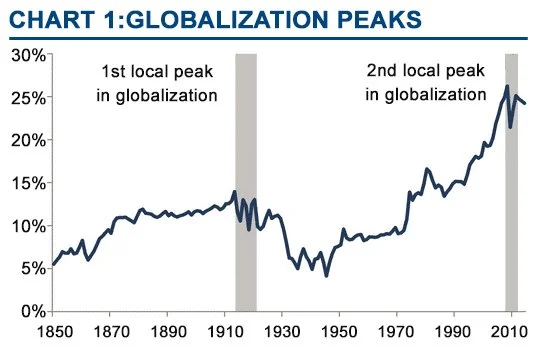
It took a pandemic, war, and surging inflation to end the great age of globalization…105 years ago.

Source: The Wall Street Journal, Fouquin and Hugot (CEPII 2016), Goldman Sachs GIR

The first modern age of globalization was the period between the 1850s and WWI. This was an exciting period when business leaders like J.P. Morgan, Andrew Carnegie, and Cornelius Vanderbilt connected America and the world with networks of steamships, railroads, and telegraphs. See Chart 1.

Leading economists of the day proclaimed war was “obsolete” because of the interdependence between countries that these businesses developed. Those economists were wrong, WWI brought a decisive end to that era of globalization.

The foundations of globalization were set out by Adam Smith in his famous Wealth of Nations (1776). His notion that through trade, each country should provide the rest of the world with what it does best, where it had inherent advantages of natural resources, unique talent or manufacturing prowess.

His ideas upended the historical economic model known as mercantilism, the principle of a fixed total value of global wealth (i.e. pie). The only way for one country to get a bigger slice was to take it by force. Thus, the incessant wars since time began.

Adam Smith’s capitalism provided another way…grow the pie…make each country richer without war. Globalization embodies the ideals of capitalism for all participating countries. But globalization requires rules of the road that are fair and respected by all.

This did not happen between the two World Wars. Nationalism and communism took center stage, beggar thy neighbor policies took root, and ruthless dictators rose to power.

Globalization did not pick up again until the formation of the United Nations and the General Agreement on Tariffs and Trade (GATT) in the aftermath of WWII. At first, globalization was only among the non-communist nations of the West. Despots such as Mao Zedong and Joseph Stalin continued the cruel subjugation of their peoples in the East.

This began to change with Deng Xiaoping’s new direction for China (1978) and the fall of the Berlin Wall (1989). Capitalism had defeated communism as an economic model! This brought these new entrants to enjoy its benefits.

For several decades this new era of globalization blossomed. Countries like Germany fully bought in, putting international business connections well above any security concerns. They were not alone as businesses in most participating countries benefitted from the lower material and labor costs that globalization provided.

The inter dependencies of this era of globalization far exceed those of the prior one. Computers, the internet, container ships, air travel, and education have integrated businesses at countless points. Relationships such as “just in time inventories” were born. Most business elites (the Davos men) have presumed that “this time, major wars must be obsolete.”

Yet one thing is clear from both the earlier period as well as the current one…in the end, political forces trump business connections. Political rivalries (hegemon) and yearning for past glories have given birth to authoritarian leaders who cast aside the former business elites in favor of their own agendas — Vladimir Putin in Russia and Xi Jinping in China.

Such bullies often get their way until some breaking point is reached, when the rest of the world finally responds…as with Ukraine, today. “The Russian invasion of Ukraine has put an end to the globalization we have known for the past three decades,” wrote Larry Fink, the CEO of Blackrock. This is notable as he has been perhaps the best-known cheerleader of globalization.

The world is breaking up into several “blocks” — the West (democracies, rule of law, independent judiciaries), the East (authoritarian, controlled media), and Non-Aligned (those with some features of each, trying to play both sides).

I believe strongly that the western principles will prove more resilient in the face of this new “competition” …just as capitalism won the Cold War. The people of Ukraine have demonstrated overwhelmingly that freedom, once achieved, is not something people give up lightly.

Opportunities within the West (potentially a new League of Democracies) are endless as this is where innovation thrives and people are free to make their own choices.